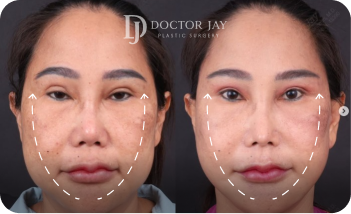


Key points
- What a facelift costs depends on the technique used, the area being corrected and the standard of each hospital, so there is no single figure that applies to everyone.
- A facelift can be done on one area only, such as the forehead, the upper face, or the lower face and neck, so the correction matches the concern. That is a different scope of work from lifting the whole face, so have a surgeon assess which one suits you first.
- What shapes the result is each person’s general health, how well they prepare for surgery, and how strictly they look after themselves afterwards.
- Choose a hospital that meets the standard, holds the correct accreditation, and sterilises its instruments before every use.
People ask what facial surgery costs, or how much a deep plane facelift costs, and why the figure differs from one hospital to the next. Once sagging skin, drooping brows or heavy cheeks start to show with age, many begin looking for a way to correct it and planning a budget for it.
In this article Dr Anuchit Adirojananon (Doctor Jay), medical licence number 45390, sets out what makes the cost different from one person to the next, covering correction of the upper, middle and lower face, and comparing the SMAS technique with endoscopic surgery. It shows what to look at before seeing a surgeon for an individual assessment of your facial structure and the actual cost for you.
What a facelift costs, broken down by the area treated

People often ask how much is a deep plane facelift, or what facelift surgery costs in general, and the answer comes down mainly to the area that has to be corrected. Dividing the correction into separate areas lets you have surgery that matches the concern without paying for work you do not need. The cost of correcting one area is a separate item from lifting the whole face, because the scope of work in theatre is different, so the two cannot be compared directly. The surgeon assesses the sagging area by area, so the incision along the front of the ear or the hairline is planned precisely.
Where the cost differs between a mid face lift and a lower face lift
A mid face lift and a lower face lift are costed separately by the area being corrected, because each one takes a different amount of time in theatre and a different amount of work. You can have one area only, so you are not paying beyond what your skin actually needs. Treating one area corrects only that area and does not cover the whole face, and having several areas done together is not the same as adding up the cost of each one, because how difficult the skin is differs from person to person.
| Area of surgery | What it corrects | What makes the cost differ |
|---|---|---|
| Mid face | Heavy cheeks and deep nasolabial folds | How wide an area is released and how much fat has to be repositioned |
| Lower face | Mouth grooves and cheeks hanging over the jawline | How deep the folds are and how much excess skin sits along the jaw |
A mid face lift concentrates on deep nasolabial folds and cheek tissue that has dropped downward, while a lower face lift smooths the jawline where the skin has sagged into a pouch. Both take around 3 to 4 hours, with the incision placed along the hairline in front of the ear so the scar is hidden along the border of the ear and looks natural.
How a neck lift is costed when it is done together with a facelift
A neck lift done together with a facelift adds to the cost of the facelift alone, but works out cheaper than having them separately, because combining them avoids paying twice for the anaesthetist and the operating theatre. To know what the two together come to for you, the surgeon has to assess the actual extent of the work first.
This corrects loose skin under the chin and on the neck so it sits smoothly against the lower face. After surgery most people take around 7 to 10 days for the swelling to settle before coming back to have the sutures removed.
Why the cost differs between facelift techniques
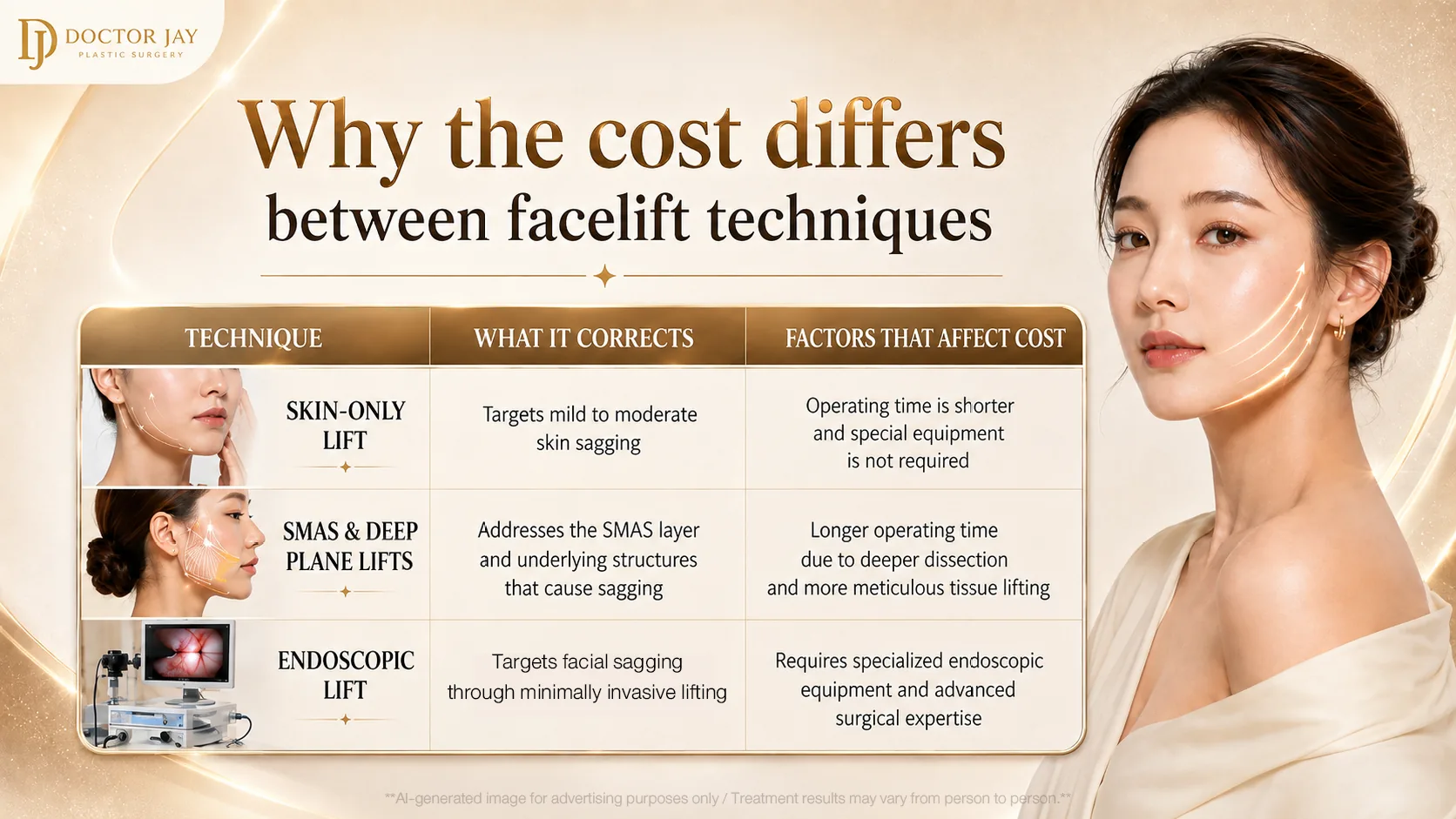
The cost of each type of facelift differs with the complexity of the technique, the specialised equipment and the time in theatre. The traditional technique that lifts the surface skin takes less time and less equipment than lifting the deep structure. Choosing the method that matches your facial structure keeps the budget realistic and makes it easier to judge how many days off work you need. The table below shows what makes the cost of each technique different.
| Surgical technique | Depth corrected | What makes the cost differ |
|---|---|---|
| Skin only facelift | The superficial layer above the muscle | Takes little time in theatre and needs no specialised equipment |
| Deep muscle layer facelift | The SMAS layer and the structure beneath the muscle | Takes longer because the muscle layer has to be released and sutured |
| Endoscopic facelift | The deep layer beneath the periosteum | Needs a camera set and specialised instruments in addition to the standard surgical set |
How far the skin has sagged and how much fibrous tissue sits beneath it decide how long surgery takes, which affects the anaesthetic cost directly. Techniques that rework the deep structure are usually done in a high standard theatre with ventilation equipment and an anaesthetist present throughout the operation and the recovery period in hospital.
Why a deep plane facelift and a SMAS facelift differ in cost
When people ask how much is a deep plane facelift compared with a SMAS facelift, the difference comes down to how complex the work in theatre is. The deep plane technique has to release the fibrous attachments and move the whole muscle layer, which takes longer, in return for a result that lasts longer and does not leave the face looking tight or unnatural. The table below shows the difference between the two techniques.
| Surgical technique | What it anchors and how | What makes the cost differ | How long the result lasts |
|---|---|---|---|
| SMAS facelift | Lifts and sutures the muscle layer | Releases and sutures the muscle layer along the direction of the sagging | 5 to 10 years |
| Deep plane facelift | Releases the fibrous attachments and repositions the muscle layer | Releases the whole fibrous layer and takes longer in theatre | 10 to 15 years |
A deep plane facelift takes tension off the surface skin, which lowers the chance of a keloid scar in front of the ear. Patients need an average of only 7 to 10 days for the swelling and bruising to settle.
For people aged 50 and over with heavy cheeks and deep mouth grooves, the deep plane technique is the option that holds up over time, because the result usually lasts around 10 to 15 years, depending on the skin and on how each person cares for themselves.
How a Face Lock facelift differs from a standard facelift
A Face Lock facelift costs more than standard facelift surgery, because it is a specific technique that anchors the skin at set points to keep the incision small and hide it along the hairline, which takes more care and more time than the traditional long incision around the ear.
| Type of surgery | Incision and suture line | What makes the cost differ | Recovery time |
|---|---|---|---|
| Standard facelift | A long line around the ear to the nape | Uses the standard surgical set and the usual incision | 14 days |
| Face Lock facelift | Small incisions in the hairline or in front of the ear | Anchored at set points, which takes greater precision | 5 days |
A Face Lock suits patients aged 35 to 45 with sagging in specific areas who are looking to lift the face, or who want a short recovery with less swelling afterwards, so they are back at work sooner and can wash their hair once the surgeon allows it.
Why an endoscopic facelift costs more than other techniques, and who it suits
An endoscopic facelift costs more than the usual techniques, because it needs an endoscope and high precision instruments to rework the deep structure through small incisions, along with specialised supplies used to avoid the major nerves of the face.
It suits people with mild to moderate sagging aged 30 to 45 who want to lift the forehead, the outer eye corners or the upper cheeks. The incisions are small, around 1 to 2 centimetres, hidden in the hairline, so recovery is short and patients are back to daily life within 7 days.
What the cost of facelift surgery depends on

There is no fixed figure when people ask how much a deep plane facelift, because it varies with how difficult each person’s skin is and how much work has to be done. Each hospital costs the surgery from the degree of sagging and from the specialised equipment used to reduce swelling and bruising. Having your facial structure assessed in person is the only way to know your own cost clearly.
Operating theatre and anaesthetist standards set by the Ministry of Public Health
Surgery that is carried out safely shows in the use of a properly registered operating theatre with controlled air pressure to keep contaminants out. Hospitals that meet Ministry of Public Health criteria have set requirements for the structure of the theatre and for resuscitation equipment ready for immediate use.
A standard operating theatre has clear requirements for cleanliness and for the staff present.
- An anaesthetist manages the general anaesthesia and stays with the patient on a one to one basis throughout.
- HEPA filtration captures dust and micro organisms in the air.
- Ventilators and resuscitation equipment are checked on a set schedule, every 30 days.
Holding these conditions raises the cost of care, which feeds directly into the fee. Surgery in a properly licensed hospital keeps the standard of cleanliness under control and lowers the risk of infection afterwards.
What to ask about in full before you decide, so nothing comes as a surprise
Check what is included and what is not before you decide, because a facelift promotion priced well below the market usually carries costs the patient has to pay later. Asking about the extra items clearly from the start lets you compare hospitals on the same basis. These are the ways to check how transparent the offer is.
- Ask whether the blood tests and the electrocardiogram before surgery are included in the package, because these two are usually separate from the figure quoted at the start.
- Ask about the medical facial compression garment and the medication for looking after yourself at home through the 14 days of recovery.
- Check whether the anaesthetic team and the removal of sutures are included in what you pay, so there is nothing extra to settle at the first wound check 7 days after surgery.
Why people choose SMAS facelift surgery at Doctor Jay Plastic Surgery
A SMAS facelift at Doctor Jay Plastic Surgery corrects the sagging deep structure of the skin methodically. We concentrate on precise suturing in the muscle layer for a result that lasts 5 to 10 years. Assessing the structure of the face in detail before surgery lets the surgeon plan the treatment around each person’s skin and budget.
Planned around each individual by a specialist surgeon
Studying the structure of each face lets us suture the SMAS layer precisely along the direction in which that face has sagged, which differs from person to person. The surgeon assesses the thickness of the fat layer together with the elasticity of the skin before planning surgery. Planning it this way avoids a face that looks tight and unnatural afterwards.
Sagging across the cheeks, the corners of the mouth or under the chin is lifted at an angle that follows each patient’s nerves and bone structure. The incisions are hidden carefully along the hairline and the border of the ear, and we use very fine sutures to keep the scars from raising during the first 6 months of follow up.
Every cost set out in full before you decide
We set out every cost involved at the assessment, so you can plan ahead without anything unexpected appearing later. The pre operative examination, the anaesthetic team, the operating theatre and the wound care afterwards are all stated from the start, along with which items are included and which are separate.
The surgeon explains the follow up appointments after surgery and the details of the wound care at the assessment, together with the scope of care that fits each case. That is what answers the question of what a facelift costs in a way that matches the work actually involved.
Frequently asked questions about the cost of a facelift
Does the cost differ with age and with how far the skin has sagged
What facelift surgery costs, including how much is a deep plane facelift, does differ with age and with how far each person’s skin has actually sagged, because the complexity and the number of areas involved are not the same. Younger patients aged 30 to 40 with slight cheek sagging usually have surgery on one area only to correct a specific concern, which takes around 2 hours.
Patients aged 50 to 60 and over, whose sagging reaches the muscle layer and who have a large amount of excess skin, need a full facelift together with a neck lift for a firm, smooth and natural result. That calls for care and precision and takes 4 to 5 hours in theatre, so the cost varies with the hours involved and the specialised equipment each person needs.
How many years does one facelift last, and is it worth what you pay
One facelift keeps the face looking firm for roughly 5 to 10 years, and the result changes gradually as the body ages naturally. Lifting down to the SMAS muscle layer supports the facial structure more strongly than a thread lift or an ordinary device, and the result becomes clearer once the incisions have healed.
Set against how long it holds, facelift surgery corrects the problem at the deep structure, which is why the result lasts longer than ordinary treatments. Planning the treatment properly with a surgeon is what addresses sagging effectively over the long term.
Besides the surgery itself, what should you have ready for the recovery period
Besides the cost of surgery, there are things to have ready at home for the recovery period. Most of them are wound care supplies and everyday medication that help the body recover. Here is what to prepare.
- A wound care kit, including sterile saline, small cotton buds and a concentrated silicone gel for scars.
- A tall U shaped neck pillow and a wedge pillow to keep the head raised and reduce swelling through the first 7 days.
- Liquid or soft food that is easy to chew, so the jaw joint moves less during the first week.
- Cold and warm gel packs for the swelling and bruising around the face.
Having these ready in advance takes the worry out of it and means you can care for the incisions correctly, following the nursing advice, from the moment you get home.
In summary
Planning for what a facelift costs, including how much is a deep plane facelift, comes down to choosing the technique that fits how far your skin has sagged and the structure of your face, because the cost varies with the extent of the work, the time in theatre and the equipment needed. Choosing a technique that reaches the deep muscle layer, the SMAS, keeps the firmness for roughly 5 to 10 years.
To know your own cost clearly, come in for a consultation and a detailed assessment of your facial structure with a surgeon at Doctor Jay Plastic Surgery, so the approach is matched to your actual concern.