
Key points
- A facelift is surgery on the deep structural layer beneath the facial muscles, correcting loose skin, wrinkles and sagging under the chin so the face is firmer and still looks natural.
- The deep plane technique lifts the facial structure from its foundation, which takes tension off the outer skin, so the incisions heal sooner and expression returns to normal.
- Preparing for surgery means stopping blood thinners, supplements, alcohol and smoking for at least 14 days, to prevent complications and help the incisions heal.
- After surgery, sleep with the head raised and use cold compresses early on to reduce swelling. The incisions are usually dry and you are back to your routine within 7 to 10 days.
A facelift is an option for anyone dealing with loose facial skin, deep nasolabial folds and sagging under the chin that makes the face look tired beyond its years. Skincare and facial massage rarely reach folds this deep, so reworking the structure of the skin becomes the way to restore firmness and smooth the face again, particularly for people from the age of 40 onwards, who lose collagen faster than they did before.
In this article Dr Anuchit Adirojananon (Doctor Jay), medical licence number 45390, covers the steps of deep plane facelift surgery, how the incisions are hidden in front of and behind the ear, and how thread lifts compare with facelift surgery, so anyone considering it has accurate information for preparing before and after the procedure.
What is a facelift?

A facelift is surgery that reworks a sagging facial structure so it looks firm and fresh again. It addresses excess skin together with the deeper structures that have dropped with age, covering the cheeks, the mouth grooves, the jawline and the neck.
The procedure works on the deep facial structure known as the SMAS layer, the muscle layer that dictates how much the face sags. That sets it apart from ordinary laser tightening, which only reaches the surface. The result of facelift surgery holds for several years, depending on how each person cares for themselves and lives day to day.
The deep plane facelift technique
A deep plane facelift reaches the structural tissue and the fat beneath the SMAS layer together, without separating the skin from what lies under it. That takes tension off the outer skin and holds the result longer than a traditional facelift. Here is why the technique corrects sagging so effectively.
- Less swelling, because the thin outer skin is not separated, so circulation carries on as usual.
- The face moves normally without feeling tight, because the whole deep structure is repositioned from its base, and the result looks natural.
- It corrects deep nasolabial folds and heavy cheeks by releasing the ligaments that anchor the skin to the bone, then setting them in a new position.
The surgery is done under general anaesthesia and takes about 3 to 4 hours. Recovery is shorter, and you can return to your daily routine within 7 to 10 days, sleeping with the head raised through the first 3 days to reduce swelling.
What makes the facelift technique stand out?
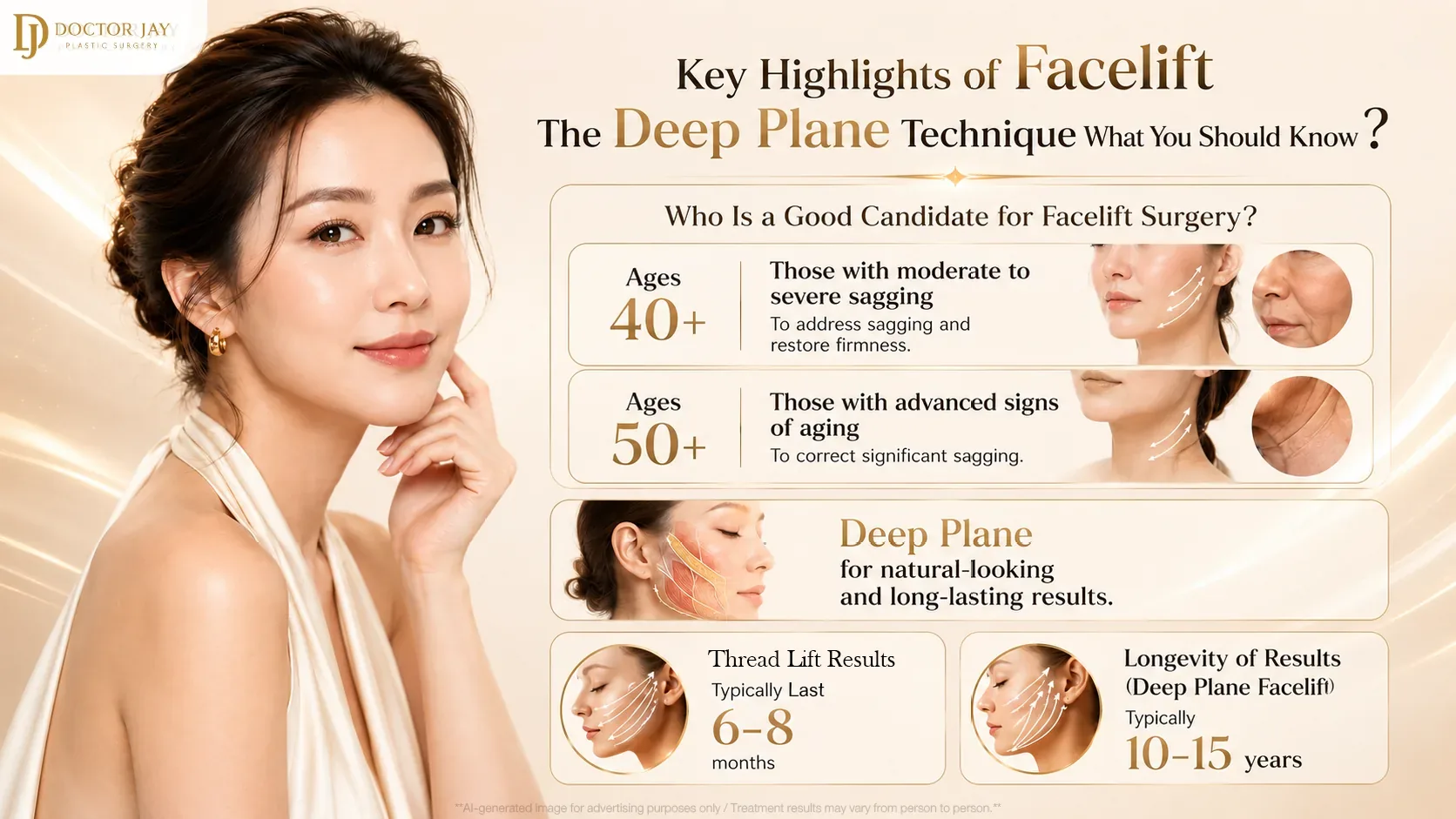
What sets facelift surgery apart is that it corrects sagging right down at the deep muscle structure, addressing the source of the change that skincare and energy based devices cannot reach.
Returning the dropped structure to where it used to sit keeps the result natural, so the face is not stretched out of shape. The surgeon studies the vectors of the lift so they follow the mid face and lower face structure of each individual.
How deep nasolabial folds and heavy cheeks are corrected
Deep nasolabial folds and heavy cheeks are corrected at the source by lifting the SMAS layer and the cheek fat and anchoring them higher. This addresses the cause by repositioning the internal structures that have dropped with age.
- Releasing the ligaments over the cheekbone that pull on the skin and create the deep fold.
- Moving the cheek fat pads that have slid downward back up over the cheekbone.
- Anchoring the base of the deep structure so the firmness stays where it is set.
Reworking this area corrects hollow and heavy cheeks in people aged 40 and over. The incisions are hidden along the border of the ear. Patients notice the nasolabial folds looking shallower once the sutures come out at 7 to 10 days.
Defining the jawline and reducing sagging on the neck
Defining the jawline and reducing neck sagging through a facelift improves loose skin under the chin and on the neck by addressing the deep neck muscles. It turns a neck that folds into layers into a firm one, and gives the jawline a cleaner edge.
- Suturing the platysma, the muscle at the front of the neck, so the bands that create the visible cords are brought back together.
- Removing the right amount of excess fat under the chin and along the jaw.
- Redraping the excess skin towards the back of the ear so the surface lies smooth.
This step addresses neck sagging in people aged 50 and over. The incisions around the ear and at the back of the head fade until they blend into the surrounding skin within 3 to 6 months.
How the deep plane technique differs from other types of facelift
There are several types of facelift and other ways to restore the face, and each one reaches a different depth of the skin. Understanding how deep plane facelift surgery differs from the alternatives helps you choose what fits your own skin, judged by how far it has sagged and how the structure has changed with age from 35 to 60 and beyond.
A traditional SMAS facelift compared with the deep plane technique
Facelift surgery differs clearly between the traditional SMAS technique, which separates the skin from the SMAS layer and then tightens the SMAS directly (each layer is lifted on its own), and the deep plane technique, which goes beneath the muscle layer to raise the whole facial structure at once (the dissection runs under the SMAS, so skin and SMAS are lifted together as one sheet).
Traditional SMAS surgery separates the skin from the muscle, which puts considerable tension on the skin. The deep plane technique releases the ligaments at depth, so the structure moves as one and the result looks natural. It also reduces the pull around the ear and the incisions heal sooner, within 7 to 10 days.
*Results depend on the individual.
| Point of comparison | Traditional SMAS facelift | Deep plane technique |
|---|---|---|
| Layer the surgery works on | Lifts the skin and sutures the SMAS layer above | Releases beneath the SMAS layer to raise the deep structure |
| Skin tension afterwards | More pull on the skin | Less pull, the skin looks natural |
| Recovery time | 14 to 21 days | 7 to 10 days |
Thread lift compared with a facelift and which one fits you
Choosing between a thread lift and facelift surgery comes down to how far the skin has sagged and how long you want the result to hold. A thread lift is a temporary option for anyone with the first lines. A facelift is surgery designed for people whose skin has sagged considerably and who want it addressed properly.
*Results depend on the individual.
| Method of lifting | Thread lift | Facelift |
|---|---|---|
| Who it is for | Mild to moderate sagging | Severe sagging with deep nasolabial folds |
| How long the result lasts | 6 to 8 months | 10 to 15 years |
| Recovery | 2 to 3 days | 7 to 10 days |
Counting what repeated sessions add up to over time, facelift surgery may suit anyone who would rather not keep coming back for the same procedure. Whichever of the types of facelift you consider, have a plastic surgeon assess the SMAS muscle structure of your own face in detail before you decide.
Who a facelift suits
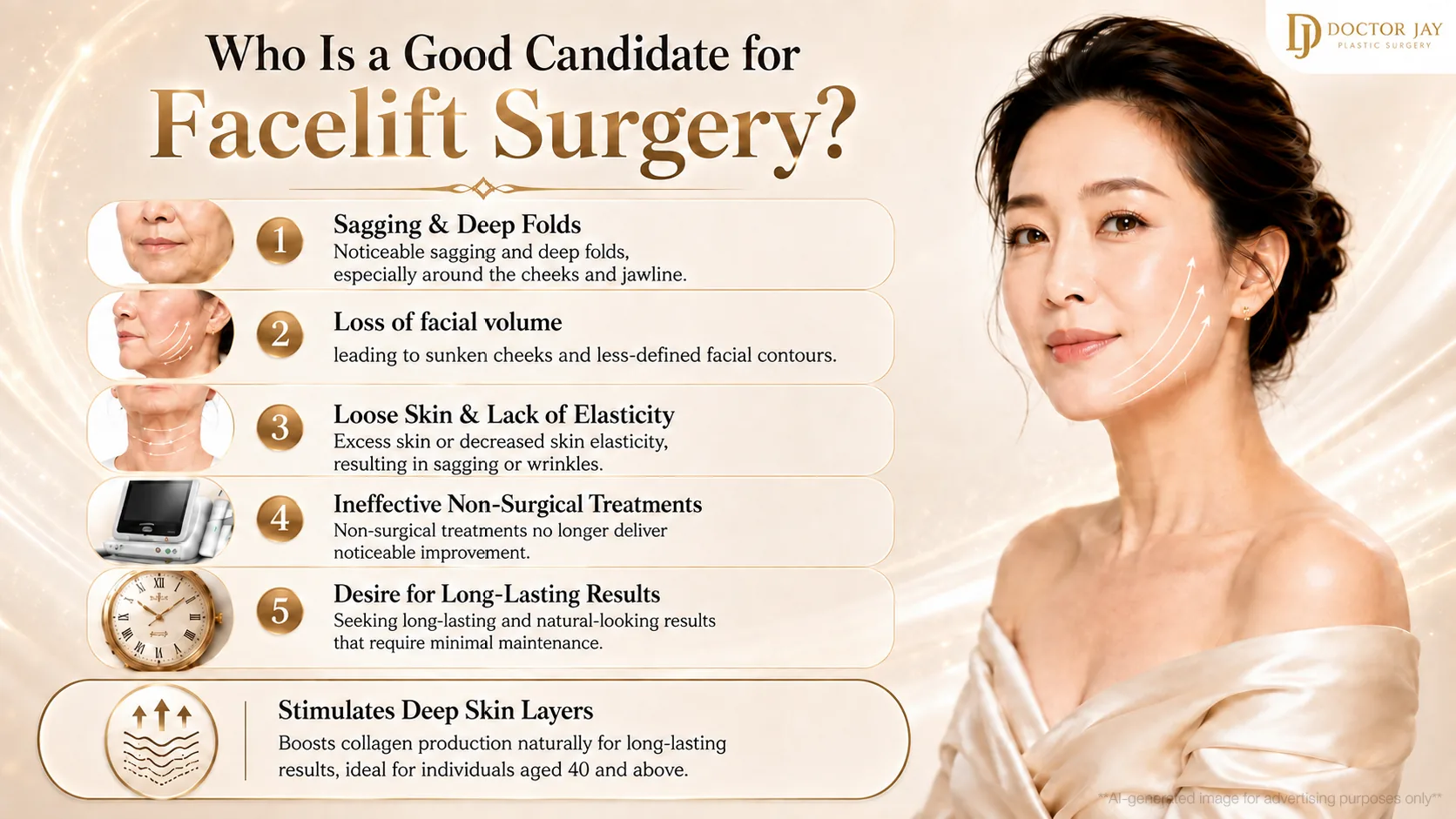
A facelift suits people with deep nasolabial folds, heavy cheeks that hide the jawline, and loose skin under the chin and on the neck, which is commonly seen from the age of 40 onwards.
Whether a facelift suits someone is judged by how far the deep structure of the skin has sagged with age. From the age of 40 onwards the body produces less collagen, so skincare and ordinary lifting devices may no longer reach the structures underneath.
That is why surgery becomes the option that restores firmness while keeping the face natural. The procedure suits people with the following concerns.
- Deep nasolabial folds and mouth grooves, with a visible fold running down the side of the cheek towards the mouth, which leaves the face looking tired.
- Heavy cheeks that hide the jawline, where the lower cheek tissue has dropped below the jaw, so the lower face loses definition or changes shape.
- Loose skin under the chin and on the neck, folding into layers, or neck muscles that have dropped until the sagging is obvious.
- People who have tried other approaches without the result they wanted, having been through alternative procedures or temporary lifting devices that could not reach the deep structure.
- People who want a long term answer, reworking the facial structure so the firmness holds for years rather than returning for repeated procedures.
How facelift surgery differs between women and men
A facelift reworks the facial structure differently in women and men, in the hairline, the blood supply of the skin, and where the incisions are placed.
| Point of comparison | Women | Men |
|---|---|---|
| Hairline and sideburn | Incisions hide easily along the ear and hairline | Beard bearing skin and the sideburn must not be drawn behind the ear |
| Structure of the skin | Thinner skin with fewer small vessels | Thicker skin with a richer blood supply, twice the risk of a haematoma |
A facelift in men has to preserve the natural squareness of the jaw and avoid raising the brow too high, so masculine features are kept. In women the adjustment favours softer curves across the face. Men also need care with shaving through the first 14 days after surgery, so the incisions around the ear are not irritated.
Signs that it may be time for a facelift
The sign that a facelift is worth considering is skin and deep facial muscle that have sagged until the lower face loses its definition. It usually comes with deep nasolabial folds and heavy cheeks hanging over the jawline, obscuring the original shape of the face, at a point where skincare and collagen stimulating treatments can no longer rework the weakened deep structure.
These structural changes usually become pronounced from the age of 40 to 60 and beyond. You can gauge the state of the skin from what shows plainly on the face.
| Sign of ageing on the face | What you can see |
|---|---|
| Deep nasolabial folds and mouth grooves | A fold beside the cheek running down to the corner of the mouth, leaving a tired look |
| Heavy cheeks hiding the jawline | Lower cheek tissue hanging below the border of the jawbone |
| Loose skin on the neck | Skin under the chin and on the neck folding into layers with obvious sagging |
Having a plastic surgeon assess the elasticity of your skin narrows the types of facelift down to the plan that fits the actual concern, and makes the work on the deep muscle structure more precise.
Safety standards and medical requirements for facelift surgery
A facelift is major surgery under general anaesthesia and has to be carried out in a hospital that meets high safety standards. The facility needs emergency resuscitation equipment and a sterile operating theatre accredited to the standard set by the Ministry of Public Health, so infection is prevented.
What matters most is that the surgery is performed by a board certified plastic surgeon accredited by the Medical Council, because the face carries many branches of the nerves that drive muscle movement. Surgery by someone without that experience risks serious complications such as a crooked mouth, an uneven smile, or an eye that will not close fully after injury to the facial nerve.
These are the safety standards worth checking before surgery to lower the risk.
- Check the surgeon on the Medical Council website to confirm they are a board certified plastic surgeon.
- Check the operating licence of the hospital, which must be displayed clearly in the service area.
- Confirm that a specialist anaesthetist manages the general anaesthesia and stays with you throughout the operation.
- Confirm that a full physical examination and blood tests are done at least 7 days before the operating theatre, to assess whether the body is ready.
Preparing for a facelift and caring for the incisions afterwards
How you look after yourself before and after facelift surgery is the main factor in how flat the scars settle and how long the skin takes to recover. A facelift reworks the deep structure of the skin, so preparing the body and following the surgeon’s instructions makes a real difference to swelling.
Caring for the incisions properly shortens recovery to roughly 7 to 10 days and lowers the risk of a raised scar around the ear.
What to tell your surgeon and how to prepare for surgery
Preparing for a facelift starts with getting the body ready and being straightforward with your surgeon about your health. What matters here is any history of drug allergy, underlying conditions such as high blood pressure or heart disease, and any blood thinners, supplements or vitamins taken regularly. Follow the preparation steps below for safety and to lower the chance of complications.
- Stop aspirin, ibuprofen and any supplement that affects blood clotting for at least 14 days.
- Stop smoking and drinking alcohol for at least 2 weeks, so the incisions do not heal slowly.
- Take nothing to eat or drink for at least 8 hours before surgery under general anaesthesia.
Hiding the incisions in front of and behind the ear, and care through the first week
The incisions are placed along the front border of the ear and curved around into the crease behind it, so the scars blend with the surrounding skin. The surgeon closes them with very fine sutures and redrapes the skin under low tension so the edges do not separate.
Careful wound care through the first 7 days after surgery is what keeps the scars flat and helps them heal well.
- Apply cold compresses to the cheeks and around the ears through the first 3 days to reduce swelling.
- Sleep on at least 2 pillows so the head stays above the chest, which stops fluid collecting.
- Clean the incisions around the ear with saline and apply the antiseptic your surgeon prescribes twice a day.
- Avoid food that needs hard chewing, so the facial muscles move less during the first week after surgery.
Why people choose a deep plane facelift at Doctor Jay Plastic Surgery

A deep plane facelift at Doctor Jay Plastic Surgery is planned around each individual, redefining the jawline and lifting the SMAS muscle layer along the direction in which that face has sagged.
A facelift reworks the structure of the skin from within, so the lift holds for years. These are the points people come to us for.
- Careful closure along the front border of the ear and around into the crease behind it, so the scars improve steadily.
- Tension sets on the deep muscle layer rather than on the surface skin, which keeps the face from looking tight and protects the facial nerves.
- Surgery in a sterile theatre that meets Ministry of Public Health criteria, with a nursing team watching over you closely for 24 hours afterwards.
Frequently asked questions about facelift surgery
How many years does the result of a facelift last
A facelift keeps the skin firm for roughly 10 to 15 years. Because the surgery reaches down to the SMAS muscle layer and the structures that support the skin, the result holds longer than temporary lifting methods, and the face looks fresh and natural.
How long it holds depends on your habits and on the environment. Staying out of strong sun and applying sunscreen at SPF 50+ every morning protects the collagen in the dermis.
Smoking and letting your weight swing by more than 5 kilograms both cost the skin its elasticity and bring the sagging back sooner than it should.
How long is the recovery after facelift surgery
A facelift means roughly 1 to 2 nights in hospital, and you can be back at work within 7 to 10 days. The surgery repositions deep tissue, and the body needs time to heal through these stages.
- The first 3 days, the face swells and the skin feels tight, which continuous cold compresses ease.
- At 7 to 10 days, the surgeon removes the sutures and checks the incisions, while the bruising turns yellow and starts to fade.
- From 14 days onwards, the incisions are dry, so light make up can cover the bruising that remains.
The deeper structure heals fully and the face settles into a natural look within 3 to 6 months. Avoiding strenuous exercise and saunas through the first 4 weeks matters, because raised circulation can leave the incisions swollen and inflamed again.
Will a facelift leave the face looking too tight or stiff
A facelift performed with the right technique does not leave the face looking tight or stiff, because the surgeon works on the deep muscle layer that supports the skin rather than pulling on the surface alone. That puts the fat and the facial muscles back where they sat at a younger age, so the outer skin is closed without excess tension and smiling and expression stay easy.
Through the first 1 to 3 months after surgery the face may swell and feel tight, which is a normal part of healing. The tightness eases gradually and the facial muscles soften until everything settles fully past the 6 month mark. Warm compresses and gentle massage as your surgeon advises help the nerves recover and relax the muscles around the mouth sooner.
In summary
Of the types of facelift, the deep plane technique lifts the muscle structure of the face from within rather than pulling on the outer skin. It corrects deep nasolabial folds, loose skin and sagging under the chin effectively, and the result holds for roughly 10 to 15 years, depending on how each person cares for themselves.
Anyone wanting to lift and reshape their face should see a board certified plastic surgeon for a detailed assessment of the skin structure before surgery. Preparing in advance by stopping medication and supplements for at least 14 days adds to safety and shortens recovery to roughly 7 to 10 days.
References
- Baker DC, Stefani WA, Chiu ES. Reducing the incidence of hematoma requiring surgical evacuation following male rhytidectomy. Plastic and Reconstructive Surgery, 2005, volume 116, issue 7 (the rate of haematoma after facelift surgery in men)
- Shuster S, Black MM, McVitie E. The influence of age and sex on skin thickness, skin collagen and density. British Journal of Dermatology, 1975, volume 93, issue 6, pages 639 to 643 (differences in skin thickness between the sexes)