
Key points
- The SMAS layer is the fibrous tissue sheet under the skin and fat that wraps the facial muscles and holds the facial structure firm.
- This layer loosens as we age, which brings on lines, nasolabial folds and sagging across the face.
- A facelift and energy based lifting devices both work down at the SMAS layer to stimulate collagen production.
- Caring for this layer lifts and reshapes the face so it looks slimmer.
The SMAS layer is the tissue sheet under the skin and fat that holds the facial structure firm. As the years pass this layer weakens and drops, which leaves deep lines, deep nasolabial folds and a jawline that loses its definition. Left alone the change builds up until the face looks older than it is, and no over the counter cream can reverse it.
In this article Dr Anuchit Adirojananon (Doctor Jay), medical licence number 45390, explains what this tissue layer does, and compares facelift surgery with energy based lifting devices so you have what you need to choose the approach that fits you.
What is the SMAS layer
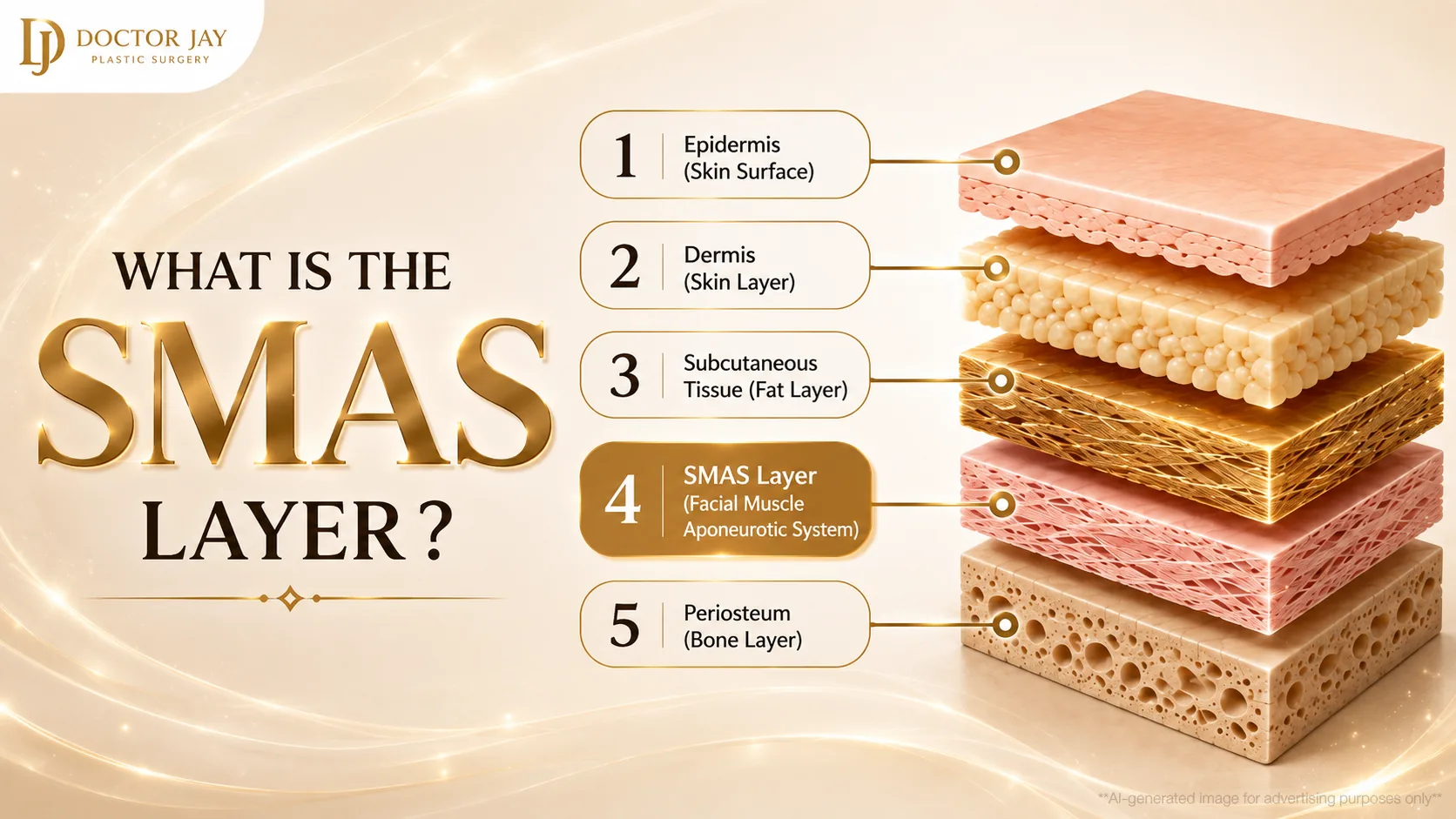
The SMAS layer is a dense, tough sheet of connective tissue interleaved with fat that sits beneath the dermis. It links the facial muscles to the skin above and keeps them firm. Its main components are collagen and elastin fibres woven tightly together.
This layer weakens with age, so it loses the elasticity it needs to hold facial fat in place. Its density is not the same everywhere on the face, and it is noticeably thicker over the cheeks and along the jaw.
When this structure gives way the outer shape of the face changes with it. The signs show clearly from the age of 30 onwards, when folds appear at the corners of the mouth and the jawline visibly drops.
Where the SMAS layer sits and what it does
The SMAS layer sits roughly 4.5 millimetres below the epidermis and dermis. It is a sheet of fat and fibrous tissue that covers every muscle of facial expression, running from the temples across the cheeks and down to the neck, anchoring the skin above so gravity cannot pull it down. Its main roles in keeping the face firm are these.
- It controls facial expression by linking each muscle group to the skin above.
- It holds subcutaneous fat in position so it does not slide down and collect along the lower border of the face.
- It keeps the face defined, particularly along the jawline and under the chin where fat gathers easily.
Collagen in this area is what keeps facial skin elastic. These support fibres normally break down at an average of 1 percent a year after the age of 25, so the skin loses its support.
Why surgeons pay attention to the SMAS skin
Surgeons pay attention to the SMAS skin because this layer is the main support for the firmness of the whole face. Lifting only the outer skin without tightening this fibrous layer means the skin sags again before long. Reworking this tough tissue sheet lets the surgeon reposition the fibrous layer and the fat beneath the skin precisely.
The reasons surgery has to address this layer are these.
- It prevents the pulled, unnatural look after surgery, because the tension is carried by the strong fibrous layer rather than by the thin skin above it.
- It repositions sagging fat pads where they belong, so the cheeks and jawline regain their contour.
- It extends the result of the facelift to roughly 5 to 10 years, depending on how well each person looks after themselves.
Why sagging starts in the SMAS layer as we age
Facial sagging begins when the SMAS layer loses elasticity, because the collagen and elastin that once held the structure together decline with age. This tissue works like a net that carries the skin and the fat above it. Past the age of 25 the production of these key proteins falls by an average of 1 percent a year, so the net starts to give way under gravity from around the age of 35.
The fibrous structure that ties the facial muscles together stretches and thins over time, so the support that was once strong weakens and the fat beneath the skin drops downward. UV from the sun also damages the fibroblasts that produce the supporting fibres in the SMAS layer directly. That accumulated damage costs this tissue, which sits roughly 4.5 millimetres beneath the skin, its firmness.
Signs that the SMAS layer is weakening

The signs that the SMAS layer is weakening show up as visible sagging in the shape of the face. Once the fibrous support gives way, the tissue and fat above it move downward. You can read how far this deeper layer has weakened from what you see on the surface.
- Nasolabial folds and the lines at the corners of the mouth deepen as the cheek skin drops and gathers below.
- Loose skin under the chin folds into layers once the fibrous layer can no longer hold the excess fat.
- The jawline blurs into the neck, so the face shifts from an oval shape towards a square one.
These changes usually become steadily more visible between the ages of 35 and 40.
Is a SMAS facelift the answer to deep sagging
A SMAS facelift addresses sagging that starts in the deep support layer, which no cream or skin treatment can reach. The surgery works directly on the loosened deep structure to rebuild the contour of the face.
It resolves sagging that has built up for years into deep nasolabial folds and loose skin under the chin, and the result holds for roughly 5 to 10 years, depending on how each person cares for themselves and how their skin ages.
What is a SMAS lift
A SMAS lift is the facelift technique that works directly on the fibrous support layer, repositioning the sagging muscle structure and facial fat where they used to sit. The surgeon makes the incision in front of the ear and carries it back into the hairline behind the ear to raise the skin, then separates the skin from the muscle fascia about 4.5 millimetres down, ready to be tightened in the next step.
This approach corrects sagging across the middle and lower face as well as loose skin under the neck. It calls for care in separating the tissue planes so the facial nerve, the seventh cranial nerve that drives the muscles of expression, is not injured. After surgery a facial compression garment is worn around the clock through the first 3 days to reduce swelling, so the tissue settles into its new position.
Why a facelift has to tighten down to the SMAS layer
A facelift has to be sutured down at the SMAS layer to correct the weakened support at its base, which is the real source of facial sagging. Lifting only the surface skin while the fibrous layer beneath stays loose leaves the face looking tight and unnatural, and the sagging returns before long.
- Tightening the SMAS layer lifts and locks the fat pads and facial muscles back where they belong, so the outer skin lies smooth without being stretched thin.
- It takes the tension off the incision line, so the suture line in front of the ear stays small and flat rather than widening into a keloid scar over time.
- The deep structure, anchored with specialised sutures, holds that firmness for 5 to 10 years.
SMAS facelift surgery compared with energy based lifting devices
A SMAS facelift and energy based lifting devices differ clearly in what they do to the underlying structure and in how long the result lasts.
| Point of comparison | SMAS facelift surgery | Energy based lifting device |
|---|---|---|
| How it works | Separates the skin planes and sutures the muscle layer tight | Delivers heat energy down into the deeper skin layers |
| What it achieves | Corrects severe sagging well | Lifts and stimulates collagen |
| How long it lasts | Holds for 5 to 10 years | Holds for 1 to 2 years |
| Recovery | About 7 to 10 days of recovery before returning to work | No recovery time needed |
Surgery corrects severe sagging and removes part of the excess skin. Devices work from the inside to restore the skin without any incision, which suits people with early lines and little time to recover.
Who a SMAS lift suits

A SMAS lift suits people aged 40 and over whose facial sagging has gone beyond what a lifting device can correct. Skin that has lost its elasticity with age needs its structure repositioned, and that applies to the groups below.
- People with deep nasolabial folds, downturned corners of the mouth and cheek tissue hanging over the jawline.
- People with excess skin on the neck that has sagged until it obscures the lower jaw.
- People who have used energy based lifting devices and are not satisfied with the result.
Reworking this deep layer makes the lower face and neck look firmer. Anyone considering it should allow around 7 to 10 days of recovery for the swelling to settle and for the appointment to remove the sutures.
Safety standards and legal requirements for SMAS layer surgery
Surgery on the SMAS layer is a deep medical procedure and has to be carried out under the safety standards set by law, so the facial nerves are protected. These are the points to weigh when choosing where to have it done.
- The surgery must be performed by a board certified plastic surgeon accredited by the Medical Council, for accuracy and safety while dissecting close to the nerves that control facial movement.
- The operating theatre must hold major operating theatre accreditation from the Ministry of Public Health, with high efficiency air filtration and resuscitation equipment ready for use.
- General anaesthesia has to be managed by a specialist anaesthetist on a 1 to 1 basis, monitoring vital signs throughout the operation.
Why have SMAS facelift surgery at Doctor Jay Plastic Surgery
We study the structure of each face before suturing the SMAS layer, so the tightening follows the direction in which that face has sagged and the result looks natural. Surgery by a board certified plastic surgeon leaves the face firmer without a visible scar. Most patients are back to their normal routine within 7 to 10 days.
What we focus on in SMAS layer facelift surgery
- Careful suturing along the hairline and the ear, so the scar is hard to spot once the skin has healed.
- Close aftercare with a laser programme to reduce swelling, which helps the body recover sooner.
- Assessment and surgery by a board certified plastic surgeon, so the result looks natural and fits the structure of each face.
Frequently asked questions about the SMAS layer and facelift surgery
How long is the recovery after a facelift down to the SMAS layer
A facelift that goes down to the SMAS layer takes roughly 7 to 10 days of recovery before returning to work, and strenuous activity should be avoided for 3 to 4 weeks. Swelling eases noticeably during the first week, and the incisions in front of the ear and along the hairline are usually dry and ready for suture removal within 7 to 10 days of surgery.
You can go about daily life at home as usual after surgery, but avoid strenuous exercise and heavy lifting for the first 3 to 4 weeks, to keep the incisions from separating and to lower the risk of bleeding under the skin. Cold compresses applied correctly during the first 48 hours, together with sleeping with the head raised at 30 degrees, clear the swelling sooner.
Can a lifting device tighten the SMAS layer as well as surgery
Devices that use high frequency sound energy or radiofrequency cannot match what surgery achieves, because all they do is deliver heat that makes the SMAS layer contract and lay down new collagen. Heat based treatment therefore only addresses early to moderate sagging.
Facelift surgery separates the skin planes, then trims and sutures the weakened SMAS layer, drawing it up and anchoring it firmly to the fascia over the bone behind the ear. A lifting device only sends heat into small points 1 millimetre across at 65 to 70 degrees Celsius beneath the skin. That sustains firmness temporarily and has to be repeated every 1 to 2 years.
How long does the result of a SMAS lift last
The result of a facelift down to the SMAS layer holds for roughly 5 to 10 years. Anchoring the deep tissue supports the skin above it securely, so the face does not sag again within the short span you see after a lifting device.
Skin still ages naturally after surgery. You can extend the result by looking after yourself consistently. Daily sunscreen at SPF 50+ and avoiding smoking both protect the collagen in the skin.
In summary
The SMAS layer is the deep fibrous structure beneath the skin that carries the firmness of the whole face. As this tissue weakens with age it becomes the main reason deep lines, nasolabial folds and a sagging jawline appear. Understanding what this layer does helps you match the treatment to the cause, whether that is lifting with a heat based device or surgery that rebuilds the structure from its foundation.
For anyone whose accumulated ageing has cost them their confidence, a detailed assessment with a specialist is the first step not to skip. Choosing the approach that matches the degree of sagging brightens the look and holds the lift for longer.
References
- Shuster S, Black MM, McVitie E. The influence of age and sex on skin thickness, skin collagen and density. British Journal of Dermatology, 1975, volume 93, issue 6, pages 639 to 643 (the rate at which collagen declines with age)
- Varani J, et al. Decreased collagen production in chronologically aged skin. American Journal of Pathology, 2006, volume 168, issue 6, pages 1861 to 1868 (reduced collagen production with age)
- Microfocused ultrasound with visualization. Consensus on safety and review of energy-based devices. PubMed ID 34951735 (the 1.5 to 4.5 millimetre depths and the temperature of the thermal points used to stimulate collagen)