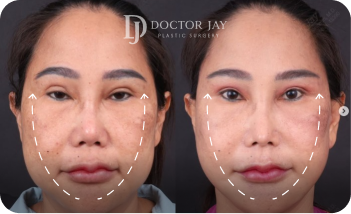


Key points
- An endoscopic facelift is surgery carried out through a small camera, correcting loose skin on the face and neck at the point where the problem starts.
- The technique cuts the size of the incision considerably and hides it in the hairline, so the scar is hard to spot and recovery is shorter.
- The camera lets the surgeon see the vessels and nerves, so the surgery runs smoothly and is more accurate because more detail is visible, with less swelling afterwards.
- See a surgeon to assess your skin and facial structure beforehand, so the plan is built around the face you have.
An endoscopic facelift corrects loose skin, deep nasolabial folds and sagging under the chin, without the long scar that comes with traditional facelift surgery, which leaves a large incision and months of recovery. This newer approach uses a small camera and brings the incision down to roughly 1 to 2 centimetres.
In this article Dr Anuchit Adirojananon (Doctor Jay), medical licence number 45390, covers how an endoscopic facelift works, the difference between lifting the upper and the lower face, and the use of a medical fixation device such as Endotine to hold the tissue in place. It sets out the facts on safety, recovery time and how to prepare for surgery, for anyone looking into ways to lift and reshape the face.
What is an endoscopic facelift

An endoscopic facelift reworks sagging facial structure through small openings instead of the long incision used before. A high resolution camera is passed beneath the skin and sends live images of the structures underneath to a screen, so the surgeon can separate the muscle layers precisely while the incisions stay hidden in the hairline.
The technique improves sagging across the upper and middle face, such as the forehead, drooping brows and deep nasolabial folds. It avoids removing large amounts of excess skin, so facial expression stays natural afterwards, and the incisions are only about 1 to 2 centimetres.
How the endoscope works
The endoscope sends a magnified live image of the structures beneath the skin to a monitor, so the surgeon can see the vessels, the nerves and the deep muscle layers in detail through a small opening. This makes reworking the facial structure accurate without opening a wide incision. The camera system works through these steps to reposition the structure of the skin.
- Passing a small camera tube 4 millimetres in diameter beneath the skin through an opening of 1 to 2 centimetres in the hairline.
- Sending the image to the monitor in Full HD to guide the specialised surgical instruments.
- Separating the muscle layer and the deep structural tissue from the bone carefully, so the nerves that drive facial movement are avoided.
Working through the camera reduces tearing of the vessels and the surrounding tissue, so the body recovers sooner and the swelling that covers the face clears in roughly 7 to 10 days.
How the endoscopic deep plane technique works and what it corrects
The endoscopic deep plane technique lifts the structure of the skin through the SMAS layer, the fibrous and muscular layer that sits beneath the fat of the face. Across the upper and middle face the endoscopic approach dissects down to the subperiosteal level, so the whole layer is raised together. It releases and divides the ligaments that anchor the facial structure, so the entire deep layer can be repositioned vertically.
The high resolution camera guides careful dissection in places the eye cannot reach, so the surgeon can move sagging fat and muscle back to where they sat at a younger age. Anchoring the deep layer takes tension off the surface skin, and the incisions knit together in roughly 7 to 10 days before settling completely.
Can loose skin, deep nasolabial folds and a sagging neck be corrected
An endoscopic facelift corrects ageing in several areas of the face, particularly where the fat pads and the deep structure have dropped. These are the main concerns that can be assessed and planned for.
- Drooping outer eye corners and brows that shadow the eyes and leave the face looking tired.
- Heavy cheeks and deep nasolabial folds caused by the cheek fat pads shifting downward.
- Sagging under the chin and a jawline that loses its definition as the deep structure drops with gravity.
The surgery releases the fibrous attachments, then moves the structures that have dropped back to where they belong. Anchoring them vertically leaves the skin smooth without relying on large amounts of filler treatment, reduces the swelling that builds up, and has the skin under the chin settling noticeably within 7 to 10 days.
Endotine fixation devices and the legal standards that apply to the materials used
Endotine is a medical device used to anchor the structures beneath the skin during an endoscopic facelift, spreading the tension evenly so the tissue does not drop again.
We use this fixation device to hold the muscle and fat layers securely in their new position. It is made from a semi synthetic material with the same structure as absorbable sutures, and it dissolves naturally without leaving anything behind beneath the skin.
- It is a tissue fixation device used in the operating theatre, and the surgeon selects the size that suits the structure of each face.
- The device has small contact points that spread the tension across the skin, so no single point is pulled and the surrounding tissue is spared.
- It stimulates natural collagen production around where it is placed, so the tissue holds its position after the device has fully dissolved.
How an endo face lift differs from an endo brow lift
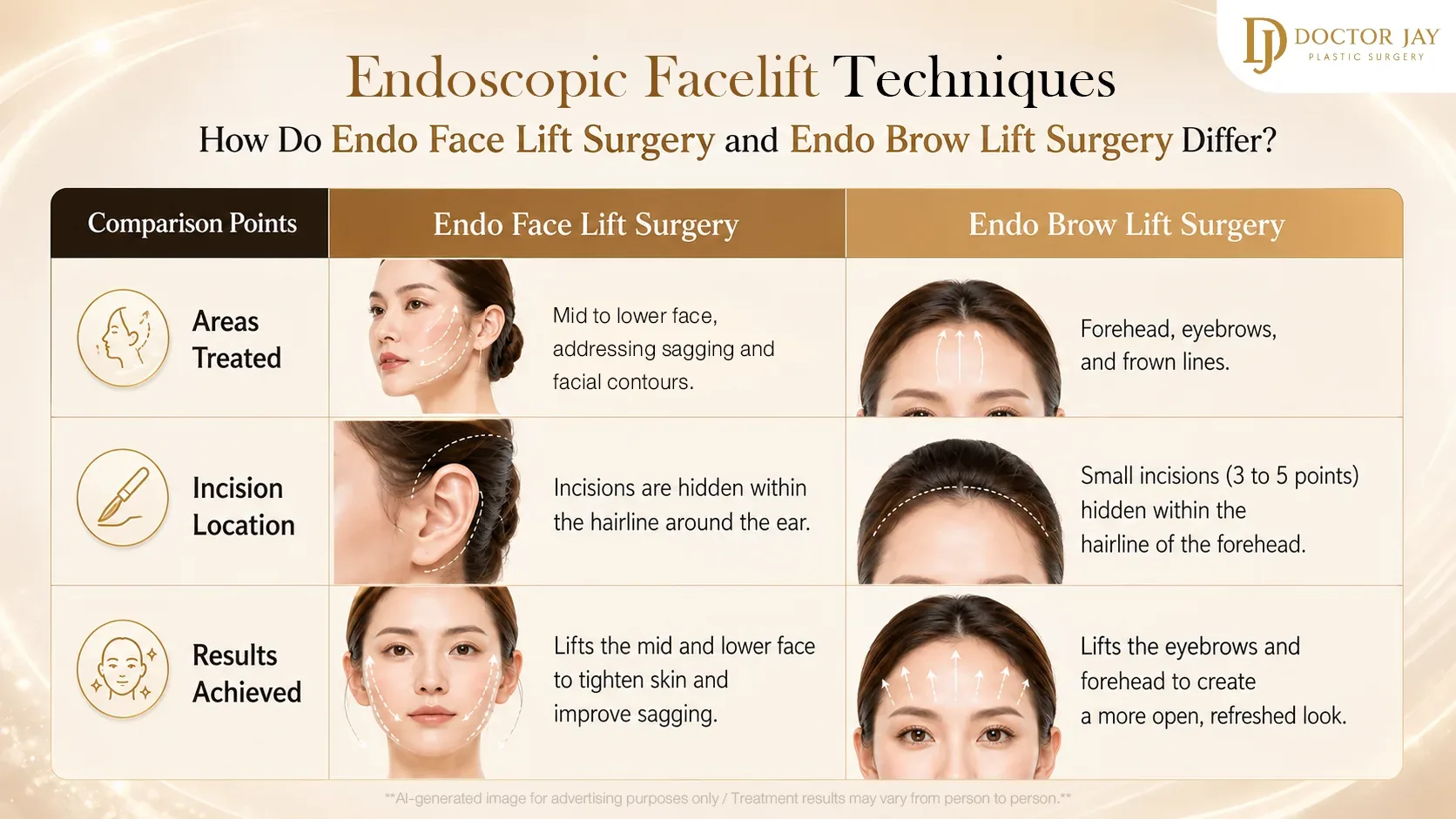
An endo face lift and an endo brow lift differ clearly in the part of the face they address and where the incisions are placed.
| Point of comparison | Endo face lift | Endo brow lift |
|---|---|---|
| Area addressed | Lower cheeks, nasolabial folds and the jawline | Forehead, drooping brows and lines around the eyes |
| Incision placement | Hidden in the hairline above the ear | Hidden in 3 to 5 small openings in the hairline of the forehead |
| What it achieves | A firmer looking middle and lower face | Lifts the brows and opens up the forehead |
An endo face lift lifts sagging cheeks so they look fuller and firmer, while an endo brow lift addresses drooping brows that leave the face looking downcast or tired. The incisions are usually about 1 to 2 centimetres and hidden in the hairline, so they are hard to notice once surgery is over.
A traditional facelift compared with an endoscopic facelift
Which way you lift and reshape the face depends on what you want and on the state of your skin. Traditional facelift surgery and an endoscopic facelift work in entirely different ways. The table below sets out the basic differences to help you decide.
| Point of comparison | Traditional facelift | Endoscopic facelift |
|---|---|---|
| Surgical technique | A long incision along the ear with excess skin removed | Small openings with a camera guiding the lift of the muscle layer |
| How the skin is handled | Suits people with considerable excess skin and heavy sagging | Lifts the internal structure without removing much skin |
| Specialised equipment | Standard surgical instruments and sutures to anchor the skin | A magnifying camera together with Endotine fixation devices |
Understanding how the two differ lets you plan the treatment with your surgeon around your own concern.
How the scars and the recovery time differ
An endoscopic facelift leaves incisions of only 1 to 2 centimetres hidden along the hairline, unlike a traditional facelift, which needs a long incision around the ear from the temple down to the nape. A smaller incision means less injury to the vessels and nerves beneath the skin, which is better for circulation and lowers the rate of tissue death at the wound edges.
Recovery after an endoscopic facelift takes roughly 7 to 10 days before returning to daily life, while a traditional facelift needs 14 to 21 days for the sutures around the ear and the swelling beneath the skin to settle. Washing the hair gently can start once the sutures are out, at around day 7 to 10.
Which age group and skin type an endoscopic facelift suits
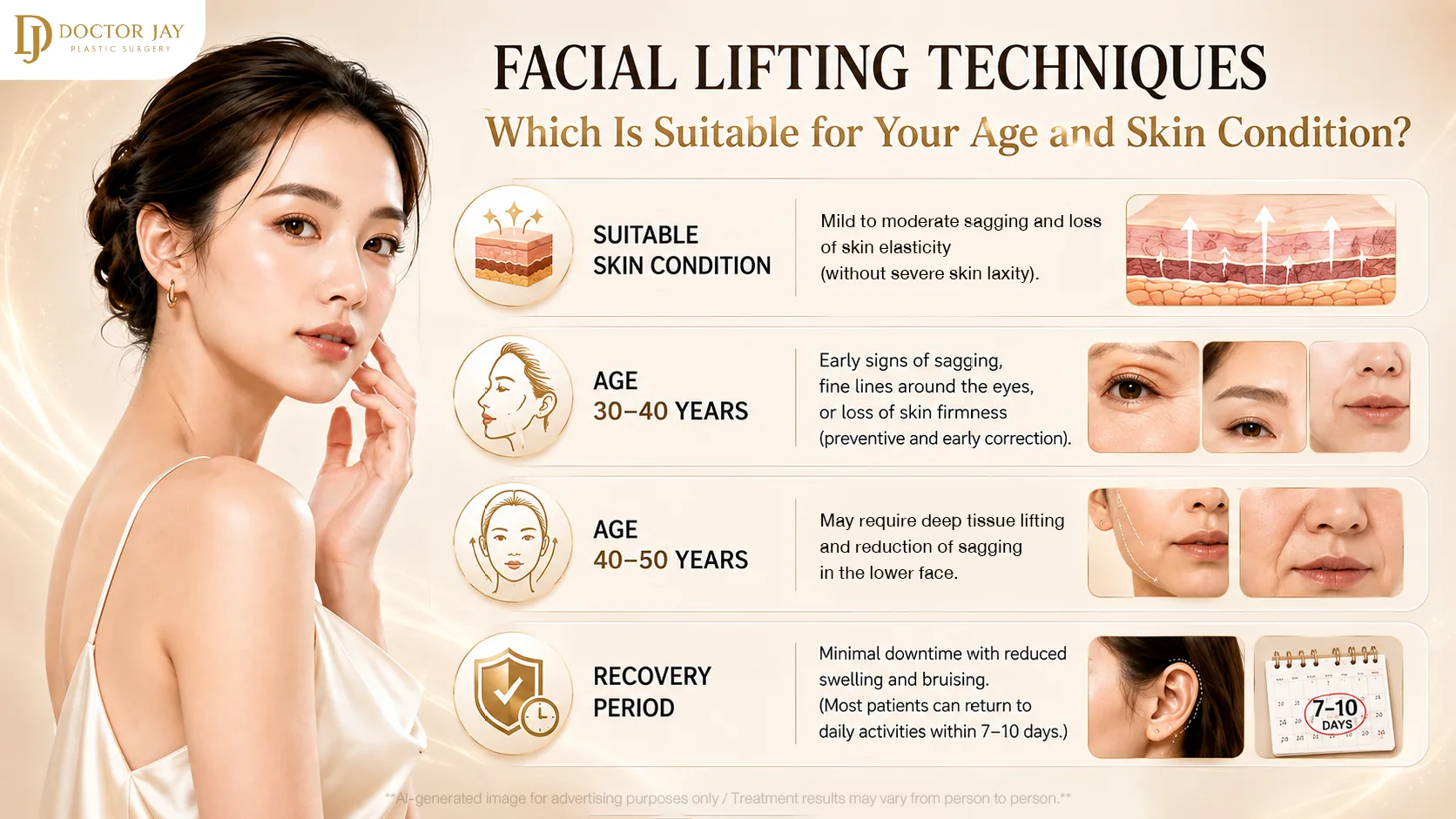
An endoscopic facelift suits people aged 30 to 50 with mild to moderate sagging whose skin still has good elasticity. The approach concentrates on the deep structure that has dropped, without removing large amounts of excess skin the way surgery once did.
- The 30 to 40 age group with drooping outer eye corners, drooping brows or the first faint nasolabial folds, where the lower jawline is still defined.
- The 40 to 50 age group who want the cheeks lifted and the deep mouth grooves softened, where the skin is still elastic enough to settle on its own afterwards.
- People who do not want a visible external scar and have only 7 to 10 days to recover before returning to work.
How many years does an endoscopic facelift last
An endoscopic facelift holds its firmness for roughly 5 to 10 years, depending on the condition of the skin beforehand and on how each person cares for themselves. The technique lifts down to the deep facial muscle layer, the SMAS, and anchors the structure beneath the skin with a fixation device, so the result holds longer than non surgical lifting treatments.
External factors that affect how long the firmness lasts come down to daily habits. Smoking, sun exposure without sunscreen and sharp swings in weight all break down the collagen beneath the skin, so the face sags again sooner as it ages naturally.
Using skincare aimed at lines and having collagen stimulating treatments regularly after surgery keeps the skin looking fresh for longer. Sleeping 7 to 8 hours a night and drinking enough water also matter in keeping the upper layers of the skin strong and elastic.
How to prepare for an endoscopic facelift
Preparing properly before an endoscopic facelift and caring for yourself afterwards reduces swelling and helps the incisions heal sooner. Stop aspirin and ibuprofen, along with supplements that affect blood clotting such as fish oil and vitamin E, at least 14 days before surgery. Telling the medical team about any drug allergy and underlying condition in advance adds to the safety of the anaesthesia.
Caring for yourself after surgery to shorten the swelling starts with these steps.
- Apply cold compresses around the incisions through the first 3 to 5 days, to keep the vessels from dilating and to ease the swelling.
- Sleep with the head raised above the level of the heart through the first 7 days, so the fluid that gathers can drain.
- Keep the incisions dry until the surgeon removes the sutures at 7 to 10 days, to prevent bacterial infection around the suture line.
Why have an endoscopic facelift at Doctor Jay Plastic Surgery
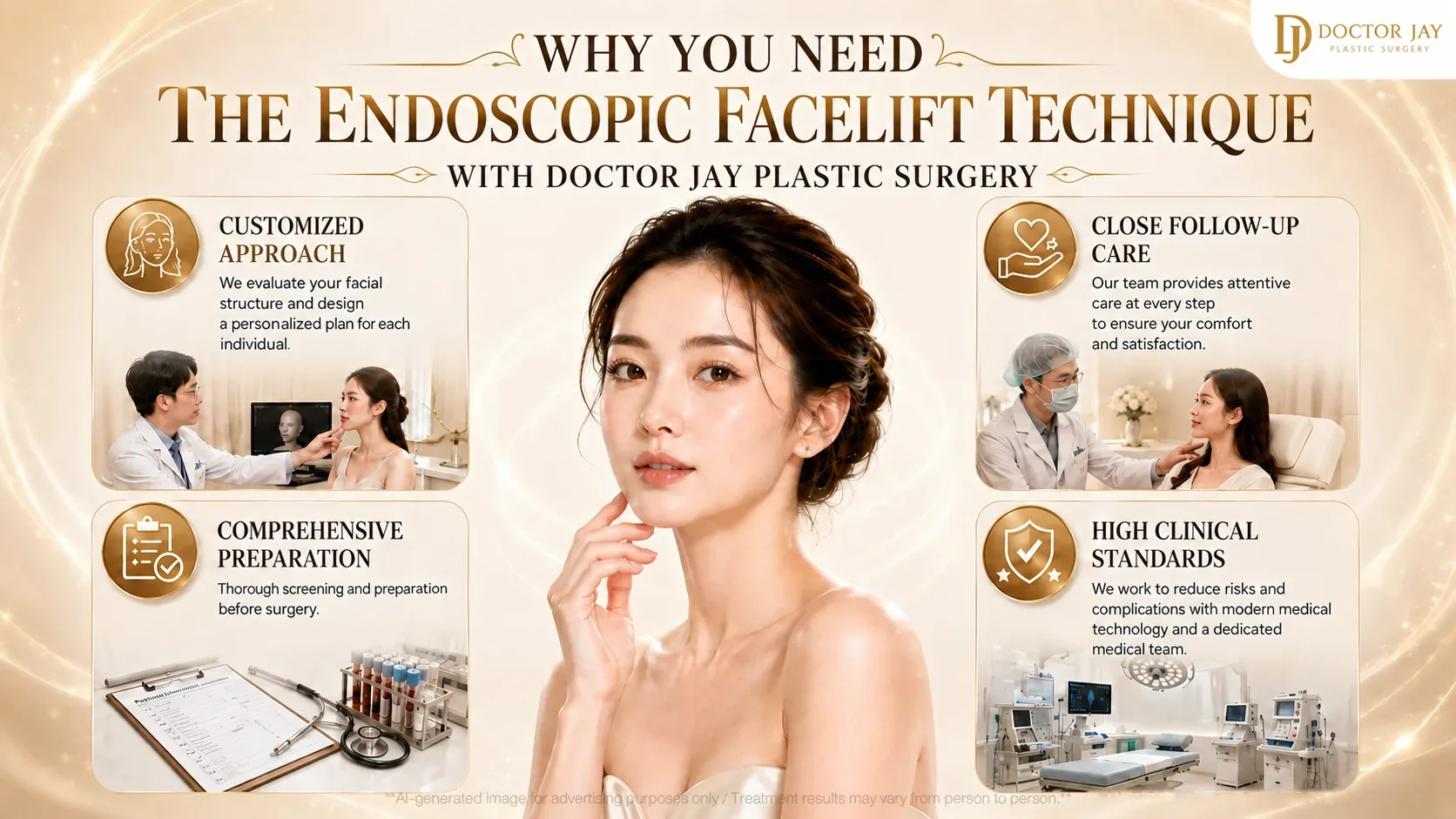
An endoscopic facelift calls for careful screening and close care to reach the result you want while keeping you safe. We assess the structure of each face individually alongside a systematic check that the body is ready, so there is less to worry about at every step. Preparing properly and holding to the standard of care lowers the risk of complications after surgery.
Our operating theatre standards and the techniques we use
We use a sterile positive pressure operating theatre with air quality controlled by HEPA filters, so nothing contaminates any stage of an endoscopic facelift. Surgery is carried out with an anaesthetic team monitoring vital signs on a one to one basis throughout. These are the technologies and instruments we use for accuracy in surgery.
- A 4K endoscope that magnifies the view of the small vessels and nerves clearly.
- Instruments with specially tapered tips for separating the deep tissue planes without damaging what lies around them.
- A technique for positioning the fixation device on the temporal bone, so the deep muscle layer is anchored securely.
The air handling system in the theatre exchanges the air as often as 20 times an hour to keep it biologically clean. Holding the room at 20 to 22 degrees Celsius with relative humidity no higher than 50 percent is the standard that keeps airborne microorganisms from building up during a procedure.
What to expect from an endoscopic facelift at Doctor Jay Plastic Surgery
The result of an endoscopic facelift shows in a cleaner jawline and an upper face that looks firmer and natural. The small incisions hidden in the hairline mean less to worry about in terms of scarring. Assessing each face individually sets the tension on the muscle layer at the right level, so nothing is pulled out of shape.
Recovery after treatment generally follows this pattern.
- The swelling around the face settles enough to return to work within 7 to 10 days.
- The folds at the corners of the mouth and the deep nasolabial folds usually look shallower 1 month after surgery.
- The skin across the cheeks and temples is evenly firm, without needing regular filler treatment.
Frequently asked questions about the endoscopic facelift
Where are the scars from an endoscopic deep plane facelift hidden
The incisions from an endoscopic facelift are hidden mainly in the hairline above the ear and at the temple, so nothing shows in daily life. The surgeon makes small openings of roughly 1 to 2 centimetres at 3 to 5 points on the scalp, set back inside the hairline, where the natural hair covers the suture lines completely.
These small scars fade until they are hard to notice within 3 to 6 months of surgery. How they turn out and how long they take to heal depend on each person’s skin. Because the technique avoids a long incision around the ear, it also lowers the chance of a keloid along the jawline. Patients can tie their hair back or wear a ponytail as usual once the incisions have healed fully, at around week 4.
Can an endoscopic facelift be combined with other procedures
An endoscopic facelift can be combined with other procedures. Doing them together means fewer rounds of anaesthesia and one recovery period rather than several. The procedures combined most often, for a brighter look around the eyes, are surgery to lift the outer eye corner, or repositioning the fat under the eyes together with a forehead lift.
Forehead augmentation with a silicone implant, or fat grafting across the face, can also be planned into the same operation. The surgeon assesses your health to keep the time under general anaesthesia within a reasonable range. Anyone with an underlying condition such as high blood pressure needs it controlled within the normal range for at least 14 days before combined surgery.
How many days of recovery does an endoscopic facelift need before returning to normal life
An endoscopic facelift needs roughly 7 to 10 days of recovery before returning to work and daily life. Most of the swelling eases noticeably during the first week after surgery. The body recovers on its own, with no need to stay overnight in hospital.
Through the first 3 to 5 days the surgeon will advise cold compresses around the face, to reduce the swelling and help the incisions settle. After 7 to 10 days the small incisions in the hairline are dry and ready for the sutures to come out. Patients can start using light make up to cover the marks, and go back to light exercise after 30 days.
In summary
An endoscopic facelift reworks the deep structure of the skin through a small camera, correcting sagging on the face and neck through incisions of 1 to 2 centimetres in the hairline. The approach reduces injury to the surrounding tissue, so there is little blood loss and recovery comes down to roughly 7 to 10 days. The firmness holds for roughly 5 to 10 years.
Have your facial structure assessed by a specialist, so the advice and the plan fit you. Preparing the body properly in advance, such as stopping aspirin at least 14 days before the procedure, is a key step in lowering the risk and adding to the safety of surgery.