


Key points
- The SMAS layer is the fibrous tissue sheet under the skin and fat that wraps the facial muscles and holds the facial structure firm.
- This layer loosens as we age, which brings on lines, nasolabial folds and sagging across the face.
- A facelift and energy based lifting devices both work down at the SMAS layer to stimulate collagen production.
- Caring for this layer lifts and reshapes the face so it looks slimmer.
The SMAS layer is the tissue sheet under the skin and fat that holds the facial structure firm. As the years pass this layer weakens and drops, which leaves deep lines, deep nasolabial folds and a jawline that loses its definition. Left alone the change builds up until the face looks older than it is, and no over the counter cream can reverse it.
In this article Dr Anuchit Adirojananon (Doctor Jay), medical licence number 45390, explains what this tissue layer does, and compares facelift surgery with energy based lifting devices so you have what you need to choose the approach that fits you.
What is the SMAS layer
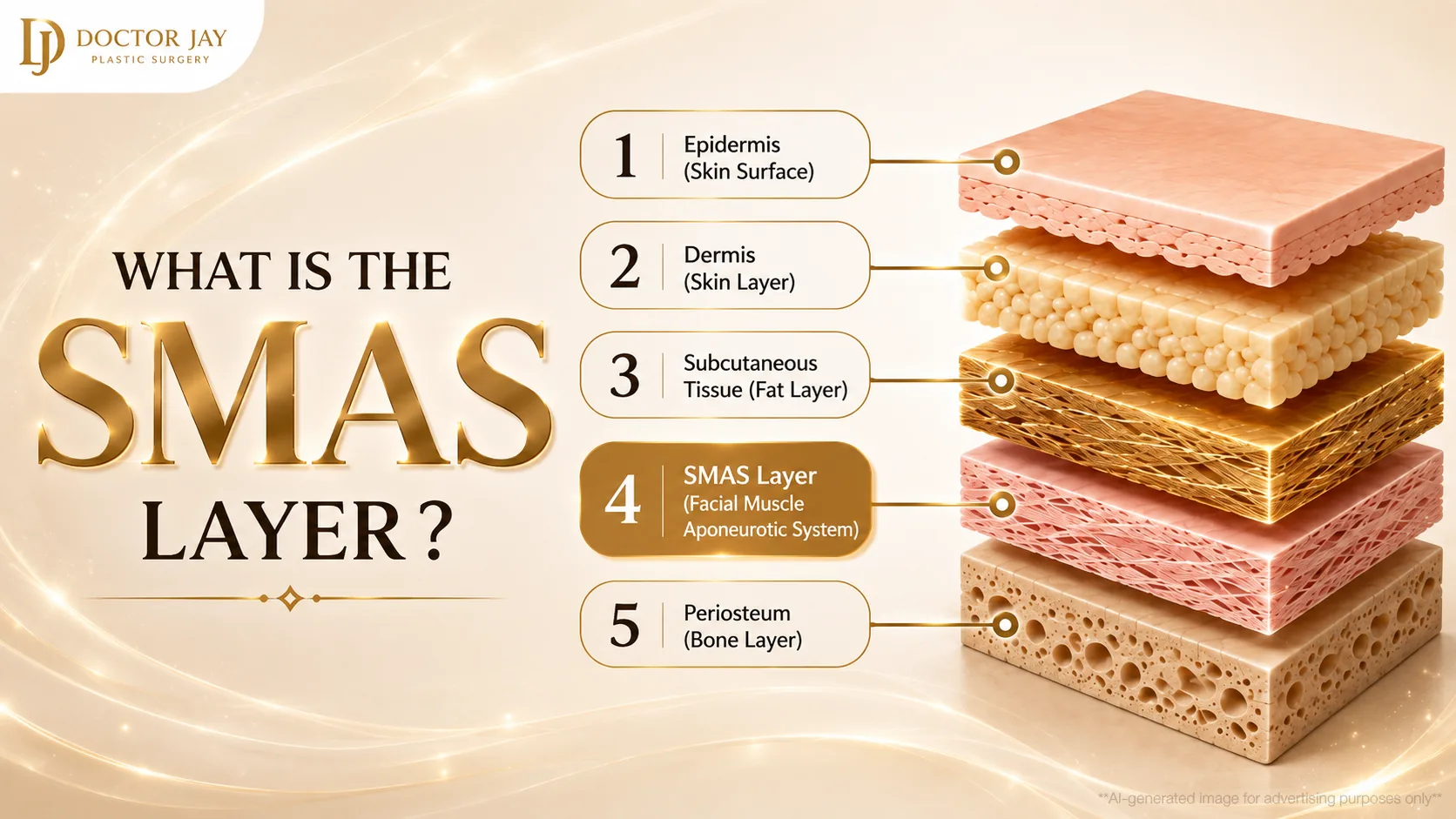
The SMAS layer is a dense, tough sheet of connective tissue interleaved with fat that sits beneath the dermis. It links the facial muscles to the skin above and keeps them firm. Its main components are collagen and elastin fibres woven tightly together.
This layer weakens with age, so it loses the elasticity it needs to hold facial fat in place. Its density is not the same everywhere on the face, and it is noticeably thicker over the cheeks and along the jaw.
When this structure gives way the outer shape of the face changes with it. The signs show clearly from the age of 30 onwards, when folds appear at the corners of the mouth and the jawline visibly drops.
Where the SMAS layer sits and what it does
The SMAS layer sits roughly 4.5 millimetres below the epidermis and dermis. It is a sheet of fat and fibrous tissue that covers every muscle of facial expression, running from the temples across the cheeks and down to the neck, anchoring the skin above so gravity cannot pull it down. Its main roles in keeping the face firm are these.
- It controls facial expression by linking each muscle group to the skin above.
- It holds subcutaneous fat in position so it does not slide down and collect along the lower border of the face.
- It keeps the face defined, particularly along the jawline and under the chin where fat gathers easily.
Collagen in this area is what keeps facial skin elastic. These support fibres normally break down at an average of 1 percent a year after the age of 25, so the skin loses its support.
Why surgeons pay attention to the SMAS skin
Surgeons pay attention to the SMAS skin because this layer is the main support for the firmness of the whole face. Lifting only the outer skin without tightening this fibrous layer means the skin sags again before long. Reworking this tough tissue sheet lets the surgeon reposition the fibrous layer and the fat beneath the skin precisely.
The reasons surgery has to address this layer are these.
- It prevents the pulled, unnatural look after surgery, because the tension is carried by the strong fibrous layer rather than by the thin skin above it.
- It repositions sagging fat pads where they belong, so the cheeks and jawline regain their contour.
- It extends the result of the facelift to roughly 5 to 10 years, depending on how well each person looks after themselves.
Why sagging starts in the SMAS layer as we age
Facial sagging begins when the SMAS layer loses elasticity, because the collagen and elastin that once held the structure together decline with age. This tissue works like a net that carries the skin and the fat above it. Past the age of 25 the production of these key proteins falls by an average of 1 percent a year, so the net starts to give way under gravity from around the age of 35.
The fibrous structure that ties the facial muscles together stretches and thins over time, so the support that was once strong weakens and the fat beneath the skin drops downward. UV from the sun also damages the fibroblasts that produce the supporting fibres in the SMAS layer directly. That accumulated damage costs this tissue, which sits roughly 4.5 millimetres beneath the skin, its firmness.
Signs that the SMAS layer is weakening

The signs that the SMAS layer is weakening show up as visible sagging in the shape of the face. Once the fibrous support gives way, the tissue and fat above it move downward. You can read how far this deeper layer has weakened from what you see on the surface.
- Nasolabial folds and the lines at the corners of the mouth deepen as the cheek skin drops and gathers below.
- Loose skin under the chin folds into layers once the fibrous layer can no longer hold the excess fat.
- The jawline blurs into the neck, so the face shifts from an oval shape towards a square one.
These changes usually become steadily more visible between the ages of 35 and 40.
Is a SMAS facelift the answer to deep sagging
A SMAS facelift addresses sagging that starts in the deep support layer, which no cream or skin treatment can reach. The surgery works directly on the loosened deep structure to rebuild the contour of the face.
It resolves sagging that has built up for years into deep nasolabial folds and loose skin under the chin, and the result holds for roughly 5 to 10 years, depending on how each person cares for themselves and how their skin ages.
What is a SMAS lift
A SMAS lift is the facelift technique that works directly on the fibrous support layer, repositioning the sagging muscle structure and facial fat where they used to sit. The surgeon makes the incision in front of the ear and carries it back into the hairline behind the ear to raise the skin, then separates the skin from the muscle fascia about 4.5 millimetres down, ready to be tightened in the next step.
This approach corrects sagging across the middle and lower face as well as loose skin under the neck. It calls for care in separating the tissue planes so the facial nerve, the seventh cranial nerve that drives the muscles of expression, is not injured. After surgery a facial compression garment is worn around the clock through the first 3 days to reduce swelling, so the tissue settles into its new position.
Why a facelift has to tighten down to the SMAS layer
A facelift has to be sutured down at the SMAS layer to correct the weakened support at its base, which is the real source of facial sagging. Lifting only the surface skin while the fibrous layer beneath stays loose leaves the face looking tight and unnatural, and the sagging returns before long.
- Tightening the SMAS layer lifts and locks the fat pads and facial muscles back where they belong, so the outer skin lies smooth without being stretched thin.
- It takes the tension off the incision line, so the suture line in front of the ear stays small and flat rather than widening into a keloid scar over time.
- The deep structure, anchored with specialised sutures, holds that firmness for 5 to 10 years.
SMAS facelift surgery compared with energy based lifting devices
A SMAS facelift and energy based lifting devices differ clearly in what they do to the underlying structure and in how long the result lasts.
| Point of comparison | SMAS facelift surgery | Energy based lifting device |
|---|---|---|
| How it works | Separates the skin planes and sutures the muscle layer tight | Delivers heat energy down into the deeper skin layers |
| What it achieves | Corrects severe sagging well | Lifts and stimulates collagen |
| How long it lasts | Holds for 5 to 10 years | Holds for 1 to 2 years |
| Recovery | About 7 to 10 days of recovery before returning to work | No recovery time needed |
Surgery corrects severe sagging and removes part of the excess skin. Devices work from the inside to restore the skin without any incision, which suits people with early lines and little time to recover.
Who a SMAS lift suits

A SMAS lift suits people aged 40 and over whose facial sagging has gone beyond what a lifting device can correct. Skin that has lost its elasticity with age needs its structure repositioned, and that applies to the groups below.
- People with deep nasolabial folds, downturned corners of the mouth and cheek tissue hanging over the jawline.
- People with excess skin on the neck that has sagged until it obscures the lower jaw.
- People who have used energy based lifting devices and are not satisfied with the result.
Reworking this deep layer makes the lower face and neck look firmer. Anyone considering it should allow around 7 to 10 days of recovery for the swelling to settle and for the appointment to remove the sutures.
Safety standards and legal requirements for SMAS layer surgery
Surgery on the SMAS layer is a deep medical procedure and has to be carried out under the safety standards set by law, so the facial nerves are protected. These are the points to weigh when choosing where to have it done.
- The surgery must be performed by a board certified plastic surgeon accredited by the Medical Council, for accuracy and safety while dissecting close to the nerves that control facial movement.
- The operating theatre must hold major operating theatre accreditation from the Ministry of Public Health, with high efficiency air filtration and resuscitation equipment ready for use.
- General anaesthesia has to be managed by a specialist anaesthetist on a 1 to 1 basis, monitoring vital signs throughout the operation.
Why have SMAS facelift surgery at Doctor Jay Plastic Surgery
We study the structure of each face before suturing the SMAS layer, so the tightening follows the direction in which that face has sagged and the result looks natural. Surgery by a board certified plastic surgeon leaves the face firmer without a visible scar. Most patients are back to their normal routine within 7 to 10 days.
What we focus on in SMAS layer facelift surgery
- Careful suturing along the hairline and the ear, so the scar is hard to spot once the skin has healed.
- Close aftercare with a laser programme to reduce swelling, which helps the body recover sooner.
- Assessment and surgery by a board certified plastic surgeon, so the result looks natural and fits the structure of each face.
Frequently asked questions about the SMAS layer and facelift surgery
How long is the recovery after a facelift down to the SMAS layer
A facelift that goes down to the SMAS layer takes roughly 7 to 10 days of recovery before returning to work, and strenuous activity should be avoided for 3 to 4 weeks. Swelling eases noticeably during the first week, and the incisions in front of the ear and along the hairline are usually dry and ready for suture removal within 7 to 10 days of surgery.
You can go about daily life at home as usual after surgery, but avoid strenuous exercise and heavy lifting for the first 3 to 4 weeks, to keep the incisions from separating and to lower the risk of bleeding under the skin. Cold compresses applied correctly during the first 48 hours, together with sleeping with the head raised at 30 degrees, clear the swelling sooner.
Can a lifting device tighten the SMAS layer as well as surgery
Devices that use high frequency sound energy or radiofrequency cannot match what surgery achieves, because all they do is deliver heat that makes the SMAS layer contract and lay down new collagen. Heat based treatment therefore only addresses early to moderate sagging.
Facelift surgery separates the skin planes, then trims and sutures the weakened SMAS layer, drawing it up and anchoring it firmly to the fascia over the bone behind the ear. A lifting device only sends heat into small points 1 millimetre across at 65 to 70 degrees Celsius beneath the skin. That sustains firmness temporarily and has to be repeated every 1 to 2 years.
How long does the result of a SMAS lift last
The result of a facelift down to the SMAS layer holds for roughly 5 to 10 years. Anchoring the deep tissue supports the skin above it securely, so the face does not sag again within the short span you see after a lifting device.
Skin still ages naturally after surgery. You can extend the result by looking after yourself consistently. Daily sunscreen at SPF 50+ and avoiding smoking both protect the collagen in the skin.
In summary
The SMAS layer is the deep fibrous structure beneath the skin that carries the firmness of the whole face. As this tissue weakens with age it becomes the main reason deep lines, nasolabial folds and a sagging jawline appear. Understanding what this layer does helps you match the treatment to the cause, whether that is lifting with a heat based device or surgery that rebuilds the structure from its foundation.
For anyone whose accumulated ageing has cost them their confidence, a detailed assessment with a specialist is the first step not to skip. Choosing the approach that matches the degree of sagging brightens the look and holds the lift for longer.
References
- Shuster S, Black MM, McVitie E. The influence of age and sex on skin thickness, skin collagen and density. British Journal of Dermatology, 1975, volume 93, issue 6, pages 639 to 643 (the rate at which collagen declines with age)
- Varani J, et al. Decreased collagen production in chronologically aged skin. American Journal of Pathology, 2006, volume 168, issue 6, pages 1861 to 1868 (reduced collagen production with age)
- Microfocused ultrasound with visualization. Consensus on safety and review of energy-based devices. PubMed ID 34951735 (the 1.5 to 4.5 millimetre depths and the temperature of the thermal points used to stimulate collagen)

Key points
- A facelift is surgery on the deep structural layer beneath the facial muscles, correcting loose skin, wrinkles and sagging under the chin so the face is firmer and still looks natural.
- The deep plane technique lifts the facial structure from its foundation, which takes tension off the outer skin, so the incisions heal sooner and expression returns to normal.
- Preparing for surgery means stopping blood thinners, supplements, alcohol and smoking for at least 14 days, to prevent complications and help the incisions heal.
- After surgery, sleep with the head raised and use cold compresses early on to reduce swelling. The incisions are usually dry and you are back to your routine within 7 to 10 days.
A facelift is an option for anyone dealing with loose facial skin, deep nasolabial folds and sagging under the chin that makes the face look tired beyond its years. Skincare and facial massage rarely reach folds this deep, so reworking the structure of the skin becomes the way to restore firmness and smooth the face again, particularly for people from the age of 40 onwards, who lose collagen faster than they did before.
In this article Dr Anuchit Adirojananon (Doctor Jay), medical licence number 45390, covers the steps of deep plane facelift surgery, how the incisions are hidden in front of and behind the ear, and how thread lifts compare with facelift surgery, so anyone considering it has accurate information for preparing before and after the procedure.
What is a facelift?

A facelift is surgery that reworks a sagging facial structure so it looks firm and fresh again. It addresses excess skin together with the deeper structures that have dropped with age, covering the cheeks, the mouth grooves, the jawline and the neck.
The procedure works on the deep facial structure known as the SMAS layer, the muscle layer that dictates how much the face sags. That sets it apart from ordinary laser tightening, which only reaches the surface. The result of facelift surgery holds for several years, depending on how each person cares for themselves and lives day to day.
The deep plane facelift technique
A deep plane facelift reaches the structural tissue and the fat beneath the SMAS layer together, without separating the skin from what lies under it. That takes tension off the outer skin and holds the result longer than a traditional facelift. Here is why the technique corrects sagging so effectively.
- Less swelling, because the thin outer skin is not separated, so circulation carries on as usual.
- The face moves normally without feeling tight, because the whole deep structure is repositioned from its base, and the result looks natural.
- It corrects deep nasolabial folds and heavy cheeks by releasing the ligaments that anchor the skin to the bone, then setting them in a new position.
The surgery is done under general anaesthesia and takes about 3 to 4 hours. Recovery is shorter, and you can return to your daily routine within 7 to 10 days, sleeping with the head raised through the first 3 days to reduce swelling.
What makes the facelift technique stand out?
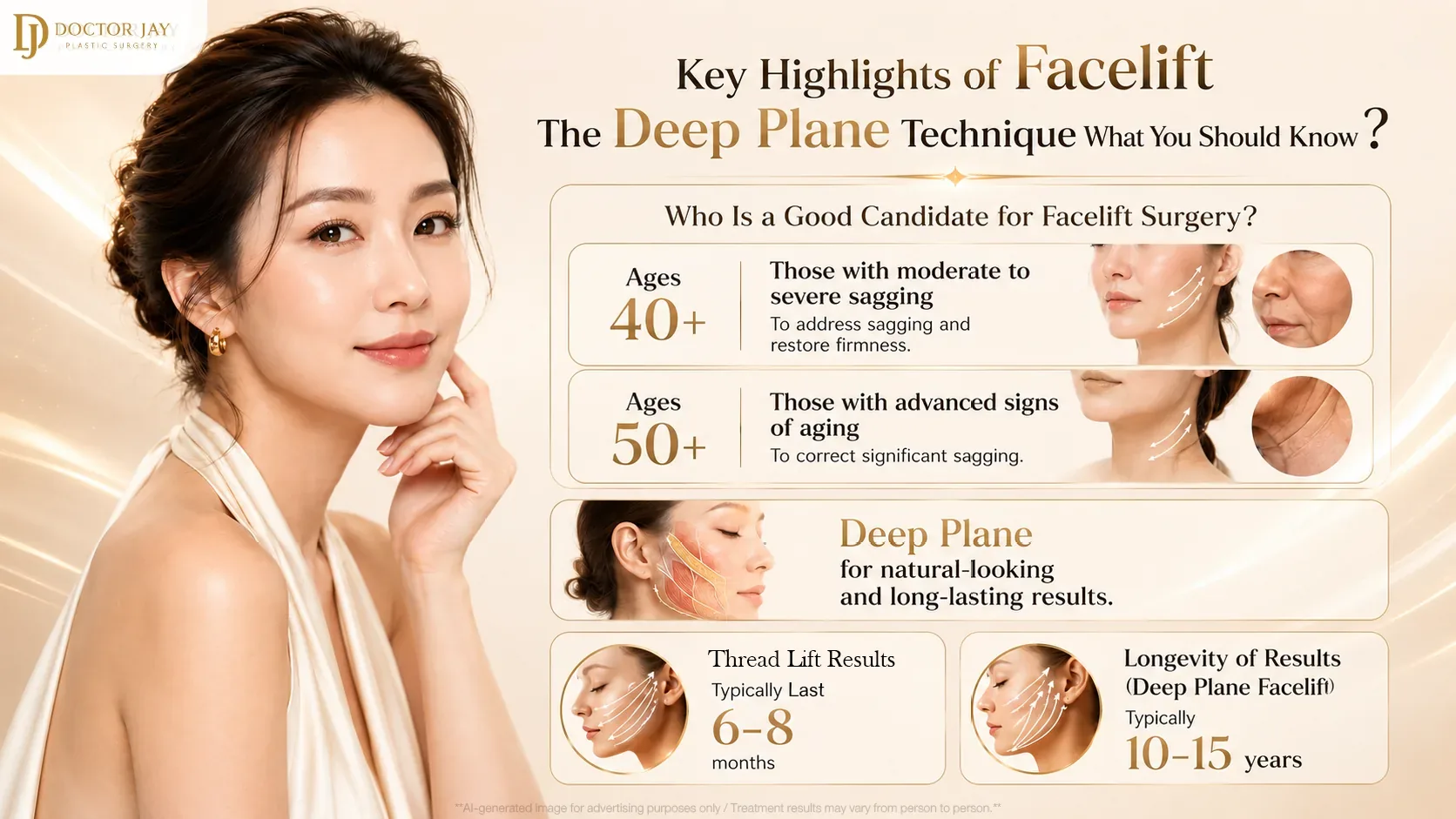
What sets facelift surgery apart is that it corrects sagging right down at the deep muscle structure, addressing the source of the change that skincare and energy based devices cannot reach.
Returning the dropped structure to where it used to sit keeps the result natural, so the face is not stretched out of shape. The surgeon studies the vectors of the lift so they follow the mid face and lower face structure of each individual.
How deep nasolabial folds and heavy cheeks are corrected
Deep nasolabial folds and heavy cheeks are corrected at the source by lifting the SMAS layer and the cheek fat and anchoring them higher. This addresses the cause by repositioning the internal structures that have dropped with age.
- Releasing the ligaments over the cheekbone that pull on the skin and create the deep fold.
- Moving the cheek fat pads that have slid downward back up over the cheekbone.
- Anchoring the base of the deep structure so the firmness stays where it is set.
Reworking this area corrects hollow and heavy cheeks in people aged 40 and over. The incisions are hidden along the border of the ear. Patients notice the nasolabial folds looking shallower once the sutures come out at 7 to 10 days.
Defining the jawline and reducing sagging on the neck
Defining the jawline and reducing neck sagging through a facelift improves loose skin under the chin and on the neck by addressing the deep neck muscles. It turns a neck that folds into layers into a firm one, and gives the jawline a cleaner edge.
- Suturing the platysma, the muscle at the front of the neck, so the bands that create the visible cords are brought back together.
- Removing the right amount of excess fat under the chin and along the jaw.
- Redraping the excess skin towards the back of the ear so the surface lies smooth.
This step addresses neck sagging in people aged 50 and over. The incisions around the ear and at the back of the head fade until they blend into the surrounding skin within 3 to 6 months.
How the deep plane technique differs from other types of facelift
There are several types of facelift and other ways to restore the face, and each one reaches a different depth of the skin. Understanding how deep plane facelift surgery differs from the alternatives helps you choose what fits your own skin, judged by how far it has sagged and how the structure has changed with age from 35 to 60 and beyond.
A traditional SMAS facelift compared with the deep plane technique
Facelift surgery differs clearly between the traditional SMAS technique, which separates the skin from the SMAS layer and then tightens the SMAS directly (each layer is lifted on its own), and the deep plane technique, which goes beneath the muscle layer to raise the whole facial structure at once (the dissection runs under the SMAS, so skin and SMAS are lifted together as one sheet).
Traditional SMAS surgery separates the skin from the muscle, which puts considerable tension on the skin. The deep plane technique releases the ligaments at depth, so the structure moves as one and the result looks natural. It also reduces the pull around the ear and the incisions heal sooner, within 7 to 10 days.
*Results depend on the individual.
| Point of comparison | Traditional SMAS facelift | Deep plane technique |
|---|---|---|
| Layer the surgery works on | Lifts the skin and sutures the SMAS layer above | Releases beneath the SMAS layer to raise the deep structure |
| Skin tension afterwards | More pull on the skin | Less pull, the skin looks natural |
| Recovery time | 14 to 21 days | 7 to 10 days |
Thread lift compared with a facelift and which one fits you
Choosing between a thread lift and facelift surgery comes down to how far the skin has sagged and how long you want the result to hold. A thread lift is a temporary option for anyone with the first lines. A facelift is surgery designed for people whose skin has sagged considerably and who want it addressed properly.
*Results depend on the individual.
| Method of lifting | Thread lift | Facelift |
|---|---|---|
| Who it is for | Mild to moderate sagging | Severe sagging with deep nasolabial folds |
| How long the result lasts | 6 to 8 months | 10 to 15 years |
| Recovery | 2 to 3 days | 7 to 10 days |
Counting what repeated sessions add up to over time, facelift surgery may suit anyone who would rather not keep coming back for the same procedure. Whichever of the types of facelift you consider, have a plastic surgeon assess the SMAS muscle structure of your own face in detail before you decide.
Who a facelift suits
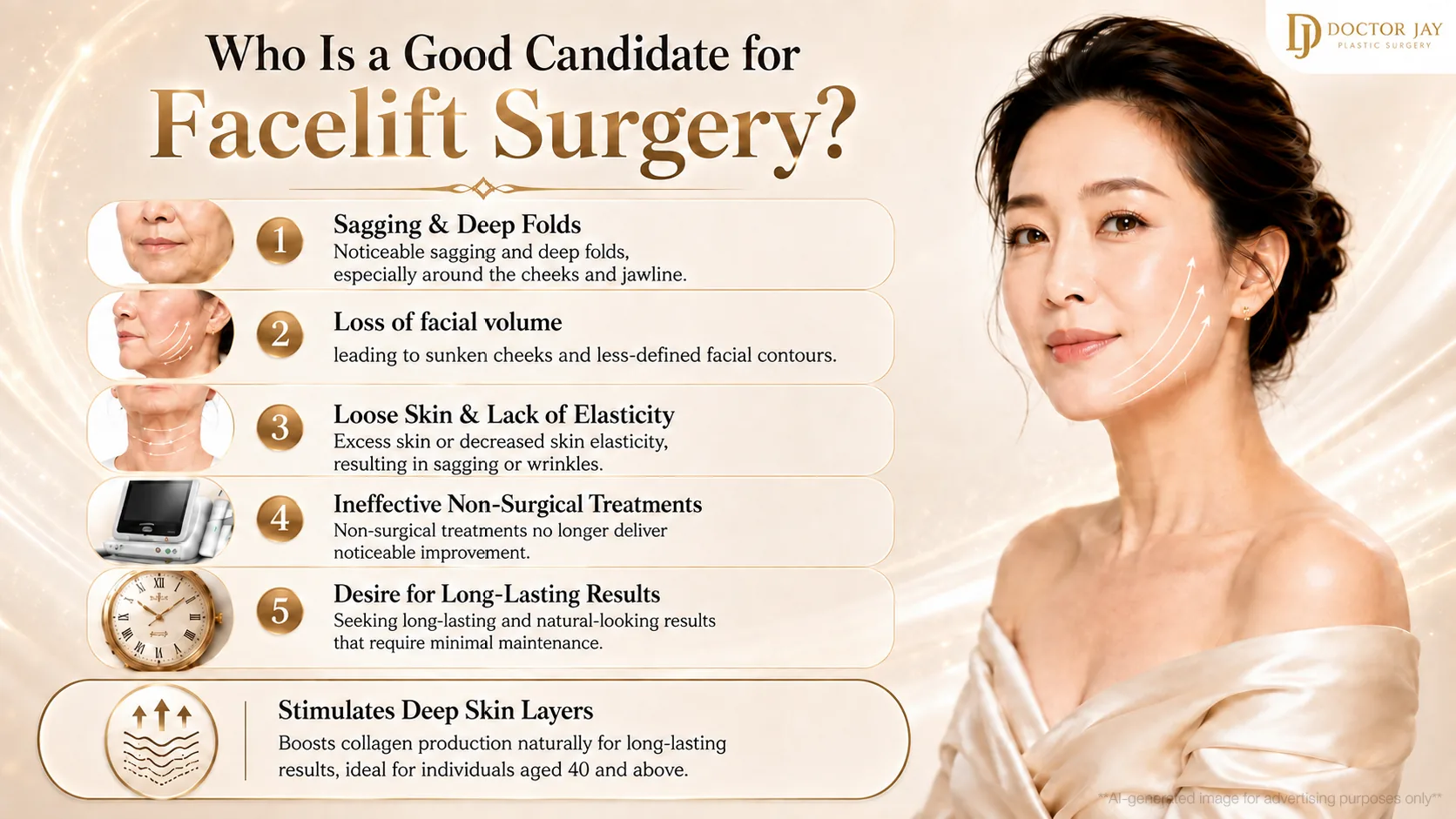
A facelift suits people with deep nasolabial folds, heavy cheeks that hide the jawline, and loose skin under the chin and on the neck, which is commonly seen from the age of 40 onwards.
Whether a facelift suits someone is judged by how far the deep structure of the skin has sagged with age. From the age of 40 onwards the body produces less collagen, so skincare and ordinary lifting devices may no longer reach the structures underneath.
That is why surgery becomes the option that restores firmness while keeping the face natural. The procedure suits people with the following concerns.
- Deep nasolabial folds and mouth grooves, with a visible fold running down the side of the cheek towards the mouth, which leaves the face looking tired.
- Heavy cheeks that hide the jawline, where the lower cheek tissue has dropped below the jaw, so the lower face loses definition or changes shape.
- Loose skin under the chin and on the neck, folding into layers, or neck muscles that have dropped until the sagging is obvious.
- People who have tried other approaches without the result they wanted, having been through alternative procedures or temporary lifting devices that could not reach the deep structure.
- People who want a long term answer, reworking the facial structure so the firmness holds for years rather than returning for repeated procedures.
How facelift surgery differs between women and men
A facelift reworks the facial structure differently in women and men, in the hairline, the blood supply of the skin, and where the incisions are placed.
| Point of comparison | Women | Men |
|---|---|---|
| Hairline and sideburn | Incisions hide easily along the ear and hairline | Beard bearing skin and the sideburn must not be drawn behind the ear |
| Structure of the skin | Thinner skin with fewer small vessels | Thicker skin with a richer blood supply, twice the risk of a haematoma |
A facelift in men has to preserve the natural squareness of the jaw and avoid raising the brow too high, so masculine features are kept. In women the adjustment favours softer curves across the face. Men also need care with shaving through the first 14 days after surgery, so the incisions around the ear are not irritated.
Signs that it may be time for a facelift
The sign that a facelift is worth considering is skin and deep facial muscle that have sagged until the lower face loses its definition. It usually comes with deep nasolabial folds and heavy cheeks hanging over the jawline, obscuring the original shape of the face, at a point where skincare and collagen stimulating treatments can no longer rework the weakened deep structure.
These structural changes usually become pronounced from the age of 40 to 60 and beyond. You can gauge the state of the skin from what shows plainly on the face.
| Sign of ageing on the face | What you can see |
|---|---|
| Deep nasolabial folds and mouth grooves | A fold beside the cheek running down to the corner of the mouth, leaving a tired look |
| Heavy cheeks hiding the jawline | Lower cheek tissue hanging below the border of the jawbone |
| Loose skin on the neck | Skin under the chin and on the neck folding into layers with obvious sagging |
Having a plastic surgeon assess the elasticity of your skin narrows the types of facelift down to the plan that fits the actual concern, and makes the work on the deep muscle structure more precise.
Safety standards and medical requirements for facelift surgery
A facelift is major surgery under general anaesthesia and has to be carried out in a hospital that meets high safety standards. The facility needs emergency resuscitation equipment and a sterile operating theatre accredited to the standard set by the Ministry of Public Health, so infection is prevented.
What matters most is that the surgery is performed by a board certified plastic surgeon accredited by the Medical Council, because the face carries many branches of the nerves that drive muscle movement. Surgery by someone without that experience risks serious complications such as a crooked mouth, an uneven smile, or an eye that will not close fully after injury to the facial nerve.
These are the safety standards worth checking before surgery to lower the risk.
- Check the surgeon on the Medical Council website to confirm they are a board certified plastic surgeon.
- Check the operating licence of the hospital, which must be displayed clearly in the service area.
- Confirm that a specialist anaesthetist manages the general anaesthesia and stays with you throughout the operation.
- Confirm that a full physical examination and blood tests are done at least 7 days before the operating theatre, to assess whether the body is ready.
Preparing for a facelift and caring for the incisions afterwards
How you look after yourself before and after facelift surgery is the main factor in how flat the scars settle and how long the skin takes to recover. A facelift reworks the deep structure of the skin, so preparing the body and following the surgeon’s instructions makes a real difference to swelling.
Caring for the incisions properly shortens recovery to roughly 7 to 10 days and lowers the risk of a raised scar around the ear.
What to tell your surgeon and how to prepare for surgery
Preparing for a facelift starts with getting the body ready and being straightforward with your surgeon about your health. What matters here is any history of drug allergy, underlying conditions such as high blood pressure or heart disease, and any blood thinners, supplements or vitamins taken regularly. Follow the preparation steps below for safety and to lower the chance of complications.
- Stop aspirin, ibuprofen and any supplement that affects blood clotting for at least 14 days.
- Stop smoking and drinking alcohol for at least 2 weeks, so the incisions do not heal slowly.
- Take nothing to eat or drink for at least 8 hours before surgery under general anaesthesia.
Hiding the incisions in front of and behind the ear, and care through the first week
The incisions are placed along the front border of the ear and curved around into the crease behind it, so the scars blend with the surrounding skin. The surgeon closes them with very fine sutures and redrapes the skin under low tension so the edges do not separate.
Careful wound care through the first 7 days after surgery is what keeps the scars flat and helps them heal well.
- Apply cold compresses to the cheeks and around the ears through the first 3 days to reduce swelling.
- Sleep on at least 2 pillows so the head stays above the chest, which stops fluid collecting.
- Clean the incisions around the ear with saline and apply the antiseptic your surgeon prescribes twice a day.
- Avoid food that needs hard chewing, so the facial muscles move less during the first week after surgery.
Why people choose a deep plane facelift at Doctor Jay Plastic Surgery

A deep plane facelift at Doctor Jay Plastic Surgery is planned around each individual, redefining the jawline and lifting the SMAS muscle layer along the direction in which that face has sagged.
A facelift reworks the structure of the skin from within, so the lift holds for years. These are the points people come to us for.
- Careful closure along the front border of the ear and around into the crease behind it, so the scars improve steadily.
- Tension sets on the deep muscle layer rather than on the surface skin, which keeps the face from looking tight and protects the facial nerves.
- Surgery in a sterile theatre that meets Ministry of Public Health criteria, with a nursing team watching over you closely for 24 hours afterwards.
Frequently asked questions about facelift surgery
How many years does the result of a facelift last
A facelift keeps the skin firm for roughly 10 to 15 years. Because the surgery reaches down to the SMAS muscle layer and the structures that support the skin, the result holds longer than temporary lifting methods, and the face looks fresh and natural.
How long it holds depends on your habits and on the environment. Staying out of strong sun and applying sunscreen at SPF 50+ every morning protects the collagen in the dermis.
Smoking and letting your weight swing by more than 5 kilograms both cost the skin its elasticity and bring the sagging back sooner than it should.
How long is the recovery after facelift surgery
A facelift means roughly 1 to 2 nights in hospital, and you can be back at work within 7 to 10 days. The surgery repositions deep tissue, and the body needs time to heal through these stages.
- The first 3 days, the face swells and the skin feels tight, which continuous cold compresses ease.
- At 7 to 10 days, the surgeon removes the sutures and checks the incisions, while the bruising turns yellow and starts to fade.
- From 14 days onwards, the incisions are dry, so light make up can cover the bruising that remains.
The deeper structure heals fully and the face settles into a natural look within 3 to 6 months. Avoiding strenuous exercise and saunas through the first 4 weeks matters, because raised circulation can leave the incisions swollen and inflamed again.
Will a facelift leave the face looking too tight or stiff
A facelift performed with the right technique does not leave the face looking tight or stiff, because the surgeon works on the deep muscle layer that supports the skin rather than pulling on the surface alone. That puts the fat and the facial muscles back where they sat at a younger age, so the outer skin is closed without excess tension and smiling and expression stay easy.
Through the first 1 to 3 months after surgery the face may swell and feel tight, which is a normal part of healing. The tightness eases gradually and the facial muscles soften until everything settles fully past the 6 month mark. Warm compresses and gentle massage as your surgeon advises help the nerves recover and relax the muscles around the mouth sooner.
In summary
Of the types of facelift, the deep plane technique lifts the muscle structure of the face from within rather than pulling on the outer skin. It corrects deep nasolabial folds, loose skin and sagging under the chin effectively, and the result holds for roughly 10 to 15 years, depending on how each person cares for themselves.
Anyone wanting to lift and reshape their face should see a board certified plastic surgeon for a detailed assessment of the skin structure before surgery. Preparing in advance by stopping medication and supplements for at least 14 days adds to safety and shortens recovery to roughly 7 to 10 days.
References
- Baker DC, Stefani WA, Chiu ES. Reducing the incidence of hematoma requiring surgical evacuation following male rhytidectomy. Plastic and Reconstructive Surgery, 2005, volume 116, issue 7 (the rate of haematoma after facelift surgery in men)
- Shuster S, Black MM, McVitie E. The influence of age and sex on skin thickness, skin collagen and density. British Journal of Dermatology, 1975, volume 93, issue 6, pages 639 to 643 (differences in skin thickness between the sexes)

Key points
- What a facelift costs depends on the technique used, the area being corrected and the standard of each hospital, so there is no single figure that applies to everyone.
- A facelift can be done on one area only, such as the forehead, the upper face, or the lower face and neck, so the correction matches the concern. That is a different scope of work from lifting the whole face, so have a surgeon assess which one suits you first.
- What shapes the result is each person’s general health, how well they prepare for surgery, and how strictly they look after themselves afterwards.
- Choose a hospital that meets the standard, holds the correct accreditation, and sterilises its instruments before every use.
People ask what facial surgery costs, or how much a deep plane facelift costs, and why the figure differs from one hospital to the next. Once sagging skin, drooping brows or heavy cheeks start to show with age, many begin looking for a way to correct it and planning a budget for it.
In this article Dr Anuchit Adirojananon (Doctor Jay), medical licence number 45390, sets out what makes the cost different from one person to the next, covering correction of the upper, middle and lower face, and comparing the SMAS technique with endoscopic surgery. It shows what to look at before seeing a surgeon for an individual assessment of your facial structure and the actual cost for you.
What a facelift costs, broken down by the area treated

People often ask how much is a deep plane facelift, or what facelift surgery costs in general, and the answer comes down mainly to the area that has to be corrected. Dividing the correction into separate areas lets you have surgery that matches the concern without paying for work you do not need. The cost of correcting one area is a separate item from lifting the whole face, because the scope of work in theatre is different, so the two cannot be compared directly. The surgeon assesses the sagging area by area, so the incision along the front of the ear or the hairline is planned precisely.
Where the cost differs between a mid face lift and a lower face lift
A mid face lift and a lower face lift are costed separately by the area being corrected, because each one takes a different amount of time in theatre and a different amount of work. You can have one area only, so you are not paying beyond what your skin actually needs. Treating one area corrects only that area and does not cover the whole face, and having several areas done together is not the same as adding up the cost of each one, because how difficult the skin is differs from person to person.
| Area of surgery | What it corrects | What makes the cost differ |
|---|---|---|
| Mid face | Heavy cheeks and deep nasolabial folds | How wide an area is released and how much fat has to be repositioned |
| Lower face | Mouth grooves and cheeks hanging over the jawline | How deep the folds are and how much excess skin sits along the jaw |
A mid face lift concentrates on deep nasolabial folds and cheek tissue that has dropped downward, while a lower face lift smooths the jawline where the skin has sagged into a pouch. Both take around 3 to 4 hours, with the incision placed along the hairline in front of the ear so the scar is hidden along the border of the ear and looks natural.
How a neck lift is costed when it is done together with a facelift
A neck lift done together with a facelift adds to the cost of the facelift alone, but works out cheaper than having them separately, because combining them avoids paying twice for the anaesthetist and the operating theatre. To know what the two together come to for you, the surgeon has to assess the actual extent of the work first.
This corrects loose skin under the chin and on the neck so it sits smoothly against the lower face. After surgery most people take around 7 to 10 days for the swelling to settle before coming back to have the sutures removed.
Why the cost differs between facelift techniques
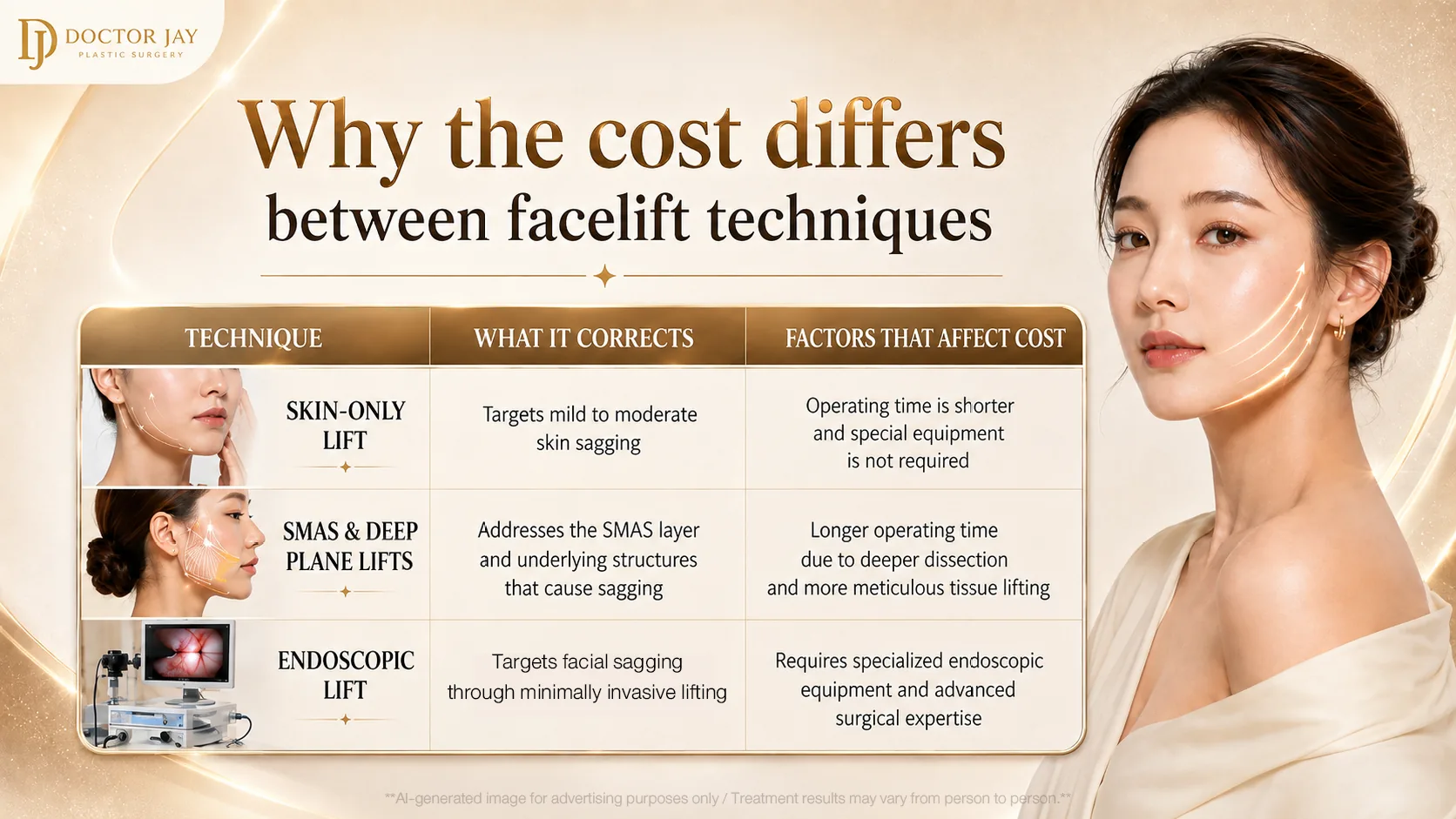
The cost of each type of facelift differs with the complexity of the technique, the specialised equipment and the time in theatre. The traditional technique that lifts the surface skin takes less time and less equipment than lifting the deep structure. Choosing the method that matches your facial structure keeps the budget realistic and makes it easier to judge how many days off work you need. The table below shows what makes the cost of each technique different.
| Surgical technique | Depth corrected | What makes the cost differ |
|---|---|---|
| Skin only facelift | The superficial layer above the muscle | Takes little time in theatre and needs no specialised equipment |
| Deep muscle layer facelift | The SMAS layer and the structure beneath the muscle | Takes longer because the muscle layer has to be released and sutured |
| Endoscopic facelift | The deep layer beneath the periosteum | Needs a camera set and specialised instruments in addition to the standard surgical set |
How far the skin has sagged and how much fibrous tissue sits beneath it decide how long surgery takes, which affects the anaesthetic cost directly. Techniques that rework the deep structure are usually done in a high standard theatre with ventilation equipment and an anaesthetist present throughout the operation and the recovery period in hospital.
Why a deep plane facelift and a SMAS facelift differ in cost
When people ask how much is a deep plane facelift compared with a SMAS facelift, the difference comes down to how complex the work in theatre is. The deep plane technique has to release the fibrous attachments and move the whole muscle layer, which takes longer, in return for a result that lasts longer and does not leave the face looking tight or unnatural. The table below shows the difference between the two techniques.
| Surgical technique | What it anchors and how | What makes the cost differ | How long the result lasts |
|---|---|---|---|
| SMAS facelift | Lifts and sutures the muscle layer | Releases and sutures the muscle layer along the direction of the sagging | 5 to 10 years |
| Deep plane facelift | Releases the fibrous attachments and repositions the muscle layer | Releases the whole fibrous layer and takes longer in theatre | 10 to 15 years |
A deep plane facelift takes tension off the surface skin, which lowers the chance of a keloid scar in front of the ear. Patients need an average of only 7 to 10 days for the swelling and bruising to settle.
For people aged 50 and over with heavy cheeks and deep mouth grooves, the deep plane technique is the option that holds up over time, because the result usually lasts around 10 to 15 years, depending on the skin and on how each person cares for themselves.
How a Face Lock facelift differs from a standard facelift
A Face Lock facelift costs more than standard facelift surgery, because it is a specific technique that anchors the skin at set points to keep the incision small and hide it along the hairline, which takes more care and more time than the traditional long incision around the ear.
| Type of surgery | Incision and suture line | What makes the cost differ | Recovery time |
|---|---|---|---|
| Standard facelift | A long line around the ear to the nape | Uses the standard surgical set and the usual incision | 14 days |
| Face Lock facelift | Small incisions in the hairline or in front of the ear | Anchored at set points, which takes greater precision | 5 days |
A Face Lock suits patients aged 35 to 45 with sagging in specific areas who are looking to lift the face, or who want a short recovery with less swelling afterwards, so they are back at work sooner and can wash their hair once the surgeon allows it.
Why an endoscopic facelift costs more than other techniques, and who it suits
An endoscopic facelift costs more than the usual techniques, because it needs an endoscope and high precision instruments to rework the deep structure through small incisions, along with specialised supplies used to avoid the major nerves of the face.
It suits people with mild to moderate sagging aged 30 to 45 who want to lift the forehead, the outer eye corners or the upper cheeks. The incisions are small, around 1 to 2 centimetres, hidden in the hairline, so recovery is short and patients are back to daily life within 7 days.
What the cost of facelift surgery depends on

There is no fixed figure when people ask how much a deep plane facelift, because it varies with how difficult each person’s skin is and how much work has to be done. Each hospital costs the surgery from the degree of sagging and from the specialised equipment used to reduce swelling and bruising. Having your facial structure assessed in person is the only way to know your own cost clearly.
Operating theatre and anaesthetist standards set by the Ministry of Public Health
Surgery that is carried out safely shows in the use of a properly registered operating theatre with controlled air pressure to keep contaminants out. Hospitals that meet Ministry of Public Health criteria have set requirements for the structure of the theatre and for resuscitation equipment ready for immediate use.
A standard operating theatre has clear requirements for cleanliness and for the staff present.
- An anaesthetist manages the general anaesthesia and stays with the patient on a one to one basis throughout.
- HEPA filtration captures dust and micro organisms in the air.
- Ventilators and resuscitation equipment are checked on a set schedule, every 30 days.
Holding these conditions raises the cost of care, which feeds directly into the fee. Surgery in a properly licensed hospital keeps the standard of cleanliness under control and lowers the risk of infection afterwards.
What to ask about in full before you decide, so nothing comes as a surprise
Check what is included and what is not before you decide, because a facelift promotion priced well below the market usually carries costs the patient has to pay later. Asking about the extra items clearly from the start lets you compare hospitals on the same basis. These are the ways to check how transparent the offer is.
- Ask whether the blood tests and the electrocardiogram before surgery are included in the package, because these two are usually separate from the figure quoted at the start.
- Ask about the medical facial compression garment and the medication for looking after yourself at home through the 14 days of recovery.
- Check whether the anaesthetic team and the removal of sutures are included in what you pay, so there is nothing extra to settle at the first wound check 7 days after surgery.
Why people choose SMAS facelift surgery at Doctor Jay Plastic Surgery
A SMAS facelift at Doctor Jay Plastic Surgery corrects the sagging deep structure of the skin methodically. We concentrate on precise suturing in the muscle layer for a result that lasts 5 to 10 years. Assessing the structure of the face in detail before surgery lets the surgeon plan the treatment around each person’s skin and budget.
Planned around each individual by a specialist surgeon
Studying the structure of each face lets us suture the SMAS layer precisely along the direction in which that face has sagged, which differs from person to person. The surgeon assesses the thickness of the fat layer together with the elasticity of the skin before planning surgery. Planning it this way avoids a face that looks tight and unnatural afterwards.
Sagging across the cheeks, the corners of the mouth or under the chin is lifted at an angle that follows each patient’s nerves and bone structure. The incisions are hidden carefully along the hairline and the border of the ear, and we use very fine sutures to keep the scars from raising during the first 6 months of follow up.
Every cost set out in full before you decide
We set out every cost involved at the assessment, so you can plan ahead without anything unexpected appearing later. The pre operative examination, the anaesthetic team, the operating theatre and the wound care afterwards are all stated from the start, along with which items are included and which are separate.
The surgeon explains the follow up appointments after surgery and the details of the wound care at the assessment, together with the scope of care that fits each case. That is what answers the question of what a facelift costs in a way that matches the work actually involved.
Frequently asked questions about the cost of a facelift
Does the cost differ with age and with how far the skin has sagged
What facelift surgery costs, including how much is a deep plane facelift, does differ with age and with how far each person’s skin has actually sagged, because the complexity and the number of areas involved are not the same. Younger patients aged 30 to 40 with slight cheek sagging usually have surgery on one area only to correct a specific concern, which takes around 2 hours.
Patients aged 50 to 60 and over, whose sagging reaches the muscle layer and who have a large amount of excess skin, need a full facelift together with a neck lift for a firm, smooth and natural result. That calls for care and precision and takes 4 to 5 hours in theatre, so the cost varies with the hours involved and the specialised equipment each person needs.
How many years does one facelift last, and is it worth what you pay
One facelift keeps the face looking firm for roughly 5 to 10 years, and the result changes gradually as the body ages naturally. Lifting down to the SMAS muscle layer supports the facial structure more strongly than a thread lift or an ordinary device, and the result becomes clearer once the incisions have healed.
Set against how long it holds, facelift surgery corrects the problem at the deep structure, which is why the result lasts longer than ordinary treatments. Planning the treatment properly with a surgeon is what addresses sagging effectively over the long term.
Besides the surgery itself, what should you have ready for the recovery period
Besides the cost of surgery, there are things to have ready at home for the recovery period. Most of them are wound care supplies and everyday medication that help the body recover. Here is what to prepare.
- A wound care kit, including sterile saline, small cotton buds and a concentrated silicone gel for scars.
- A tall U shaped neck pillow and a wedge pillow to keep the head raised and reduce swelling through the first 7 days.
- Liquid or soft food that is easy to chew, so the jaw joint moves less during the first week.
- Cold and warm gel packs for the swelling and bruising around the face.
Having these ready in advance takes the worry out of it and means you can care for the incisions correctly, following the nursing advice, from the moment you get home.
In summary
Planning for what a facelift costs, including how much is a deep plane facelift, comes down to choosing the technique that fits how far your skin has sagged and the structure of your face, because the cost varies with the extent of the work, the time in theatre and the equipment needed. Choosing a technique that reaches the deep muscle layer, the SMAS, keeps the firmness for roughly 5 to 10 years.
To know your own cost clearly, come in for a consultation and a detailed assessment of your facial structure with a surgeon at Doctor Jay Plastic Surgery, so the approach is matched to your actual concern.

Key takeaways
- Facelift covers every way of firming the face and reducing sagging, from daily skincare through medical technology to facelift surgery itself.
- Treatments that need no surgery, such as radiofrequency or focused ultrasound, stimulate collagen under the skin and suit mild to moderate laxity.
- Facelift surgery is the option for significant sagging, though it needs a longer recovery than the other options.
- Having your skin assessed by a doctor before you start makes it easier to pick the method that matches your own concern and to get a result you are happy with.
Facelift is what many people look for once they notice heavier cheeks, a double chin and deeper lines around the mouth that make the face look tired and older than it is. When collagen is lost year after year without any care, the structure under the skin keeps weakening until ordinary skincare can no longer bring firmness back. Restoring shape and definition therefore calls for methods that reach the deeper layers and strengthen the structure itself.
This article was prepared by Dr. Anuchit Adirojnanont (Doctor Jay), medical licence number 45390, who has brought together detailed information on the ways sagging skin is treated, covering energy based technology, thread lifting and surgery that lifts the structure of the face. The comparison in the sections below explains how each one works, so you can judge which suits the condition of your own SMAS layer.
What causes a sagging face and why lifting is needed

A facelift becomes necessary once the structure under the skin starts to change with age, particularly after the age of 25, when the body produces around one percent less collagen each year and laxity slowly builds up. The change happens across several layers, from the dermis down to the bone that gradually recedes. The main reasons the face loses its firmness are these.
- Collagen and elastin fibres in the dermis are lost, so the skin becomes thinner.
- The SMAS layer that supports the face weakens and slides downward with gravity.
- Fat pads under the skin shrink and shift, which leaves heavier cheeks and deeper folds.
Treating the face early slows down the changes in its structure. Building new collagen keeps the skin fuller and more elastic, which can postpone the point at which facelift surgery is worth considering by several years.
How to match a facelift method to your own skin concern
Getting a good result from a facelift depends on choosing the method that works at the layer where the problem actually is, because a tired looking face comes from changes at several different depths.
If you are wondering which treatment suits a sagging face, understanding how each layer changes makes the choice far more accurate. The face loses firmness at different depths, from about 1.5 millimetres just under the surface down to the bone that lies deepest of all.
Changes in the dermis, where lost collagen leaves skin without firmness
The dermis changes when collagen and elastin break down, so the skin loses elasticity and fine lines and visible laxity appear. This continues as you get older and is made worse by ultraviolet light in sunlight.
You can notice it when the skin feels dry, pores look wider and the skin no longer springs back at once when you press it with a finger. Collagen in this layer is lost at an average of one percent a year after the age of 25. Retinol based creams and laser treatments that stimulate protein under the skin are what restore density at this level.
Loosening of the SMAS layer, the main reason the face drops
The SMAS, or superficial muscular aponeurotic system, is the fibrous sheet that holds the whole face in place. It is the same layer a surgeon repositions during facelift surgery to correct a dropped face directly. With age this sheet stretches and slides down with gravity, which brings heavier cheeks, deeper folds beside the mouth and a fuller jawline. Lifting the face therefore has to reach this layer at a depth of about 4.5 millimetres.
Sending focused ultrasound energy down to the SMAS makes the tissue contract and draws the structure of the face upward from the first weeks after treatment, with the clearest result at around 3 months, once new collagen and elastin have formed to replace the fibres that had weakened with age.
Loss of fat under the skin, which leaves the face hollow and tired
Loss of the fat pads under the skin is a major reason a face looks tired and older than it is, because the body loses deep fat in the cheeks, temples and under the eyes as the years pass. The skin above then has less to rest on, so it sags and clear folds appear.
This usually becomes noticeable from the age of 30, as the fat in the cheeks gradually shrinks and slips downward, gathering instead along the folds beside the mouth. The result is deeper folds, flatter cheeks and hollow temples, so the face loses the oval shape it had in earlier years.
The way to correct this as part of a facelift plan is to replace the volume that has been lost, either with hyaluronic acid filler treatment placed in the deep fat layer, or with absorbable materials that prompt the body to build its own collagen, so the skin stays firm for longer.
Bone that recedes with age, the deepest cause of all
Bone loss in the face is the deepest cause of lines and sagging, because bone is the foundation that carries the skin and muscle above it. With age the bone thins and recedes, so the tissue above has nothing to anchor to and drifts downward with gravity. The eye sockets widen, the cheekbones flatten and the jaw becomes smaller.
These changes usually become clear after the age of 40, and women lose bone density faster than men because of falling oestrogen levels. Correcting sagging that starts at bone level therefore calls for a firmer filler treatment with strong support, placed in the layer next to the bone to replace the volume that has been lost and hold the face up again.
8 facelift treatments and what each one does

Facelift treatments available today fall into several groups, according to the depth of skin they reach and how they correct sagging at its cause. They range from heat energy that tightens the deeper layers, to injectable treatments that stimulate collagen, to threads that support the tissue. These technologies send energy from the dermis down to the muscle layer at about 4.5 millimetres to restore the structure from within.
Microfocused ultrasound that lifts down to the SMAS layer
Microfocused ultrasound is a facelift technology that sends precise, very small points of heat to the SMAS, the same layer used in facelift surgery. The energy makes existing collagen fibres contract and prompts new collagen to form, so the face gradually lifts and looks smoother over about 3 months after treatment.
The device sends heat accurately beneath the skin, and on systems with a live image the doctor can see the layers while treating. It suits sagging cheeks, a fuller jawline, or brows that need lifting, and the result usually lasts around 1 to 2 years.
Monopolar radiofrequency for firmer skin and a slimmer lower face
Monopolar radiofrequency is a facelift treatment that sends heat down to the dermis and the fat layer below it. The heat tightens collagen fibres that have loosened, and skin over areas where fat collects, such as the cheeks and under the chin, looks firmer as a result. It suits people with fuller cheeks, or anyone who wants a slimmer, more defined face.
The heat spreads evenly over a wide area to prompt new collagen and elastin under the skin. After treatment the skin looks firmer, pores look smaller and fine lines look smoother within 2 to 3 months, with the result usually holding for about 12 months.
HIFU, a facelift with ultrasound energy for early laxity
HIFU is a facelift technology that sends focused ultrasound down to the SMAS layer as tiny points of heat to stimulate collagen. The energy makes tissue under the skin contract, so the jawline looks more defined. It suits people with early, mild laxity, often from their twenties into their thirties.
A session usually takes about 30 to 45 minutes. It needs no surgery and very little recovery, and the ultrasound energy is delivered specifically at depths from 1.5 millimetres down to 4.5 millimetres to treat the skin and lift its deeper structure.
You can notice the first changes in the skin soon after the session, and they continue to develop as new collagen forms over the following 2 to 3 months. The lifting effect usually holds for around 6 months.
Collagen stimulating injectable treatments for firmer, more elastic skin
Collagen stimulating injectable treatments firm the face without any device. Both types work by prompting the body to build new type 1 collagen and elastin, so the deeper structure grows stronger and skin that had loosened gradually becomes firmer and thicker, with a result that looks natural. The two differ in what they are made of and how they work, as follows.
| Property | PLLA based treatment | CaHA based treatment |
|---|---|---|
| Main ingredient | Poly-L-Lactic Acid, a synthetic material | Calcium Hydroxylapatite |
| How it works | Builds collagen gradually to add density to the skin | Adds volume from the start while it stimulates collagen and elastin |
| How long the result holds | About 2 years | About 1 to 2 years |
When choosing between them the doctor looks mainly at your skin quality and the degree of sagging. The material breaks down naturally over time and leaves nothing behind under the skin. The face usually begins to feel more elastic and look firmer about 4 to 6 weeks after treatment.
Botulinum toxin treatment to soften lines and define the jawline
Botulinum toxin treatment lifts the face and softens lines by relaxing the muscles that pull the skin downward and reducing lines caused by movement. Used along the jawline it relaxes the neck muscle that drags the cheeks down, so the muscles that lift can work more effectively. The skin along the jaw then looks firmer and the outline of the face becomes clearer.
The treatment itself takes only 10 to 15 minutes, and the doctor places small amounts into the superficial layer along the jawline and under the chin to refine the shape of the face. Lines start to soften within 7 to 14 days, while the change in the jawline becomes clearer over 2 to 4 weeks.
The effect usually lasts about 4 to 6 months, depending on the product chosen and on how quickly your body breaks it down. The material clears naturally over time and leaves no residue under the skin.
Hyaluronic acid filler treatment to replace volume where the face has hollowed
Hyaluronic acid filler treatment lifts the face by replacing volume in the bone and fat layers that have receded with age. The doctor places it deeply at the support points of the face to draw sagging structure back up. It suits people with deep folds beside the mouth, flat cheeks, or hollowing around the eyes that makes the face look tired.
This material draws water molecules around it, so the skin becomes denser and smoother. Products that are properly registered hold their lifting effect for about 12 to 18 months, and the material is then broken down by the body’s own processes. Published follow up studies find the effect well maintained at six months and to a lesser degree at twelve.
Thread lifting to support tissue with an immediate change
Thread lifting uses absorbable threads with small barbs, passed under the skin to catch sagging tissue and draw it upward as soon as the session ends. It corrects dropped cheeks without major surgery, and the body forms new collagen and elastin along the line of each thread, which supports the tissue for longer.
The threads dissolve naturally over time, so the lift lasts roughly 6 to 8 months. The materials most widely used are PDO and PLLA threads.
Facelift surgery for a result that lasts years
Facelift surgery is the choice for people whose skin has sagged well beyond what treatments without surgery can correct, and it gives a result that lasts far longer. The surgeon releases the skin and secures the deep muscle layer known as the SMAS back to the position it held before it stretched. Incisions are placed in front of the ear and continue behind it so the scar line is hidden. How long the result holds depends on your skin condition, your age, your lifestyle and the care you take afterwards, which your surgeon goes through with you before the operation.
Recovery after surgery runs in stages, from the first days when swelling is at its greatest, through the following weeks as it settles, and your surgeon sets when you can return to work and to exercise. A facial support garment is worn around the clock during the first week to hold the structure in place and reduce fluid gathering under the skin. Keeping the incisions clean with saline and applying the prescribed ointment keeps the suture line along the hairline clean.
Do facial exercises and natural methods actually lift the face?
Facial exercises and natural methods can genuinely slow down changes in the upper layers of the skin, but they cannot correct sagging in the deeper structure the way a medical treatment can.
These self care habits improve fluid circulation under the skin and add elasticity to the outer layers, yet the real cause of sagging lies in shrinking fat pads and a weakening SMAS layer about 4.5 millimetres down. Natural methods can therefore only maintain what you have and delay new lines, which is still worth doing over the long term.
| Type of care | Natural methods and self care | Medical treatment |
|---|---|---|
| Depth reached under the skin | Epidermis and the upper dermis | Fat layer and the SMAS at 4.5 millimetres |
| Time before a result appears | 8 to 12 weeks of consistent practice | 1 to 30 days depending on the treatment |
Facial yoga and massage to improve circulation
Facial yoga and pressure point massage improve blood flow and work the facial muscles, so the skin does look firmer. Moving specific muscles regularly brings more oxygen to the skin cells, which leaves the face brighter and noticeably less puffy around the cheeks.
These exercises are worth doing for at least 10 to 15 minutes a day to see a clear result. Massaging from the middle of the face outward and then upward toward the hairline supports the outer structure against gravity. Use cold pressed coconut oil or a serum at the same time to reduce friction, which is what causes lines around the eyes and beside the mouth.
Gua sha, the traditional Chinese approach to lifting the face
Gua sha reduces puffiness and lifts the face by using a stone tool to stimulate lymphatic flow under the skin, following traditional Chinese practice. It helps drain what has gathered in the face, so the jawline looks more defined for a while. Choose a natural stone such as jade or rose quartz, chilled beforehand to cool the skin more effectively.
Keep the pressure moderate to avoid bruising under the skin. Always draw the stone from the middle of the face outward toward the temples and behind the ears. Applying 3 to 5 drops of facial oil before you start reduces friction and protects the skin around the eyes from new lines.
Firming creams to add moisture and soften lines
Moisturising creams add elasticity and hold water in the outer layers, so shallow lines look softer and the skin looks plumper after use. Products in this group focus on hydration and on drawing water into the skin cells to limit water loss through the day. Look for humectants such as hyaluronic acid, which pulls water in and holds it in the skin.
For skin care that pays off over the years, a cream should also contain ingredients that stimulate collagen and encourage cell turnover. Retinol at 0.1 to 0.5 percent, or short chain peptides, help refine the outer structure of the skin, and this repair happens overnight while the skin renews itself naturally.
Everyday habits, water and rest that slow sagging down
Drinking 2 to 3 litres of water a day and sleeping 7 to 8 hours are the basics of firming the face from the inside. They slow collagen loss and help any lifting treatment hold its result. Dehydrated skin cells shrink, which makes the face sag and line more easily, while drinking water steadily keeps the dermis hydrated so the skin stays plump and elastic.
The key window for skin repair is the first deep sleep cycle after you fall asleep, when the body releases growth hormone to repair worn skin cells. Reaching that deep sleep improves circulation in the face, reduces inflammation and helps prevent the skin from losing firmness earlier than it should. Adjusting your sleep and drinking enough water is therefore the foundation that makes any facelift treatment hold longer.
Which facelift is right for you, treatment without surgery compared with facelift surgery
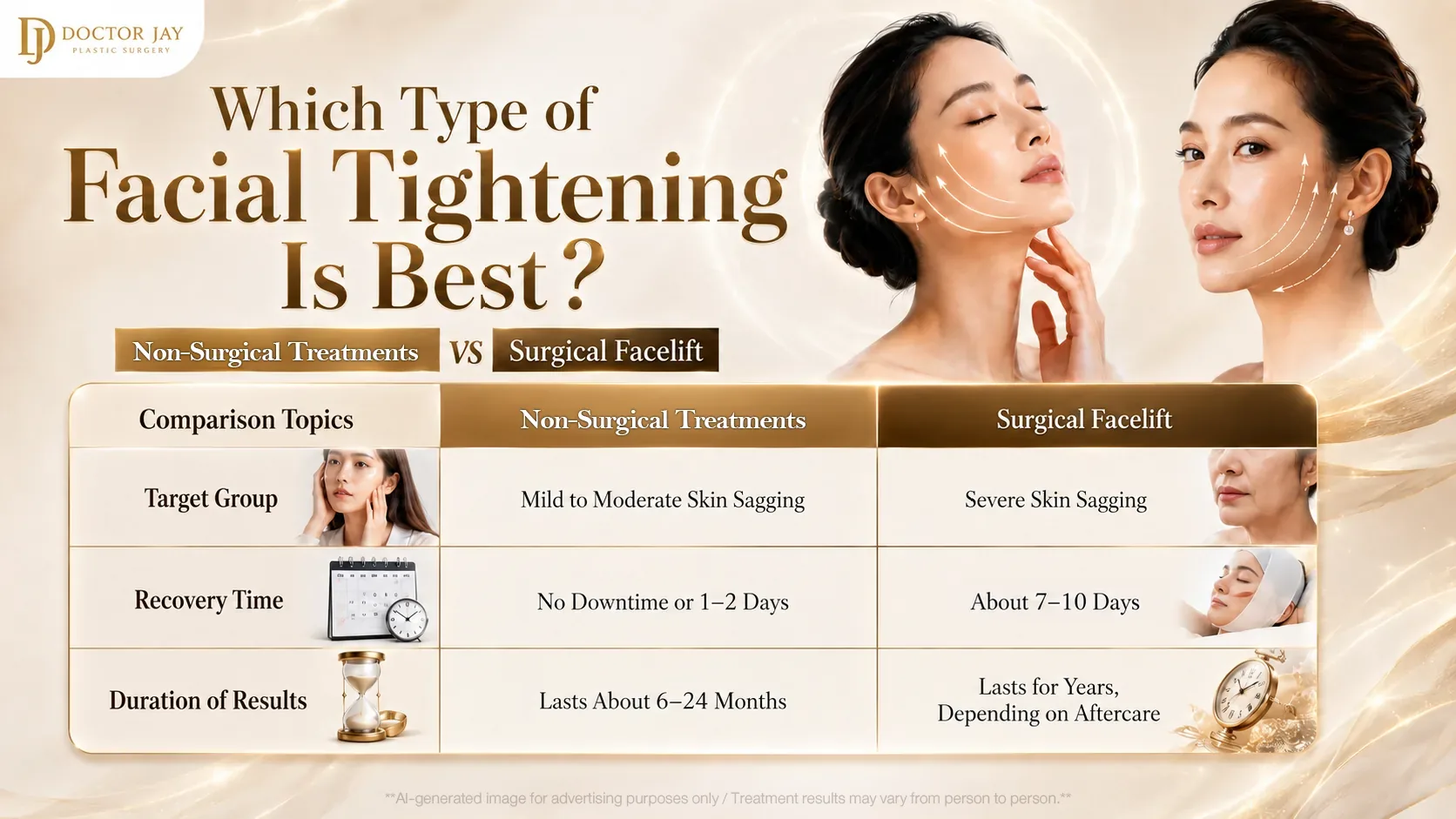
Choosing how to lift and reshape the face depends mainly on how far the skin has sagged and on how much recovery time you can accept. Treatments without surgery stimulate collagen under the skin directly, while surgery removes excess skin and repositions the deep muscle layer for a result that lasts far longer.
| Point of comparison | Treatment without surgery | Facelift surgery |
|---|---|---|
| Who it suits | Mild to moderate sagging | Significant sagging |
| Recovery | None, or 1 to 2 days | Staged, set by your surgeon |
| How long the result holds | About 6 to 24 months | Set by skin condition and aftercare |
People aged 30 to 45 usually respond well to heat energy that stimulates the deeper layers, while those aged 50 and above with heavy upper lids and deep folds beside the mouth get a result that matches the cause more closely from surgery on the SMAS layer, which draws the descended cheek tissue back and outward.
Which treatment suits a sagging face, judged by how far it has gone and by your age
Choosing an approach to lifting the face means looking at how far the skin has sagged and at the structure of each layer at your stage of life, so the result matches the concern and the spending makes sense over time.
- Age 25 to 35 with shallow lines and slightly flat cheeks. Lifting and reshaping the face alongside 1 to 2 cc of hyaluronic acid filler treatment supports skin that is starting to descend.
- Age 35 to 50 with heavier cheeks and deeper folds. Focused ultrasound once a year draws up the deeper layers with no recovery time.
- Age 50 and above with lost collagen and receding bone. Absorbable threads together with monopolar radiofrequency support loosened tissue around the mouth for roughly 6 to 8 months.
Lifting the neck and cheeks for a defined jawline
Lifting the neck and cheeks to define the jawline works well when the jaw margin and the area under the chin are treated together for a balanced result. Focused ultrasound and muscle relaxing treatment can be combined to reduce the downward pull along the neck. The main approaches are these.
- Radiofrequency treatment along the jaw margin and under the chin, to reduce excess fat and tighten the skin around the neck.
- Botulinum toxin treatment in the platysma muscle, to reduce the downward pull on the face so the cheeks are supported upward sooner.
For the first 48 hours after treatment, sleeping with your head raised reduces swelling and helps the neck settle more quickly.
What to know before a facelift, safety standards and the law on medical facilities
Checking on safety before you decide starts with the facility and the person who will treat you. A medical facility that meets the standard must display its 11 digit operating licence in plain view at the entrance. The points worth confirming before any treatment are these.
- The doctor must appear in the Thai Medical Council register with an active status, and the photograph must match the person who performs your surgery or treatment.
- Facelift surgery must take place in a sterile operating room under positive pressure, to prevent infection entering the bloodstream.
- The facility must have an automated external defibrillator, or AED, and backup oxygen ready at all times in case of an emergency during treatment.
Frequently asked questions about facelift treatment
Do the different energy based lifting treatments hurt to the same degree?
How much you feel depends on the type of energy and how deep it travels, and the sensation varies with the size of the focal point delivered under the skin to stimulate elastin. Applying a strong numbing cream 45 to 60 minutes beforehand takes the edge off the sharper sensation along the jaw.
| Type of treatment | Type of energy | How it feels during treatment |
|---|---|---|
| Microfocused ultrasound | Ultrasound in larger focal points | A deep, sharp sensation over the cheekbone |
| Monopolar radiofrequency | Radiofrequency heat over a wider area | Deep warmth alternating with cooling |
| HIFU | Ultrasound in small focal points | A warm, tight feeling like a light pinprick |
Treatments that place larger focal points down at the SMAS layer are generally felt the most, radiofrequency comes next, and small point ultrasound is the mildest of the three. Strong cool air blown over the skin, along with an ice pack, keeps heat from building up in the deeper layers.
Can several facelift treatments be combined?
Yes, and combining them often gives a better result, because each one corrects a different layer. Combining technologies covers every dimension of the change, for example focused ultrasound down at the SMAS alongside filler treatment to replace volume lost at bone level. Treating this way also means fewer separate visits and a result that looks more natural overall.
The order of treatment matters, to keep the skin from becoming too inflamed. Doctors usually advise having the treatments that use high heat at least 2 weeks before any injectable treatment, so the heat does not break down material that has only just been placed.
Do men and women need different facelift treatment?
The skin of men and women is built differently, so the energy levels and technique have to be adjusted. Male skin is roughly 25 percent thicker with denser collagen, and beard growth affects how heat energy passes into the skin.
| Skin factor | Men | Women |
|---|---|---|
| Thickness of the skin | Thicker skin with wider pores | Thinner skin that loses collagen more readily |
| How fat tends to gather | Often gathers in the lower cheeks and under the chin | Fat shrinks, leaving the face hollow and tired |
| Energy level used | Higher energy to reach the SMAS layer | Moderate energy focused on stimulating collagen |
Men usually want a defined jawline and a sharp mandibular border, so doctors tend to use handpieces that send heat deeper to reduce excess fat while lifting the skin. Women more often want softness and the replacement of volume that has been lost. Planning a facelift therefore has to follow the physical structure of each person.
In summary
Facelift covers a wide range of methods, chosen according to how far each person’s skin has sagged, from natural approaches such as gua sha that stimulate lymphatic flow, through medical technology such as focused ultrasound down at the SMAS layer, to facelift surgery for a result that lasts years. A careful assessment with a doctor who works in this field is what lets you choose the method that fits the condition of your own skin.
If you are looking for a way to make your skin look firmer and want to lift and reshape your face with confidence, start by seeing a doctor for an assessment of your skin and facial bone structure. Choose a medical facility that meets the standard and holds a valid operating licence.

Key points
- An endoscopic facelift is surgery carried out through a small camera, correcting loose skin on the face and neck at the point where the problem starts.
- The technique cuts the size of the incision considerably and hides it in the hairline, so the scar is hard to spot and recovery is shorter.
- The camera lets the surgeon see the vessels and nerves, so the surgery runs smoothly and is more accurate because more detail is visible, with less swelling afterwards.
- See a surgeon to assess your skin and facial structure beforehand, so the plan is built around the face you have.
An endoscopic facelift corrects loose skin, deep nasolabial folds and sagging under the chin, without the long scar that comes with traditional facelift surgery, which leaves a large incision and months of recovery. This newer approach uses a small camera and brings the incision down to roughly 1 to 2 centimetres.
In this article Dr Anuchit Adirojananon (Doctor Jay), medical licence number 45390, covers how an endoscopic facelift works, the difference between lifting the upper and the lower face, and the use of a medical fixation device such as Endotine to hold the tissue in place. It sets out the facts on safety, recovery time and how to prepare for surgery, for anyone looking into ways to lift and reshape the face.
What is an endoscopic facelift

An endoscopic facelift reworks sagging facial structure through small openings instead of the long incision used before. A high resolution camera is passed beneath the skin and sends live images of the structures underneath to a screen, so the surgeon can separate the muscle layers precisely while the incisions stay hidden in the hairline.
The technique improves sagging across the upper and middle face, such as the forehead, drooping brows and deep nasolabial folds. It avoids removing large amounts of excess skin, so facial expression stays natural afterwards, and the incisions are only about 1 to 2 centimetres.
How the endoscope works
The endoscope sends a magnified live image of the structures beneath the skin to a monitor, so the surgeon can see the vessels, the nerves and the deep muscle layers in detail through a small opening. This makes reworking the facial structure accurate without opening a wide incision. The camera system works through these steps to reposition the structure of the skin.
- Passing a small camera tube 4 millimetres in diameter beneath the skin through an opening of 1 to 2 centimetres in the hairline.
- Sending the image to the monitor in Full HD to guide the specialised surgical instruments.
- Separating the muscle layer and the deep structural tissue from the bone carefully, so the nerves that drive facial movement are avoided.
Working through the camera reduces tearing of the vessels and the surrounding tissue, so the body recovers sooner and the swelling that covers the face clears in roughly 7 to 10 days.
How the endoscopic deep plane technique works and what it corrects
The endoscopic deep plane technique lifts the structure of the skin through the SMAS layer, the fibrous and muscular layer that sits beneath the fat of the face. Across the upper and middle face the endoscopic approach dissects down to the subperiosteal level, so the whole layer is raised together. It releases and divides the ligaments that anchor the facial structure, so the entire deep layer can be repositioned vertically.
The high resolution camera guides careful dissection in places the eye cannot reach, so the surgeon can move sagging fat and muscle back to where they sat at a younger age. Anchoring the deep layer takes tension off the surface skin, and the incisions knit together in roughly 7 to 10 days before settling completely.
Can loose skin, deep nasolabial folds and a sagging neck be corrected
An endoscopic facelift corrects ageing in several areas of the face, particularly where the fat pads and the deep structure have dropped. These are the main concerns that can be assessed and planned for.
- Drooping outer eye corners and brows that shadow the eyes and leave the face looking tired.
- Heavy cheeks and deep nasolabial folds caused by the cheek fat pads shifting downward.
- Sagging under the chin and a jawline that loses its definition as the deep structure drops with gravity.
The surgery releases the fibrous attachments, then moves the structures that have dropped back to where they belong. Anchoring them vertically leaves the skin smooth without relying on large amounts of filler treatment, reduces the swelling that builds up, and has the skin under the chin settling noticeably within 7 to 10 days.
Endotine fixation devices and the legal standards that apply to the materials used
Endotine is a medical device used to anchor the structures beneath the skin during an endoscopic facelift, spreading the tension evenly so the tissue does not drop again.
We use this fixation device to hold the muscle and fat layers securely in their new position. It is made from a semi synthetic material with the same structure as absorbable sutures, and it dissolves naturally without leaving anything behind beneath the skin.
- It is a tissue fixation device used in the operating theatre, and the surgeon selects the size that suits the structure of each face.
- The device has small contact points that spread the tension across the skin, so no single point is pulled and the surrounding tissue is spared.
- It stimulates natural collagen production around where it is placed, so the tissue holds its position after the device has fully dissolved.
How an endo face lift differs from an endo brow lift
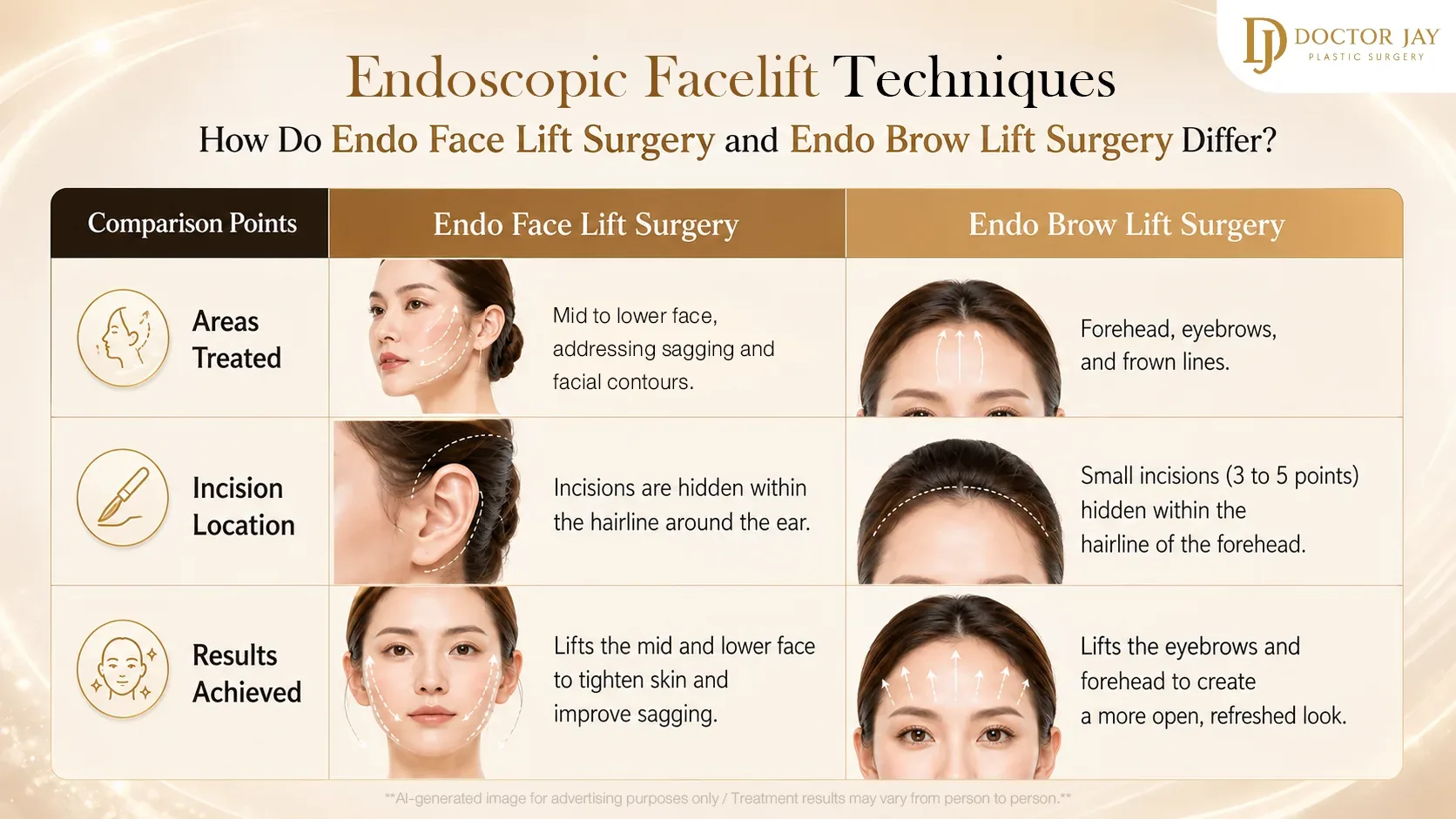
An endo face lift and an endo brow lift differ clearly in the part of the face they address and where the incisions are placed.
| Point of comparison | Endo face lift | Endo brow lift |
|---|---|---|
| Area addressed | Lower cheeks, nasolabial folds and the jawline | Forehead, drooping brows and lines around the eyes |
| Incision placement | Hidden in the hairline above the ear | Hidden in 3 to 5 small openings in the hairline of the forehead |
| What it achieves | A firmer looking middle and lower face | Lifts the brows and opens up the forehead |
An endo face lift lifts sagging cheeks so they look fuller and firmer, while an endo brow lift addresses drooping brows that leave the face looking downcast or tired. The incisions are usually about 1 to 2 centimetres and hidden in the hairline, so they are hard to notice once surgery is over.
A traditional facelift compared with an endoscopic facelift
Which way you lift and reshape the face depends on what you want and on the state of your skin. Traditional facelift surgery and an endoscopic facelift work in entirely different ways. The table below sets out the basic differences to help you decide.
| Point of comparison | Traditional facelift | Endoscopic facelift |
|---|---|---|
| Surgical technique | A long incision along the ear with excess skin removed | Small openings with a camera guiding the lift of the muscle layer |
| How the skin is handled | Suits people with considerable excess skin and heavy sagging | Lifts the internal structure without removing much skin |
| Specialised equipment | Standard surgical instruments and sutures to anchor the skin | A magnifying camera together with Endotine fixation devices |
Understanding how the two differ lets you plan the treatment with your surgeon around your own concern.
How the scars and the recovery time differ
An endoscopic facelift leaves incisions of only 1 to 2 centimetres hidden along the hairline, unlike a traditional facelift, which needs a long incision around the ear from the temple down to the nape. A smaller incision means less injury to the vessels and nerves beneath the skin, which is better for circulation and lowers the rate of tissue death at the wound edges.
Recovery after an endoscopic facelift takes roughly 7 to 10 days before returning to daily life, while a traditional facelift needs 14 to 21 days for the sutures around the ear and the swelling beneath the skin to settle. Washing the hair gently can start once the sutures are out, at around day 7 to 10.
Which age group and skin type an endoscopic facelift suits
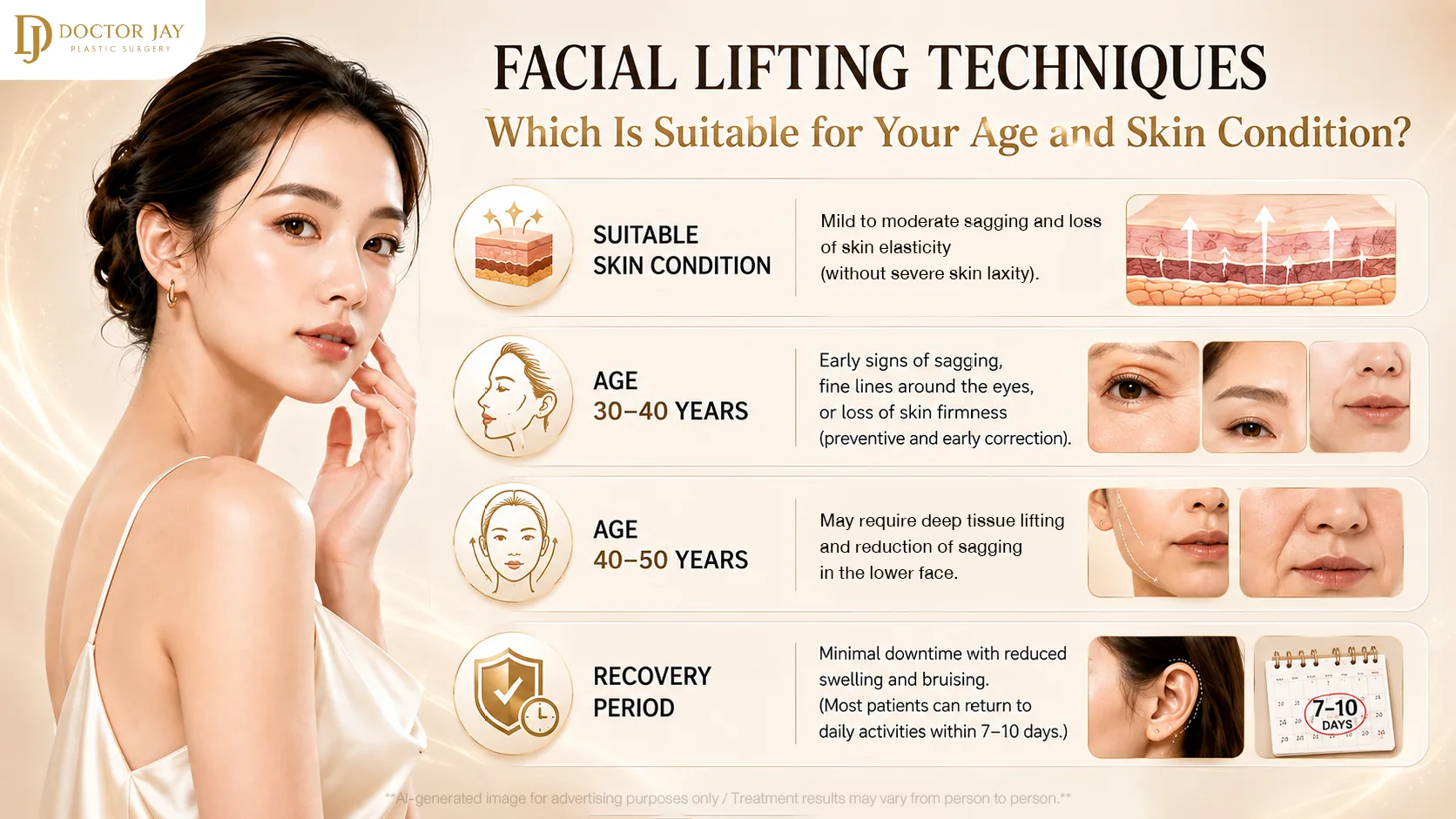
An endoscopic facelift suits people aged 30 to 50 with mild to moderate sagging whose skin still has good elasticity. The approach concentrates on the deep structure that has dropped, without removing large amounts of excess skin the way surgery once did.
- The 30 to 40 age group with drooping outer eye corners, drooping brows or the first faint nasolabial folds, where the lower jawline is still defined.
- The 40 to 50 age group who want the cheeks lifted and the deep mouth grooves softened, where the skin is still elastic enough to settle on its own afterwards.
- People who do not want a visible external scar and have only 7 to 10 days to recover before returning to work.
How many years does an endoscopic facelift last
An endoscopic facelift holds its firmness for roughly 5 to 10 years, depending on the condition of the skin beforehand and on how each person cares for themselves. The technique lifts down to the deep facial muscle layer, the SMAS, and anchors the structure beneath the skin with a fixation device, so the result holds longer than non surgical lifting treatments.
External factors that affect how long the firmness lasts come down to daily habits. Smoking, sun exposure without sunscreen and sharp swings in weight all break down the collagen beneath the skin, so the face sags again sooner as it ages naturally.
Using skincare aimed at lines and having collagen stimulating treatments regularly after surgery keeps the skin looking fresh for longer. Sleeping 7 to 8 hours a night and drinking enough water also matter in keeping the upper layers of the skin strong and elastic.
How to prepare for an endoscopic facelift
Preparing properly before an endoscopic facelift and caring for yourself afterwards reduces swelling and helps the incisions heal sooner. Stop aspirin and ibuprofen, along with supplements that affect blood clotting such as fish oil and vitamin E, at least 14 days before surgery. Telling the medical team about any drug allergy and underlying condition in advance adds to the safety of the anaesthesia.
Caring for yourself after surgery to shorten the swelling starts with these steps.
- Apply cold compresses around the incisions through the first 3 to 5 days, to keep the vessels from dilating and to ease the swelling.
- Sleep with the head raised above the level of the heart through the first 7 days, so the fluid that gathers can drain.
- Keep the incisions dry until the surgeon removes the sutures at 7 to 10 days, to prevent bacterial infection around the suture line.
Why have an endoscopic facelift at Doctor Jay Plastic Surgery
An endoscopic facelift calls for careful screening and close care to reach the result you want while keeping you safe. We assess the structure of each face individually alongside a systematic check that the body is ready, so there is less to worry about at every step. Preparing properly and holding to the standard of care lowers the risk of complications after surgery.
Our operating theatre standards and the techniques we use
We use a sterile positive pressure operating theatre with air quality controlled by HEPA filters, so nothing contaminates any stage of an endoscopic facelift. Surgery is carried out with an anaesthetic team monitoring vital signs on a one to one basis throughout. These are the technologies and instruments we use for accuracy in surgery.
- A 4K endoscope that magnifies the view of the small vessels and nerves clearly.
- Instruments with specially tapered tips for separating the deep tissue planes without damaging what lies around them.
- A technique for positioning the fixation device on the temporal bone, so the deep muscle layer is anchored securely.
The air handling system in the theatre exchanges the air as often as 20 times an hour to keep it biologically clean. Holding the room at 20 to 22 degrees Celsius with relative humidity no higher than 50 percent is the standard that keeps airborne microorganisms from building up during a procedure.
What to expect from an endoscopic facelift at Doctor Jay Plastic Surgery
The result of an endoscopic facelift shows in a cleaner jawline and an upper face that looks firmer and natural. The small incisions hidden in the hairline mean less to worry about in terms of scarring. Assessing each face individually sets the tension on the muscle layer at the right level, so nothing is pulled out of shape.
Recovery after treatment generally follows this pattern.
- The swelling around the face settles enough to return to work within 7 to 10 days.
- The folds at the corners of the mouth and the deep nasolabial folds usually look shallower 1 month after surgery.
- The skin across the cheeks and temples is evenly firm, without needing regular filler treatment.
Frequently asked questions about the endoscopic facelift
Where are the scars from an endoscopic deep plane facelift hidden
The incisions from an endoscopic facelift are hidden mainly in the hairline above the ear and at the temple, so nothing shows in daily life. The surgeon makes small openings of roughly 1 to 2 centimetres at 3 to 5 points on the scalp, set back inside the hairline, where the natural hair covers the suture lines completely.
These small scars fade until they are hard to notice within 3 to 6 months of surgery. How they turn out and how long they take to heal depend on each person’s skin. Because the technique avoids a long incision around the ear, it also lowers the chance of a keloid along the jawline. Patients can tie their hair back or wear a ponytail as usual once the incisions have healed fully, at around week 4.
Can an endoscopic facelift be combined with other procedures
An endoscopic facelift can be combined with other procedures. Doing them together means fewer rounds of anaesthesia and one recovery period rather than several. The procedures combined most often, for a brighter look around the eyes, are surgery to lift the outer eye corner, or repositioning the fat under the eyes together with a forehead lift.
Forehead augmentation with a silicone implant, or fat grafting across the face, can also be planned into the same operation. The surgeon assesses your health to keep the time under general anaesthesia within a reasonable range. Anyone with an underlying condition such as high blood pressure needs it controlled within the normal range for at least 14 days before combined surgery.
How many days of recovery does an endoscopic facelift need before returning to normal life
An endoscopic facelift needs roughly 7 to 10 days of recovery before returning to work and daily life. Most of the swelling eases noticeably during the first week after surgery. The body recovers on its own, with no need to stay overnight in hospital.
Through the first 3 to 5 days the surgeon will advise cold compresses around the face, to reduce the swelling and help the incisions settle. After 7 to 10 days the small incisions in the hairline are dry and ready for the sutures to come out. Patients can start using light make up to cover the marks, and go back to light exercise after 30 days.
In summary
An endoscopic facelift reworks the deep structure of the skin through a small camera, correcting sagging on the face and neck through incisions of 1 to 2 centimetres in the hairline. The approach reduces injury to the surrounding tissue, so there is little blood loss and recovery comes down to roughly 7 to 10 days. The firmness holds for roughly 5 to 10 years.
Have your facial structure assessed by a specialist, so the advice and the plan fit you. Preparing the body properly in advance, such as stopping aspirin at least 14 days before the procedure, is a key step in lowering the risk and adding to the safety of surgery.

Key points
- The drawbacks of a facelift are the risk of scarring along the hairline and behind the ear, a long recovery, and swelling with temporary numbness in the early weeks.
- This is costly surgery and the result does not last forever, because skin keeps sagging with age. There is also a risk of complications such as asymmetry between the two sides of the face, or temporary hair loss around the incisions.
- Surgery in a facility that does not meet the standard risks severe bloodstream infection, and can be life threatening where there is no emergency resuscitation equipment and no monitoring of vital signs throughout the operation.
- Preparing the body properly and choosing a deep plane technique with a specialist surgeon reduces the tension on the skin and lowers the chance of a stiff looking face or a distorted earlobe.
People often ask how risky a facelift is and what the deep plane facelift complications actually look like, and worry that the result will look tight and unnatural after surgery. Understanding these side effects is what lets you plan for them properly.
In this article Dr Anuchit Adirojananon (Doctor Jay), medical licence number 45390, covers the complications that can follow surgery, how to spot the warning signs, and the steps that lower the risk through reworking the deep structure of the skin, so anyone considering a lift has the full picture before deciding.
5 drawbacks of a facelift and the surgical errors that make people hesitate
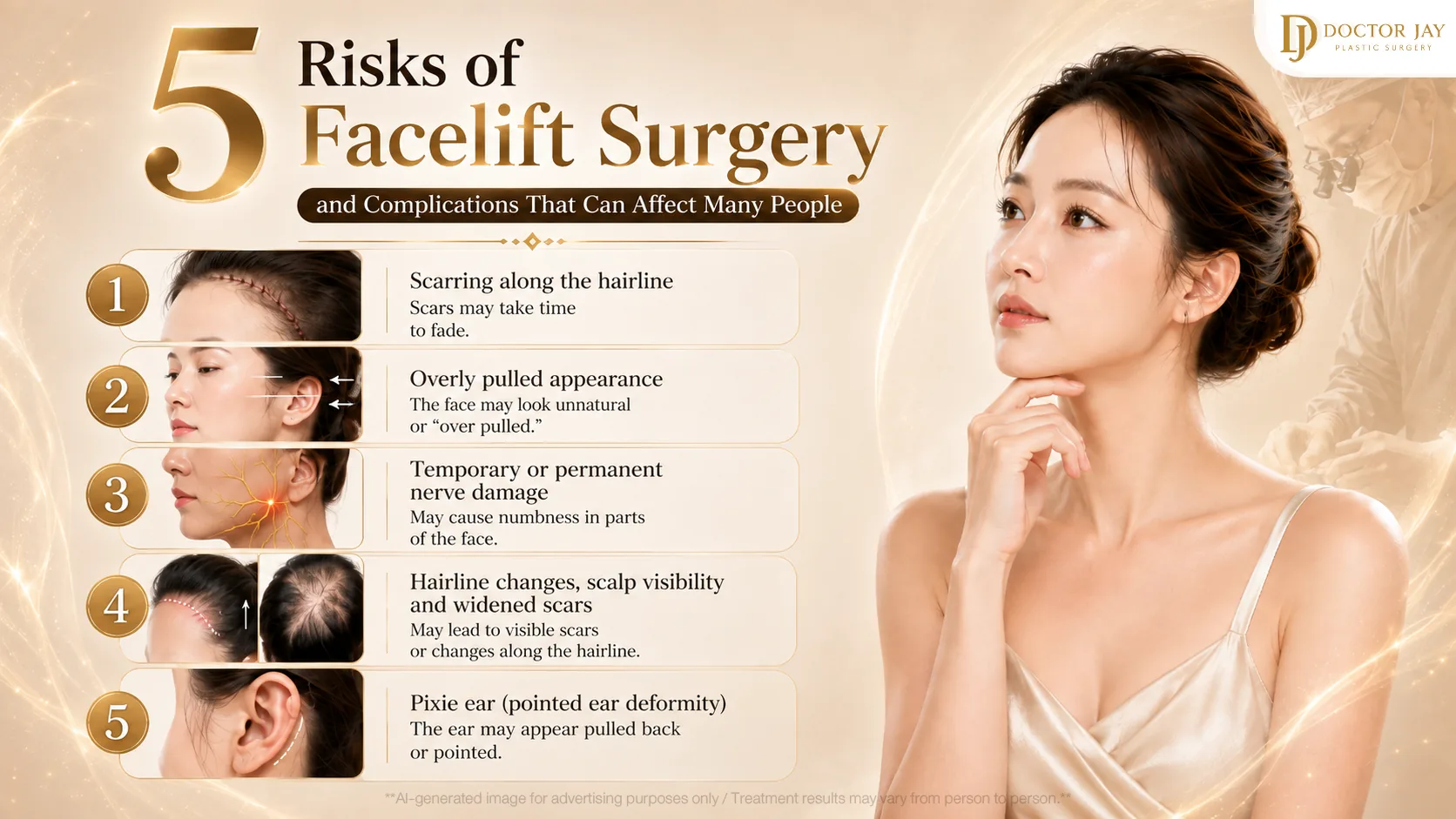
What worries most people about a facelift is an unnatural result and scarring around the ear. These usually come from suturing the skin under too much tension and from placing the incision away from the natural hairline. Anyone considering surgery should understand all 5 risks before meeting a surgeon to plan the treatment carefully.
1. Scarring along the hairline that takes time to care for
The scarring side of a facelift leaves a long line running along the temple, around the ear and back to the nape, which traditional facelift surgery cannot avoid. These lines look dark red and raised at first, and need consistent care so they do not thicken into keloid scars.
Caring for these incisions takes real discipline. Clean them with saline and apply the antiseptic your surgeon prescribes strictly through the first 7 to 14 days, then start silicone gel for scars and keep it up for 3 to 6 months, so the line fades and settles level with the skin around it.
These are the steps that keep the scars along the hairline from standing out.
- Apply silicone scar gel once the sutures are out, to keep collagen from building up under the skin and raising the line.
- Keep the incisions out of direct sun for at least 3 months, so they do not darken.
- Do not pull, stretch or massage hard around the ear and hairline during the first 1 month, so the incisions do not separate and widen.
2. A face that looks too tight and unnatural, the over pulled look
A common drawback of a facelift is skin pulled so tight that expression becomes difficult. It happens when the outer skin is stretched without suturing the deep muscle layer, the SMAS layer, to match. The corners of the mouth are drawn up abnormally, the eyes look permanently wide, and the cheeks flatten out when smiling. The stiff, mask like look comes mainly from these mechanisms.
- Trimming away too much excess skin, so the tension falls on the surface skin instead of the deep muscle.
- Pulling the skin too steeply up towards the ear, which distorts the shape of the mouth and cheeks.
- Skin that has lost elasticity in people who have had frequent high heat treatments, where the internal structure has scarred and pulls more easily.
Balanced facial proportions after surgery keep this from happening. The outer skin should stay supple and move with the muscles beneath it by roughly 5 to 10 millimetres, which is the normal range of movement after surgery, while talking or smiling.
3. The risk of injury to the facial nerve
Injury to the seventh cranial nerve, which drives facial movement, is the most serious risk of a facelift that goes wrong. The damage leaves a crooked mouth, an uneven smile, a drooping corner of the mouth, or an eye that will not close fully because the muscle is weak. Most cases are temporary bruising from traction during surgery, and they improve as the nerve recovers. Nerve damage falls into 2 patterns.
- Temporary nerve bruising from traction, which recovers within 3 to 6 months, helped by a vitamin B complex.
- Long term nerve damage where the nerve has been cut by a surgical instrument, which leaves permanent loss of movement on that side of the face and has to be repaired by nerve surgery within 72 hours, the window in which the nerve can still be joined.
4. A receding hairline, thinning scalp and hair loss around the incisions
The hairline side of a facelift is temporary or permanent hair loss around the incisions, because the follicles are damaged as the skin is cut and sutured. It usually follows pulling the skin at the temple too tight, which disrupts the blood supply to the follicles there. Without that supply the existing hairs gradually fall and the scalp thins.
A hairline that recedes backwards is another side effect seen often, when the incision is placed too far into the scalp. In most cases follicles that have gone dormant recover and grow again 3 to 6 months after surgery. Anyone with heavy hair loss may need a hair transplant around the incisions to restore a natural hairline.
5. A distorted earlobe, the pixie ear, from suturing under uneven tension
An earlobe stretched long or pulled to a point comes from too much tension on the skin around the ear while the incisions are closed. Where the technique has not anchored the deep muscle layer firmly enough, all the tension falls on the surface skin and drags the earlobe down until it merges with the cheek.
This usually shows clearly 2 to 3 months after surgery, once the swelling settles and the tissue contracts into place. It is corrected with minor surgery to reset the base of the earlobe, and most surgeons advise waiting at least 6 months for the original incisions to heal completely, for the safety of the skin around the ear.
How Doctor Jay Plastic Surgery reduces deep plane facelift complications
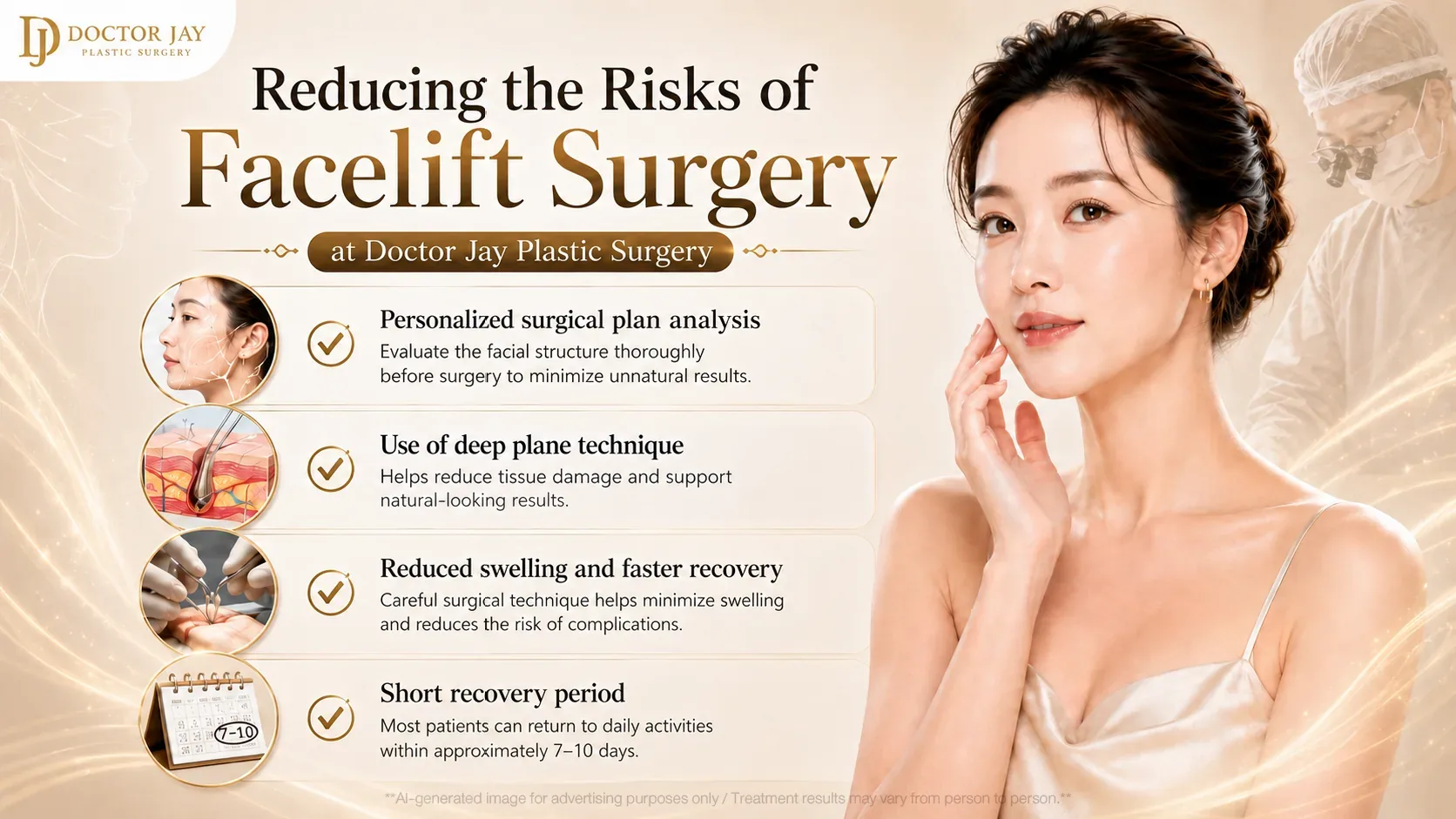
The drawbacks of a facelift can be managed by choosing a deep plane technique together with care that meets the standards set by the Ministry of Public Health. We plan the correction of sagging around each individual, so the skin is not pulled further than it should be.
Patient safety starts with a detailed study of the facial muscle structure before every operation. That reduces trauma to the layers beneath the skin and the scarring afterwards, so patients are back to their routine within 7 to 10 days.
How the deep plane facelift technique avoids these side effects
The deep plane facelift technique reduces the drawbacks of traditional surgery by lifting the deep muscle layer beneath the skin directly, rather than pulling on the surface. The tension is spread across the deep structure, so the skin above looks firm and natural. We separate the tissue planes carefully to avoid the following side effects.
- Less tension on the surface skin, which avoids pulled scars and a distorted earlobe after surgery.
- The circulation beneath the skin is preserved, so there is less swelling and the body recovers within 7 to 10 days.
- The hair follicles at the temple and along the hairline are spared, which lowers the risk of long term hair loss.
Board certified plastic surgeons and an operating theatre that meets the standard
Safety in facelift surgery rests on the experience of the surgeon and the standard of the facility. Choosing a surgeon who holds board certification in plastic surgery lowers the risk of serious complications. We hold the safety standard of every operation through the following.
- Board certified plastic surgeons listed with the Medical Council, with a thorough knowledge of the facial nerve anatomy, which avoids injury to the nerves that move the corners of the mouth and the brows.
- A positive pressure operating theatre with high efficiency air filtration, capable of capturing dust and micro organisms to the rating of a HEPA filter, to prevent bloodstream infection.
- General anaesthesia managed by a specialist anaesthetist on a one to one basis, monitoring the airway and vital signs throughout an operation that runs longer than 3 to 4 hours.
How risky is a facelift in a facility that does not meet the standard, and what can go wrong
Deep plane facelift complications, and the dangers of facelift surgery in general, rise sharply when it is done in a facility without accreditation and without emergency resuscitation equipment. Screening whether the body is fit for surgery, along with choosing a properly licensed facility, lowers the risk of severe complications afterwards. You can check the licence status of a facility straight away through the Ministry of Public Health directory before surgery.
The risks of general anaesthesia and major surgery
General anaesthesia for major surgery such as a facelift affects breathing and blood pressure directly, and an allergic reaction to the anaesthetic occurs in some cases. An operation running longer than 3 to 4 hours adds risk for the circulation and the lungs. The physical risks of major surgery under anaesthesia include the following.
- An abnormally low body temperature during surgery, which slows blood clotting.
- Severe nausea and vomiting on waking, where the straining can tear the incisions around the ear.
- Unstable blood pressure in people with an undiagnosed underlying condition.
Before the day of surgery you need an electrocardiogram and a chest x ray at least 7 days in advance, so the body is ready.
The drawbacks of a facelift done in a facility below Ministry of Public Health standards
A facelift in an unaccredited facility often leads to severe complications from infection and unclean surgical instruments. A facility without accreditation may have no quality control over its drugs and no air pressure control in the theatre, and both of those raise the risk of infection after surgery.
The errors seen most often in unlicensed facilities are these.
- Rates of drug resistant bacterial infection in the airway and the incisions, because there is no high efficiency air filtration.
- Delayed resuscitation in shock, because there is no reserve oxygen supply or emergency equipment in the theatre.
- A severed facial nerve, leaving a crooked mouth and an eye that will not close, from surgery performed by someone who is not a specialist.
You can avoid all of this by taking the 11 digit licence number of the facility and checking its status through the online system of the Department of Health Service Support before deciding on surgery.
Side effects of a facelift you may meet during recovery
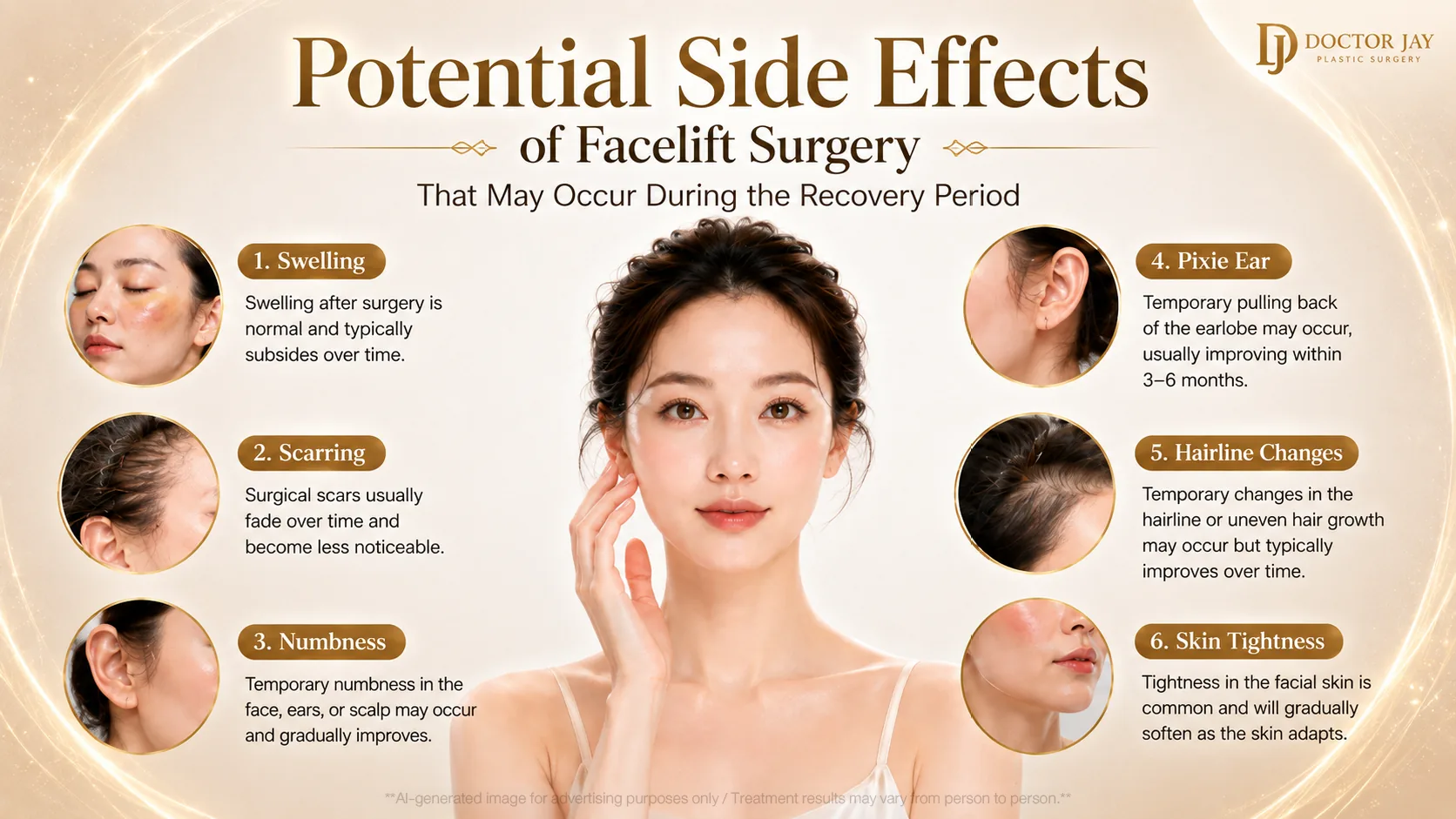
Temporary side effects after facelift surgery are the normal response of the body while the circulation and the peripheral nerves recover during the healing period.
The physical changes around the jawline and the ears are most obvious during the first 14 days of self care, and they ease as the incisions knit together.
Swelling and a haematoma under the skin
Swelling and blood collecting under the skin are common side effects after a facelift, because separating the tissue planes tears the small vessels. The body drains fluid that gathers under the skin, leaving dark discolouration and puffiness around the ear and on the neck. This peaks during the first 48 hours after surgery.
A severe collection of blood under the skin, a haematoma, comes from bleeding that does not stop beneath the skin until it forms a firm raised lump. Left alone, the area around the incision can lose its blood supply and the skin can die. Watch for severe tightness and pain that builds quickly on one side of the face.
Cold compresses on the cheeks and neck through the first 3 days keep the vessels from dilating, and you need to sleep with the head raised at 30 degrees for the whole first week of recovery, to reduce the pressure of blood collecting in the face.
Temporary tightness and numbness across the face and ears
Numbness and tightness across the cheeks and ears are normal side effects, caused by disturbance to the peripheral sensory nerves while the tissue planes are separated. The surgeon has to move the skin and suture the deep muscle layer tighter, which leaves the small nerves beneath the skin dormant for a time.
That thick, temporarily paralysed feeling improves gradually as the nerves recover and regrow to connect with the surrounding area. Sensation at the side of the cheek and the ear returns to normal within 3 to 6 months. Gentle circular massage around the incisions after the sutures come out stimulates circulation and speeds up the peripheral nerves.
Frequently asked questions about the drawbacks of a facelift
How many days does the swelling after a facelift take to settle
Swelling after a facelift subsides gradually and settles to a normal look within 14 to 30 days, depending on each person’s health and how they care for themselves. In the early days the face swells heavily through the first 3 days, which is a normal response of the skin. After that the dark marks turn yellow and fade on their own within 2 weeks. Recovery breaks down into these stages, which helps you plan.
- The first 1 to 3 days, when the swelling is heaviest. Use cold compresses around the face often, to steady the circulation and keep the swelling from building.
- At 7 to 10 days, the marks under the skin fade noticeably, and this is when the surgeon takes the sutures out.
- From 14 days onwards, most of the swelling has gone down by more than 80%, so you can start using light make up to cover the remaining marks and return to work.
How well can the scars from facelift surgery be hidden
The scars from a facelift can be hidden by placing the incisions along the natural curve of the ear and the hairline. The surgeon uses a fine suturing technique to conceal the line in front of the ear, up into the scalp and around into the crease behind the ear. Those lines change gradually from pink red to a fine white line that blends with the skin, 6 to 12 months after surgery.
Wound care after surgery is the main factor in how thick and dark the scars turn out. Applying medical silicone gel for scars twice a day, starting once the sutures come out on day 7 to 10 after surgery, encourages the collagen beneath the skin to lay down evenly.
How many years does the result of a facelift last
The result of a facelift does not last a lifetime, because the skin carries on ageing as it normally would. A superficial lift usually holds its firmness for roughly 5 to 10 years, while a deep plane lift that reaches the muscle layer holds for 10 to 15 years. Choosing a technique that does not match the concern is the drawback most likely to leave the skin sagging again and bring forward a second corrective operation.
How fast collagen breaks down and how the facial bones recede are the main reasons firmness changes after surgery. You can slow that ageing by staying out of strong sun and applying sunscreen at SPF 50 PA++++ every day, to protect the elastin fibres beneath the skin.
In summary
Deep plane facelift complications and the drawbacks of a facelift are the risk of scarring along the hairline and behind the ear, temporary numbness, and a recovery that takes time through the first 14 days. Incisions closed under too much tension can stretch the earlobe out of shape or pull the hairline backwards. Surgery in a facility that does not meet the standard adds the risk of severe infection and injury to the nerves that control facial expression.
See a board certified plastic surgeon to assess the deep structure of your face before deciding on surgery. A deep plane facelift in a theatre that meets Ministry of Public Health standards reduces these side effects and has the face settling sooner, so you are back to normal life in around 7 to 10 days on average, depending on how each person heals.

Have you ever wondered how a single strand of hair, one drop of saliva, or a small blood sample can reveal so many details about our lives?
I recently became very interested in DNA testing. I thought that knowing in advance which diseases we may be at risk of developing could help us make better decisions about our health. I am currently planning to have my own DNA tested, and in the meantime I wanted to share what I have learned for anyone who may not yet be familiar with it.
DNA, or deoxyribonucleic acid, is the genetic code that contains most of the information needed to build and regulate the human body. It is more than the double-helix structure we see in scientific illustrations. DNA is a “blueprint for life” that influences our appearance, characteristics, and potential risk of developing certain diseases.
In the past, many people mainly encountered DNA testing in news reports about criminal investigations. Today, as of 2025, it has become an important tool in many fields, including precision medicine, health planning, ancestry research, and family relationship testing.
What are the main benefits of DNA testing?
1. Precision Medicine
DNA testing can help physicians select treatments and medications that are more suitable for each patient. For example, people with certain genetic variants may metabolize some medicines more slowly than usual. Knowing this can help reduce side effects and improve the effectiveness of treatment.
2. Identifying the Risk of Genetic Disease
Testing can identify variants such as BRCA1 and BRCA2, which are associated with breast and ovarian cancer, as well as genes linked to heart disease, high blood pressure, and neurological conditions such as Alzheimer’s disease.
3. Family Relationship Testing
One of the best-known applications is DNA testing to establish biological parentage. It may also be used in legal disputes involving family relationships.
4. Ancestry and Ethnicity Testing
Many private companies now offer DNA tests that estimate ethnicity, ancestral origins, and family history. These services have become especially popular in many countries outside Thailand.
5. Forensic Science
DNA is one of the most important forms of evidence used in criminal investigations. It can also help identify individuals following disasters or serious accidents.
New Technologies in DNA Testing
Next-Generation Sequencing (NGS): This technology reads genetic sequences faster and more comprehensively than earlier methods. Costs have fallen from millions of baht to tens of thousands of baht.
Whole Genome Sequencing (WGS): This method reads all approximately three billion letters of the human genome.
CRISPR-based Diagnostics: Gene-editing technology can be adapted to detect specific diseases.
Artificial Intelligence and Machine Learning: These tools can analyze enormous volumes of genetic information and identify risks that might otherwise remain hidden.
Rapid DNA and Portable Devices: New systems can produce results within hours and may even be used directly at a crime or disaster scene.
Important Precautions and Ethical Questions
Although DNA testing offers many benefits, it also raises important questions:
Genetic Privacy: DNA results do not concern only the person being tested; they can also reveal information about family members. If genetic data is leaked, it could be used for purposes that were never intended.
Genetic Discrimination: There are concerns that insurers or employers could use genetic information to deny coverage or employment opportunities.
Interpreting Results: Not every genetic variant will definitely cause disease. Many findings indicate only an increased risk and should be explained by a qualified physician or genetic specialist.
Future Trends
DNA testing will become increasingly relevant to everyday life, moving from use in specific cases toward preventive care and routine health screening.
Home DNA Kits: At-home testing is likely to become more popular as it becomes faster and easier to access.
AI and Big Data: These technologies will help make genetic analysis more accurate and useful.
Stronger Regulation: More countries are expected to introduce stricter laws to protect the genetic information of their citizens.
Academic References
Halbisen AL, et al. Trends in Availability of Genetic Tests in the United States. PMC10142561
Alketbi SK, et al. Emerging Technologies in Forensic DNA Analysis. SciePublish
Butler JM. Recent advances in forensic biology and forensic DNA typing. ScienceDirect
Amankwaa AO, et al. The effectiveness of the current use of forensic DNA in criminal investigations. Wiley


This past Thursday, Dr. Sorn, one of the facelift surgeons at The Art Plastic Surgery Hospital, and I were honored to attend the Hello Beauty Awards.
Over the past 2 years, I’ve had the opportunity to work with Burda Luxury and Hello! Magazine Thailand and got to know P’Da, who holds a key position in management and event creation for the organization. She is one of the people who has shown me that…being professional doesn’t just mean being precise in the details, but it’s about inspiring those around you to develop and create new things that are beneficial to society. Stepping up to receive the Hello! Best Beauty & Wellness 2025 award in the category of “The Signature Deep Plane Facelift Technique” for me… is not just an award, but a confirmation of the value of the effort and intention we put into every surgery, every case, and every patient who places their trust in us.
The atmosphere at the event was full of warmth and luxury. There were many celebrities joining the celebration. Awards were announced in many categories, from Best Product, and there was also a workshop from Antidotes, founded by “Mickey,” a friend of mine from our days at Triam Udom Suksa School.
The night concluded with beautiful, special songs from Mr. Two Popetorn, which brought smiles and a happy atmosphere to everyone at the event.
But above all…
I want to thank the entire team behind the scenes. From the medical team, the surgical team, the nursing team, the marketing team, the management team, to everyone in the hospital.

Because every step I took onto the stage that day was not just my own, but the step of all of us who together have set a new standard and made this dream a reality.
When the spotlight hit the stage …
What I thought about wasn’t just the award in my hand, but the entire journey that has passed. A journey filled with effort, learning, and the heart of a team that has always supported each other.
Because in the end…
“Success is not measured by the awards we receive, but by the inspiration we can pass on to others. ”
With love ,❤️Dr. Jay – Crafting Confidence with Care


