

Key takeaways
- Facelift covers every way of firming the face and reducing sagging, from daily skincare through medical technology to facelift surgery itself.
- Treatments that need no surgery, such as radiofrequency or focused ultrasound, stimulate collagen under the skin and suit mild to moderate laxity.
- Facelift surgery is the option for significant sagging, though it needs a longer recovery than the other options.
- Having your skin assessed by a doctor before you start makes it easier to pick the method that matches your own concern and to get a result you are happy with.
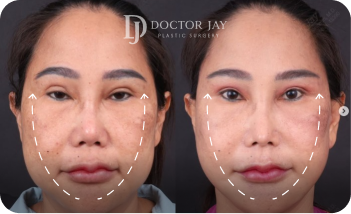
Facelift is what many people look for once they notice heavier cheeks, a double chin and deeper lines around the mouth that make the face look tired and older than it is. When collagen is lost year after year without any care, the structure under the skin keeps weakening until ordinary skincare can no longer bring firmness back. Restoring shape and definition therefore calls for methods that reach the deeper layers and strengthen the structure itself.
This article was prepared by Dr. Anuchit Adirojnanont (Doctor Jay), medical licence number 45390, who has brought together detailed information on the ways sagging skin is treated, covering energy based technology, thread lifting and surgery that lifts the structure of the face. The comparison in the sections below explains how each one works, so you can judge which suits the condition of your own SMAS layer.
What causes a sagging face and why lifting is needed

A facelift becomes necessary once the structure under the skin starts to change with age, particularly after the age of 25, when the body produces around one percent less collagen each year and laxity slowly builds up. The change happens across several layers, from the dermis down to the bone that gradually recedes. The main reasons the face loses its firmness are these.
- Collagen and elastin fibres in the dermis are lost, so the skin becomes thinner.
- The SMAS layer that supports the face weakens and slides downward with gravity.
- Fat pads under the skin shrink and shift, which leaves heavier cheeks and deeper folds.
Treating the face early slows down the changes in its structure. Building new collagen keeps the skin fuller and more elastic, which can postpone the point at which facelift surgery is worth considering by several years.
How to match a facelift method to your own skin concern
Getting a good result from a facelift depends on choosing the method that works at the layer where the problem actually is, because a tired looking face comes from changes at several different depths.
If you are wondering which treatment suits a sagging face, understanding how each layer changes makes the choice far more accurate. The face loses firmness at different depths, from about 1.5 millimetres just under the surface down to the bone that lies deepest of all.
Changes in the dermis, where lost collagen leaves skin without firmness
The dermis changes when collagen and elastin break down, so the skin loses elasticity and fine lines and visible laxity appear. This continues as you get older and is made worse by ultraviolet light in sunlight.
You can notice it when the skin feels dry, pores look wider and the skin no longer springs back at once when you press it with a finger. Collagen in this layer is lost at an average of one percent a year after the age of 25. Retinol based creams and laser treatments that stimulate protein under the skin are what restore density at this level.
Loosening of the SMAS layer, the main reason the face drops
The SMAS, or superficial muscular aponeurotic system, is the fibrous sheet that holds the whole face in place. It is the same layer a surgeon repositions during facelift surgery to correct a dropped face directly. With age this sheet stretches and slides down with gravity, which brings heavier cheeks, deeper folds beside the mouth and a fuller jawline. Lifting the face therefore has to reach this layer at a depth of about 4.5 millimetres.
Sending focused ultrasound energy down to the SMAS makes the tissue contract and draws the structure of the face upward from the first weeks after treatment, with the clearest result at around 3 months, once new collagen and elastin have formed to replace the fibres that had weakened with age.
Loss of fat under the skin, which leaves the face hollow and tired
Loss of the fat pads under the skin is a major reason a face looks tired and older than it is, because the body loses deep fat in the cheeks, temples and under the eyes as the years pass. The skin above then has less to rest on, so it sags and clear folds appear.
This usually becomes noticeable from the age of 30, as the fat in the cheeks gradually shrinks and slips downward, gathering instead along the folds beside the mouth. The result is deeper folds, flatter cheeks and hollow temples, so the face loses the oval shape it had in earlier years.
The way to correct this as part of a facelift plan is to replace the volume that has been lost, either with hyaluronic acid filler treatment placed in the deep fat layer, or with absorbable materials that prompt the body to build its own collagen, so the skin stays firm for longer.
Bone that recedes with age, the deepest cause of all
Bone loss in the face is the deepest cause of lines and sagging, because bone is the foundation that carries the skin and muscle above it. With age the bone thins and recedes, so the tissue above has nothing to anchor to and drifts downward with gravity. The eye sockets widen, the cheekbones flatten and the jaw becomes smaller.
These changes usually become clear after the age of 40, and women lose bone density faster than men because of falling oestrogen levels. Correcting sagging that starts at bone level therefore calls for a firmer filler treatment with strong support, placed in the layer next to the bone to replace the volume that has been lost and hold the face up again.
8 facelift treatments and what each one does

Facelift treatments available today fall into several groups, according to the depth of skin they reach and how they correct sagging at its cause. They range from heat energy that tightens the deeper layers, to injectable treatments that stimulate collagen, to threads that support the tissue. These technologies send energy from the dermis down to the muscle layer at about 4.5 millimetres to restore the structure from within.
Microfocused ultrasound that lifts down to the SMAS layer
Microfocused ultrasound is a facelift technology that sends precise, very small points of heat to the SMAS, the same layer used in facelift surgery. The energy makes existing collagen fibres contract and prompts new collagen to form, so the face gradually lifts and looks smoother over about 3 months after treatment.
The device sends heat accurately beneath the skin, and on systems with a live image the doctor can see the layers while treating. It suits sagging cheeks, a fuller jawline, or brows that need lifting, and the result usually lasts around 1 to 2 years.
Monopolar radiofrequency for firmer skin and a slimmer lower face
Monopolar radiofrequency is a facelift treatment that sends heat down to the dermis and the fat layer below it. The heat tightens collagen fibres that have loosened, and skin over areas where fat collects, such as the cheeks and under the chin, looks firmer as a result. It suits people with fuller cheeks, or anyone who wants a slimmer, more defined face.
The heat spreads evenly over a wide area to prompt new collagen and elastin under the skin. After treatment the skin looks firmer, pores look smaller and fine lines look smoother within 2 to 3 months, with the result usually holding for about 12 months.
HIFU, a facelift with ultrasound energy for early laxity
HIFU is a facelift technology that sends focused ultrasound down to the SMAS layer as tiny points of heat to stimulate collagen. The energy makes tissue under the skin contract, so the jawline looks more defined. It suits people with early, mild laxity, often from their twenties into their thirties.
A session usually takes about 30 to 45 minutes. It needs no surgery and very little recovery, and the ultrasound energy is delivered specifically at depths from 1.5 millimetres down to 4.5 millimetres to treat the skin and lift its deeper structure.
You can notice the first changes in the skin soon after the session, and they continue to develop as new collagen forms over the following 2 to 3 months. The lifting effect usually holds for around 6 months.
Collagen stimulating injectable treatments for firmer, more elastic skin
Collagen stimulating injectable treatments firm the face without any device. Both types work by prompting the body to build new type 1 collagen and elastin, so the deeper structure grows stronger and skin that had loosened gradually becomes firmer and thicker, with a result that looks natural. The two differ in what they are made of and how they work, as follows.
| Property | PLLA based treatment | CaHA based treatment |
|---|---|---|
| Main ingredient | Poly-L-Lactic Acid, a synthetic material | Calcium Hydroxylapatite |
| How it works | Builds collagen gradually to add density to the skin | Adds volume from the start while it stimulates collagen and elastin |
| How long the result holds | About 2 years | About 1 to 2 years |
When choosing between them the doctor looks mainly at your skin quality and the degree of sagging. The material breaks down naturally over time and leaves nothing behind under the skin. The face usually begins to feel more elastic and look firmer about 4 to 6 weeks after treatment.
Botulinum toxin treatment to soften lines and define the jawline
Botulinum toxin treatment lifts the face and softens lines by relaxing the muscles that pull the skin downward and reducing lines caused by movement. Used along the jawline it relaxes the neck muscle that drags the cheeks down, so the muscles that lift can work more effectively. The skin along the jaw then looks firmer and the outline of the face becomes clearer.
The treatment itself takes only 10 to 15 minutes, and the doctor places small amounts into the superficial layer along the jawline and under the chin to refine the shape of the face. Lines start to soften within 7 to 14 days, while the change in the jawline becomes clearer over 2 to 4 weeks.
The effect usually lasts about 4 to 6 months, depending on the product chosen and on how quickly your body breaks it down. The material clears naturally over time and leaves no residue under the skin.
Hyaluronic acid filler treatment to replace volume where the face has hollowed
Hyaluronic acid filler treatment lifts the face by replacing volume in the bone and fat layers that have receded with age. The doctor places it deeply at the support points of the face to draw sagging structure back up. It suits people with deep folds beside the mouth, flat cheeks, or hollowing around the eyes that makes the face look tired.
This material draws water molecules around it, so the skin becomes denser and smoother. Products that are properly registered hold their lifting effect for about 12 to 18 months, and the material is then broken down by the body’s own processes. Published follow up studies find the effect well maintained at six months and to a lesser degree at twelve.
Thread lifting to support tissue with an immediate change
Thread lifting uses absorbable threads with small barbs, passed under the skin to catch sagging tissue and draw it upward as soon as the session ends. It corrects dropped cheeks without major surgery, and the body forms new collagen and elastin along the line of each thread, which supports the tissue for longer.
The threads dissolve naturally over time, so the lift lasts roughly 6 to 8 months. The materials most widely used are PDO and PLLA threads.
Facelift surgery for a result that lasts years
Facelift surgery is the choice for people whose skin has sagged well beyond what treatments without surgery can correct, and it gives a result that lasts far longer. The surgeon releases the skin and secures the deep muscle layer known as the SMAS back to the position it held before it stretched. Incisions are placed in front of the ear and continue behind it so the scar line is hidden. How long the result holds depends on your skin condition, your age, your lifestyle and the care you take afterwards, which your surgeon goes through with you before the operation.
Recovery after surgery runs in stages, from the first days when swelling is at its greatest, through the following weeks as it settles, and your surgeon sets when you can return to work and to exercise. A facial support garment is worn around the clock during the first week to hold the structure in place and reduce fluid gathering under the skin. Keeping the incisions clean with saline and applying the prescribed ointment keeps the suture line along the hairline clean.
Do facial exercises and natural methods actually lift the face?
Facial exercises and natural methods can genuinely slow down changes in the upper layers of the skin, but they cannot correct sagging in the deeper structure the way a medical treatment can.
These self care habits improve fluid circulation under the skin and add elasticity to the outer layers, yet the real cause of sagging lies in shrinking fat pads and a weakening SMAS layer about 4.5 millimetres down. Natural methods can therefore only maintain what you have and delay new lines, which is still worth doing over the long term.
| Type of care | Natural methods and self care | Medical treatment |
|---|---|---|
| Depth reached under the skin | Epidermis and the upper dermis | Fat layer and the SMAS at 4.5 millimetres |
| Time before a result appears | 8 to 12 weeks of consistent practice | 1 to 30 days depending on the treatment |
Facial yoga and massage to improve circulation
Facial yoga and pressure point massage improve blood flow and work the facial muscles, so the skin does look firmer. Moving specific muscles regularly brings more oxygen to the skin cells, which leaves the face brighter and noticeably less puffy around the cheeks.
These exercises are worth doing for at least 10 to 15 minutes a day to see a clear result. Massaging from the middle of the face outward and then upward toward the hairline supports the outer structure against gravity. Use cold pressed coconut oil or a serum at the same time to reduce friction, which is what causes lines around the eyes and beside the mouth.
Gua sha, the traditional Chinese approach to lifting the face
Gua sha reduces puffiness and lifts the face by using a stone tool to stimulate lymphatic flow under the skin, following traditional Chinese practice. It helps drain what has gathered in the face, so the jawline looks more defined for a while. Choose a natural stone such as jade or rose quartz, chilled beforehand to cool the skin more effectively.
Keep the pressure moderate to avoid bruising under the skin. Always draw the stone from the middle of the face outward toward the temples and behind the ears. Applying 3 to 5 drops of facial oil before you start reduces friction and protects the skin around the eyes from new lines.
Firming creams to add moisture and soften lines
Moisturising creams add elasticity and hold water in the outer layers, so shallow lines look softer and the skin looks plumper after use. Products in this group focus on hydration and on drawing water into the skin cells to limit water loss through the day. Look for humectants such as hyaluronic acid, which pulls water in and holds it in the skin.
For skin care that pays off over the years, a cream should also contain ingredients that stimulate collagen and encourage cell turnover. Retinol at 0.1 to 0.5 percent, or short chain peptides, help refine the outer structure of the skin, and this repair happens overnight while the skin renews itself naturally.
Everyday habits, water and rest that slow sagging down
Drinking 2 to 3 litres of water a day and sleeping 7 to 8 hours are the basics of firming the face from the inside. They slow collagen loss and help any lifting treatment hold its result. Dehydrated skin cells shrink, which makes the face sag and line more easily, while drinking water steadily keeps the dermis hydrated so the skin stays plump and elastic.
The key window for skin repair is the first deep sleep cycle after you fall asleep, when the body releases growth hormone to repair worn skin cells. Reaching that deep sleep improves circulation in the face, reduces inflammation and helps prevent the skin from losing firmness earlier than it should. Adjusting your sleep and drinking enough water is therefore the foundation that makes any facelift treatment hold longer.
Which facelift is right for you, treatment without surgery compared with facelift surgery
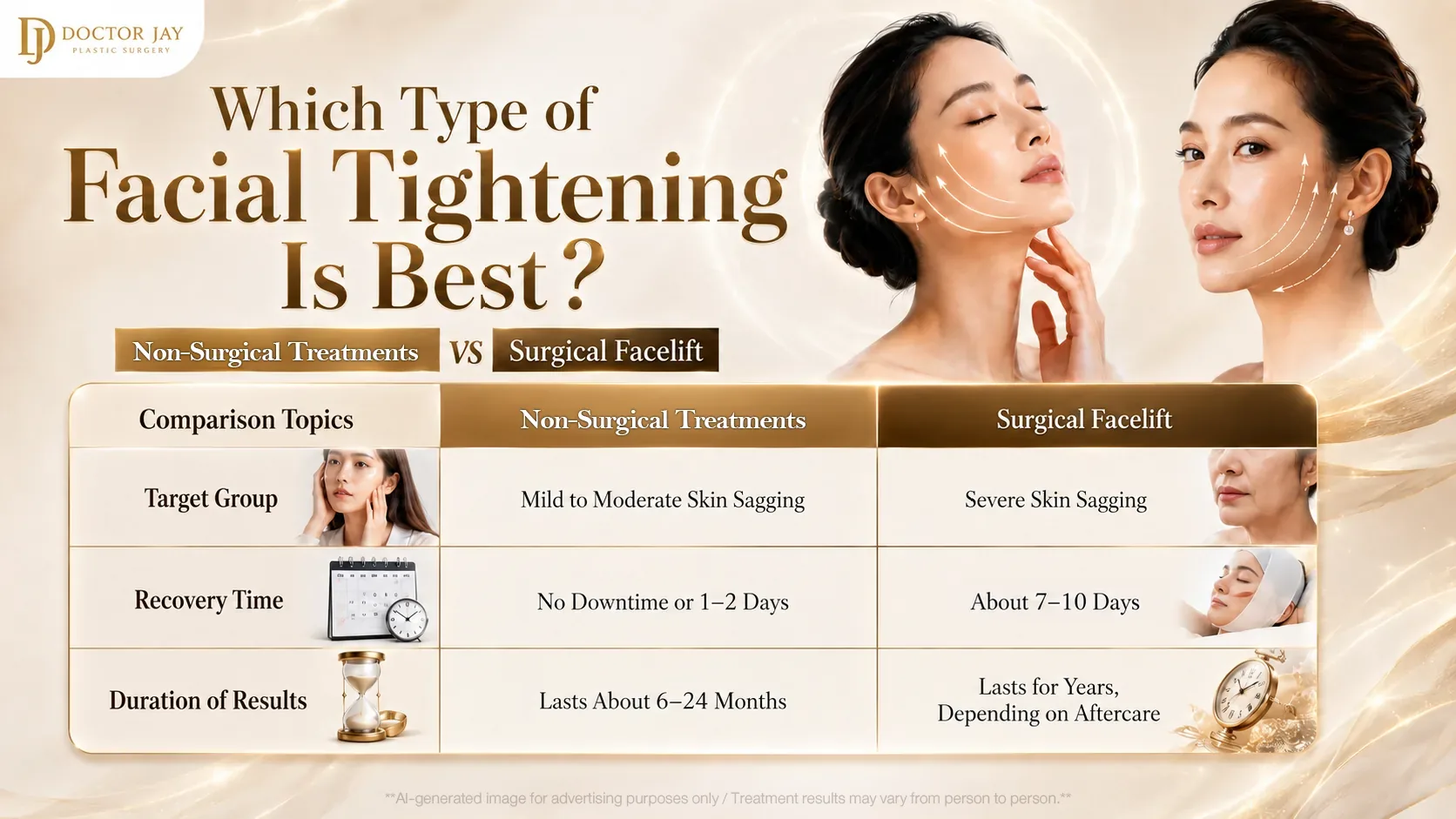
Choosing how to lift and reshape the face depends mainly on how far the skin has sagged and on how much recovery time you can accept. Treatments without surgery stimulate collagen under the skin directly, while surgery removes excess skin and repositions the deep muscle layer for a result that lasts far longer.
| Point of comparison | Treatment without surgery | Facelift surgery |
|---|---|---|
| Who it suits | Mild to moderate sagging | Significant sagging |
| Recovery | None, or 1 to 2 days | Staged, set by your surgeon |
| How long the result holds | About 6 to 24 months | Set by skin condition and aftercare |
People aged 30 to 45 usually respond well to heat energy that stimulates the deeper layers, while those aged 50 and above with heavy upper lids and deep folds beside the mouth get a result that matches the cause more closely from surgery on the SMAS layer, which draws the descended cheek tissue back and outward.
Which treatment suits a sagging face, judged by how far it has gone and by your age
Choosing an approach to lifting the face means looking at how far the skin has sagged and at the structure of each layer at your stage of life, so the result matches the concern and the spending makes sense over time.
- Age 25 to 35 with shallow lines and slightly flat cheeks. Lifting and reshaping the face alongside 1 to 2 cc of hyaluronic acid filler treatment supports skin that is starting to descend.
- Age 35 to 50 with heavier cheeks and deeper folds. Focused ultrasound once a year draws up the deeper layers with no recovery time.
- Age 50 and above with lost collagen and receding bone. Absorbable threads together with monopolar radiofrequency support loosened tissue around the mouth for roughly 6 to 8 months.
Lifting the neck and cheeks for a defined jawline
Lifting the neck and cheeks to define the jawline works well when the jaw margin and the area under the chin are treated together for a balanced result. Focused ultrasound and muscle relaxing treatment can be combined to reduce the downward pull along the neck. The main approaches are these.
- Radiofrequency treatment along the jaw margin and under the chin, to reduce excess fat and tighten the skin around the neck.
- Botulinum toxin treatment in the platysma muscle, to reduce the downward pull on the face so the cheeks are supported upward sooner.
For the first 48 hours after treatment, sleeping with your head raised reduces swelling and helps the neck settle more quickly.
What to know before a facelift, safety standards and the law on medical facilities
Checking on safety before you decide starts with the facility and the person who will treat you. A medical facility that meets the standard must display its 11 digit operating licence in plain view at the entrance. The points worth confirming before any treatment are these.
- The doctor must appear in the Thai Medical Council register with an active status, and the photograph must match the person who performs your surgery or treatment.
- Facelift surgery must take place in a sterile operating room under positive pressure, to prevent infection entering the bloodstream.
- The facility must have an automated external defibrillator, or AED, and backup oxygen ready at all times in case of an emergency during treatment.
Frequently asked questions about facelift treatment
Do the different energy based lifting treatments hurt to the same degree?
How much you feel depends on the type of energy and how deep it travels, and the sensation varies with the size of the focal point delivered under the skin to stimulate elastin. Applying a strong numbing cream 45 to 60 minutes beforehand takes the edge off the sharper sensation along the jaw.
| Type of treatment | Type of energy | How it feels during treatment |
|---|---|---|
| Microfocused ultrasound | Ultrasound in larger focal points | A deep, sharp sensation over the cheekbone |
| Monopolar radiofrequency | Radiofrequency heat over a wider area | Deep warmth alternating with cooling |
| HIFU | Ultrasound in small focal points | A warm, tight feeling like a light pinprick |
Treatments that place larger focal points down at the SMAS layer are generally felt the most, radiofrequency comes next, and small point ultrasound is the mildest of the three. Strong cool air blown over the skin, along with an ice pack, keeps heat from building up in the deeper layers.
Can several facelift treatments be combined?
Yes, and combining them often gives a better result, because each one corrects a different layer. Combining technologies covers every dimension of the change, for example focused ultrasound down at the SMAS alongside filler treatment to replace volume lost at bone level. Treating this way also means fewer separate visits and a result that looks more natural overall.
The order of treatment matters, to keep the skin from becoming too inflamed. Doctors usually advise having the treatments that use high heat at least 2 weeks before any injectable treatment, so the heat does not break down material that has only just been placed.
Do men and women need different facelift treatment?
The skin of men and women is built differently, so the energy levels and technique have to be adjusted. Male skin is roughly 25 percent thicker with denser collagen, and beard growth affects how heat energy passes into the skin.
| Skin factor | Men | Women |
|---|---|---|
| Thickness of the skin | Thicker skin with wider pores | Thinner skin that loses collagen more readily |
| How fat tends to gather | Often gathers in the lower cheeks and under the chin | Fat shrinks, leaving the face hollow and tired |
| Energy level used | Higher energy to reach the SMAS layer | Moderate energy focused on stimulating collagen |
Men usually want a defined jawline and a sharp mandibular border, so doctors tend to use handpieces that send heat deeper to reduce excess fat while lifting the skin. Women more often want softness and the replacement of volume that has been lost. Planning a facelift therefore has to follow the physical structure of each person.
In summary
Facelift covers a wide range of methods, chosen according to how far each person’s skin has sagged, from natural approaches such as gua sha that stimulate lymphatic flow, through medical technology such as focused ultrasound down at the SMAS layer, to facelift surgery for a result that lasts years. A careful assessment with a doctor who works in this field is what lets you choose the method that fits the condition of your own skin.
If you are looking for a way to make your skin look firmer and want to lift and reshape your face with confidence, start by seeing a doctor for an assessment of your skin and facial bone structure. Choose a medical facility that meets the standard and holds a valid operating licence.