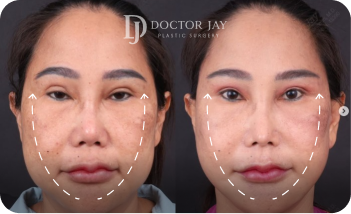
Key points
- The drawbacks of a facelift are the risk of scarring along the hairline and behind the ear, a long recovery, and swelling with temporary numbness in the early weeks.
- This is costly surgery and the result does not last forever, because skin keeps sagging with age. There is also a risk of complications such as asymmetry between the two sides of the face, or temporary hair loss around the incisions.
- Surgery in a facility that does not meet the standard risks severe bloodstream infection, and can be life threatening where there is no emergency resuscitation equipment and no monitoring of vital signs throughout the operation.
- Preparing the body properly and choosing a deep plane technique with a specialist surgeon reduces the tension on the skin and lowers the chance of a stiff looking face or a distorted earlobe.
People often ask how risky a facelift is and what the deep plane facelift complications actually look like, and worry that the result will look tight and unnatural after surgery. Understanding these side effects is what lets you plan for them properly.
In this article Dr Anuchit Adirojananon (Doctor Jay), medical licence number 45390, covers the complications that can follow surgery, how to spot the warning signs, and the steps that lower the risk through reworking the deep structure of the skin, so anyone considering a lift has the full picture before deciding.
5 drawbacks of a facelift and the surgical errors that make people hesitate
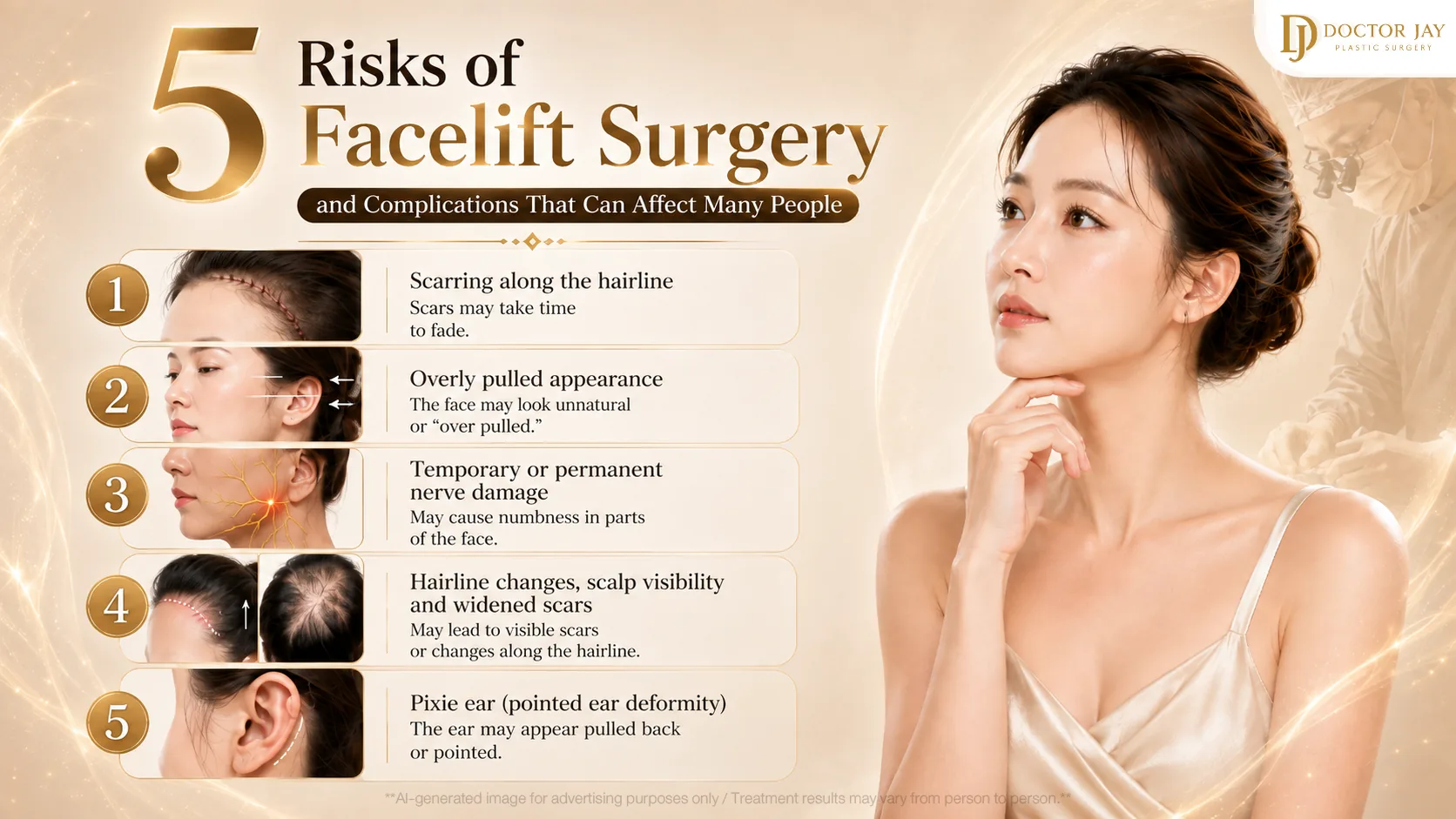
What worries most people about a facelift is an unnatural result and scarring around the ear. These usually come from suturing the skin under too much tension and from placing the incision away from the natural hairline. Anyone considering surgery should understand all 5 risks before meeting a surgeon to plan the treatment carefully.
1. Scarring along the hairline that takes time to care for
The scarring side of a facelift leaves a long line running along the temple, around the ear and back to the nape, which traditional facelift surgery cannot avoid. These lines look dark red and raised at first, and need consistent care so they do not thicken into keloid scars.
Caring for these incisions takes real discipline. Clean them with saline and apply the antiseptic your surgeon prescribes strictly through the first 7 to 14 days, then start silicone gel for scars and keep it up for 3 to 6 months, so the line fades and settles level with the skin around it.
These are the steps that keep the scars along the hairline from standing out.
- Apply silicone scar gel once the sutures are out, to keep collagen from building up under the skin and raising the line.
- Keep the incisions out of direct sun for at least 3 months, so they do not darken.
- Do not pull, stretch or massage hard around the ear and hairline during the first 1 month, so the incisions do not separate and widen.
2. A face that looks too tight and unnatural, the over pulled look
A common drawback of a facelift is skin pulled so tight that expression becomes difficult. It happens when the outer skin is stretched without suturing the deep muscle layer, the SMAS layer, to match. The corners of the mouth are drawn up abnormally, the eyes look permanently wide, and the cheeks flatten out when smiling. The stiff, mask like look comes mainly from these mechanisms.
- Trimming away too much excess skin, so the tension falls on the surface skin instead of the deep muscle.
- Pulling the skin too steeply up towards the ear, which distorts the shape of the mouth and cheeks.
- Skin that has lost elasticity in people who have had frequent high heat treatments, where the internal structure has scarred and pulls more easily.
Balanced facial proportions after surgery keep this from happening. The outer skin should stay supple and move with the muscles beneath it by roughly 5 to 10 millimetres, which is the normal range of movement after surgery, while talking or smiling.
3. The risk of injury to the facial nerve
Injury to the seventh cranial nerve, which drives facial movement, is the most serious risk of a facelift that goes wrong. The damage leaves a crooked mouth, an uneven smile, a drooping corner of the mouth, or an eye that will not close fully because the muscle is weak. Most cases are temporary bruising from traction during surgery, and they improve as the nerve recovers. Nerve damage falls into 2 patterns.
- Temporary nerve bruising from traction, which recovers within 3 to 6 months, helped by a vitamin B complex.
- Long term nerve damage where the nerve has been cut by a surgical instrument, which leaves permanent loss of movement on that side of the face and has to be repaired by nerve surgery within 72 hours, the window in which the nerve can still be joined.
4. A receding hairline, thinning scalp and hair loss around the incisions
The hairline side of a facelift is temporary or permanent hair loss around the incisions, because the follicles are damaged as the skin is cut and sutured. It usually follows pulling the skin at the temple too tight, which disrupts the blood supply to the follicles there. Without that supply the existing hairs gradually fall and the scalp thins.
A hairline that recedes backwards is another side effect seen often, when the incision is placed too far into the scalp. In most cases follicles that have gone dormant recover and grow again 3 to 6 months after surgery. Anyone with heavy hair loss may need a hair transplant around the incisions to restore a natural hairline.
5. A distorted earlobe, the pixie ear, from suturing under uneven tension
An earlobe stretched long or pulled to a point comes from too much tension on the skin around the ear while the incisions are closed. Where the technique has not anchored the deep muscle layer firmly enough, all the tension falls on the surface skin and drags the earlobe down until it merges with the cheek.
This usually shows clearly 2 to 3 months after surgery, once the swelling settles and the tissue contracts into place. It is corrected with minor surgery to reset the base of the earlobe, and most surgeons advise waiting at least 6 months for the original incisions to heal completely, for the safety of the skin around the ear.
How Doctor Jay Plastic Surgery reduces deep plane facelift complications
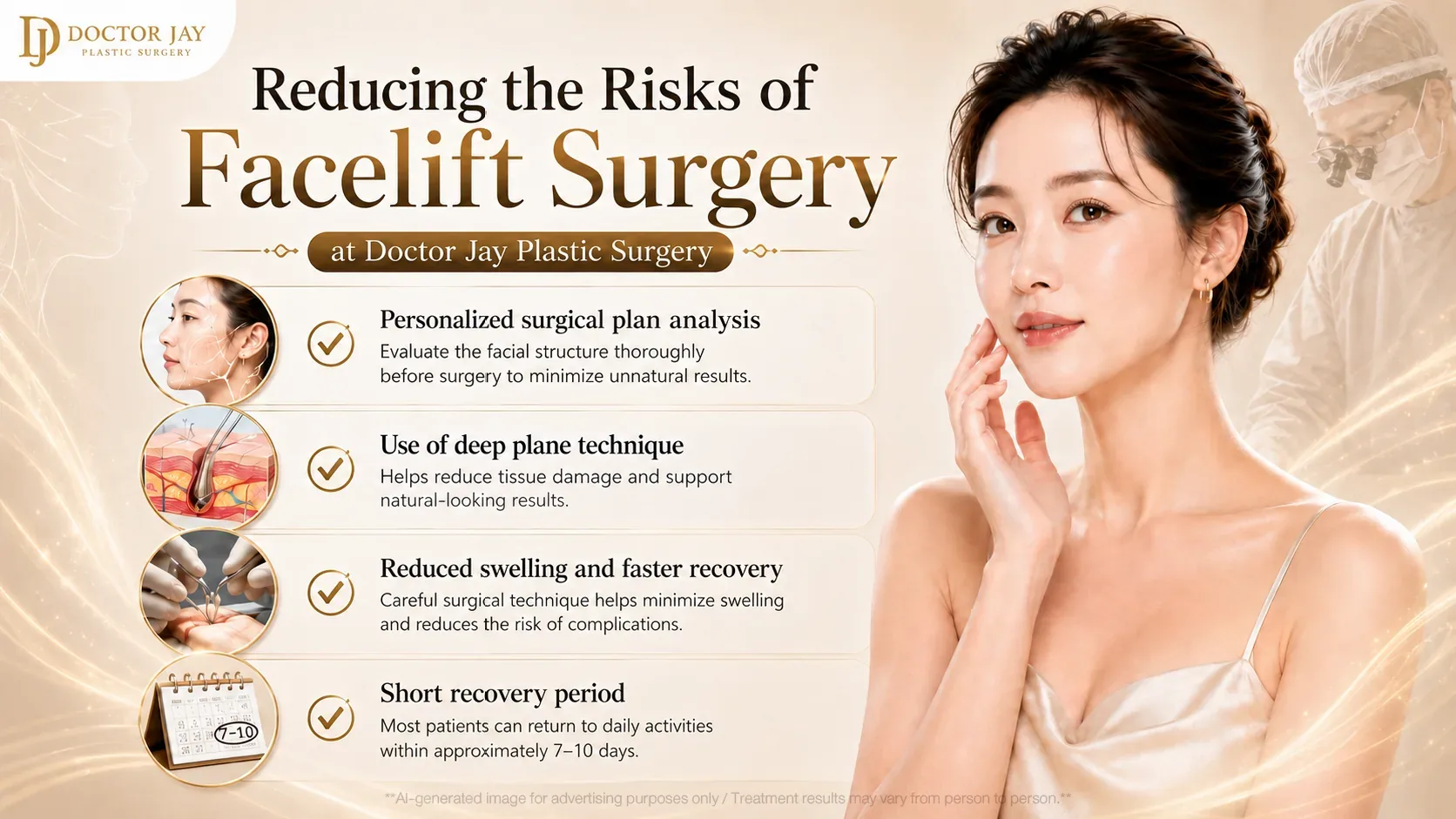
The drawbacks of a facelift can be managed by choosing a deep plane technique together with care that meets the standards set by the Ministry of Public Health. We plan the correction of sagging around each individual, so the skin is not pulled further than it should be.
Patient safety starts with a detailed study of the facial muscle structure before every operation. That reduces trauma to the layers beneath the skin and the scarring afterwards, so patients are back to their routine within 7 to 10 days.
How the deep plane facelift technique avoids these side effects
The deep plane facelift technique reduces the drawbacks of traditional surgery by lifting the deep muscle layer beneath the skin directly, rather than pulling on the surface. The tension is spread across the deep structure, so the skin above looks firm and natural. We separate the tissue planes carefully to avoid the following side effects.
- Less tension on the surface skin, which avoids pulled scars and a distorted earlobe after surgery.
- The circulation beneath the skin is preserved, so there is less swelling and the body recovers within 7 to 10 days.
- The hair follicles at the temple and along the hairline are spared, which lowers the risk of long term hair loss.
Board certified plastic surgeons and an operating theatre that meets the standard
Safety in facelift surgery rests on the experience of the surgeon and the standard of the facility. Choosing a surgeon who holds board certification in plastic surgery lowers the risk of serious complications. We hold the safety standard of every operation through the following.
- Board certified plastic surgeons listed with the Medical Council, with a thorough knowledge of the facial nerve anatomy, which avoids injury to the nerves that move the corners of the mouth and the brows.
- A positive pressure operating theatre with high efficiency air filtration, capable of capturing dust and micro organisms to the rating of a HEPA filter, to prevent bloodstream infection.
- General anaesthesia managed by a specialist anaesthetist on a one to one basis, monitoring the airway and vital signs throughout an operation that runs longer than 3 to 4 hours.
How risky is a facelift in a facility that does not meet the standard, and what can go wrong
Deep plane facelift complications, and the dangers of facelift surgery in general, rise sharply when it is done in a facility without accreditation and without emergency resuscitation equipment. Screening whether the body is fit for surgery, along with choosing a properly licensed facility, lowers the risk of severe complications afterwards. You can check the licence status of a facility straight away through the Ministry of Public Health directory before surgery.
The risks of general anaesthesia and major surgery
General anaesthesia for major surgery such as a facelift affects breathing and blood pressure directly, and an allergic reaction to the anaesthetic occurs in some cases. An operation running longer than 3 to 4 hours adds risk for the circulation and the lungs. The physical risks of major surgery under anaesthesia include the following.
- An abnormally low body temperature during surgery, which slows blood clotting.
- Severe nausea and vomiting on waking, where the straining can tear the incisions around the ear.
- Unstable blood pressure in people with an undiagnosed underlying condition.
Before the day of surgery you need an electrocardiogram and a chest x ray at least 7 days in advance, so the body is ready.
The drawbacks of a facelift done in a facility below Ministry of Public Health standards
A facelift in an unaccredited facility often leads to severe complications from infection and unclean surgical instruments. A facility without accreditation may have no quality control over its drugs and no air pressure control in the theatre, and both of those raise the risk of infection after surgery.
The errors seen most often in unlicensed facilities are these.
- Rates of drug resistant bacterial infection in the airway and the incisions, because there is no high efficiency air filtration.
- Delayed resuscitation in shock, because there is no reserve oxygen supply or emergency equipment in the theatre.
- A severed facial nerve, leaving a crooked mouth and an eye that will not close, from surgery performed by someone who is not a specialist.
You can avoid all of this by taking the 11 digit licence number of the facility and checking its status through the online system of the Department of Health Service Support before deciding on surgery.
Side effects of a facelift you may meet during recovery
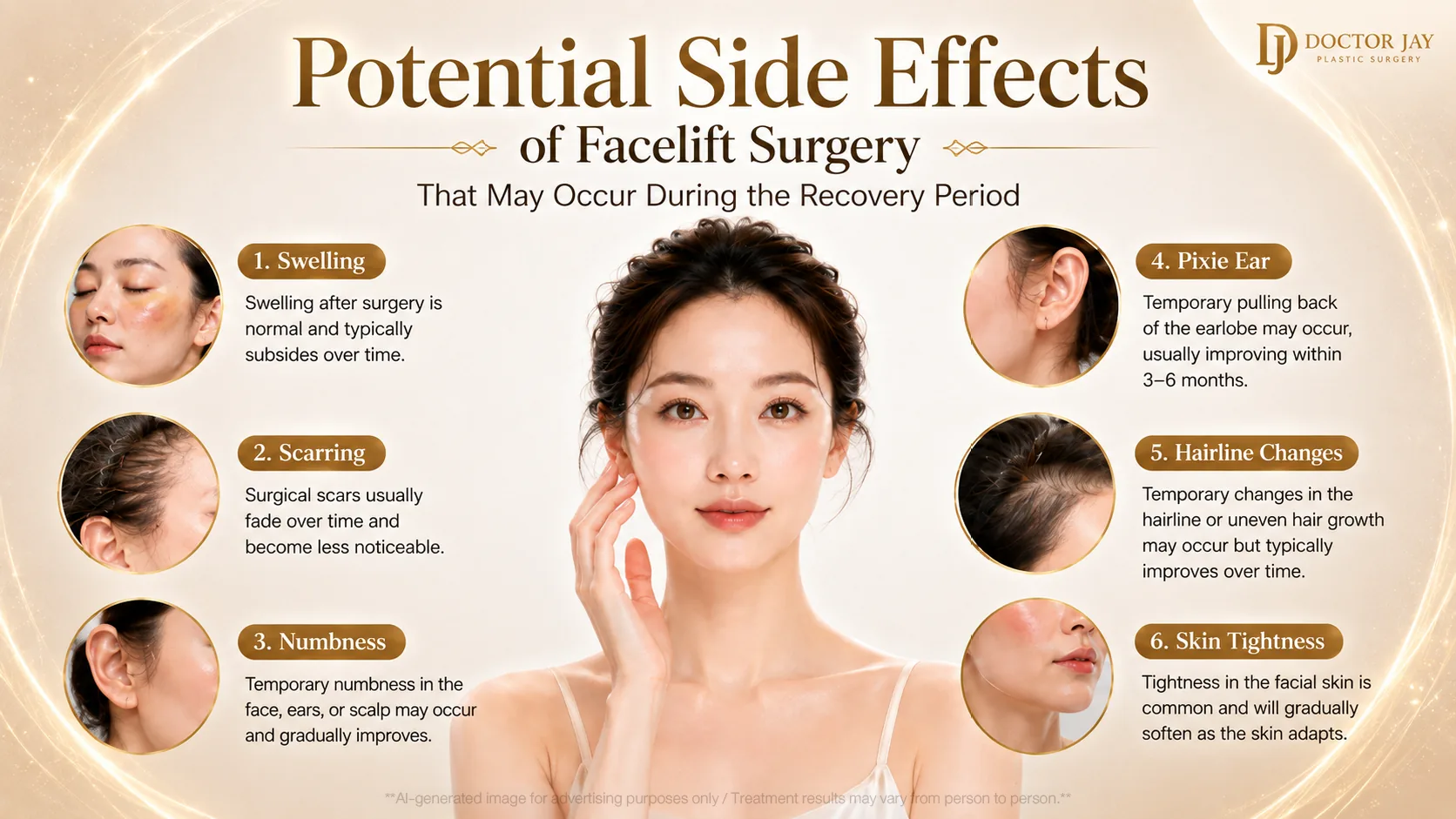
Temporary side effects after facelift surgery are the normal response of the body while the circulation and the peripheral nerves recover during the healing period.
The physical changes around the jawline and the ears are most obvious during the first 14 days of self care, and they ease as the incisions knit together.
Swelling and a haematoma under the skin
Swelling and blood collecting under the skin are common side effects after a facelift, because separating the tissue planes tears the small vessels. The body drains fluid that gathers under the skin, leaving dark discolouration and puffiness around the ear and on the neck. This peaks during the first 48 hours after surgery.
A severe collection of blood under the skin, a haematoma, comes from bleeding that does not stop beneath the skin until it forms a firm raised lump. Left alone, the area around the incision can lose its blood supply and the skin can die. Watch for severe tightness and pain that builds quickly on one side of the face.
Cold compresses on the cheeks and neck through the first 3 days keep the vessels from dilating, and you need to sleep with the head raised at 30 degrees for the whole first week of recovery, to reduce the pressure of blood collecting in the face.
Temporary tightness and numbness across the face and ears
Numbness and tightness across the cheeks and ears are normal side effects, caused by disturbance to the peripheral sensory nerves while the tissue planes are separated. The surgeon has to move the skin and suture the deep muscle layer tighter, which leaves the small nerves beneath the skin dormant for a time.
That thick, temporarily paralysed feeling improves gradually as the nerves recover and regrow to connect with the surrounding area. Sensation at the side of the cheek and the ear returns to normal within 3 to 6 months. Gentle circular massage around the incisions after the sutures come out stimulates circulation and speeds up the peripheral nerves.
Frequently asked questions about the drawbacks of a facelift
How many days does the swelling after a facelift take to settle
Swelling after a facelift subsides gradually and settles to a normal look within 14 to 30 days, depending on each person’s health and how they care for themselves. In the early days the face swells heavily through the first 3 days, which is a normal response of the skin. After that the dark marks turn yellow and fade on their own within 2 weeks. Recovery breaks down into these stages, which helps you plan.
- The first 1 to 3 days, when the swelling is heaviest. Use cold compresses around the face often, to steady the circulation and keep the swelling from building.
- At 7 to 10 days, the marks under the skin fade noticeably, and this is when the surgeon takes the sutures out.
- From 14 days onwards, most of the swelling has gone down by more than 80%, so you can start using light make up to cover the remaining marks and return to work.
How well can the scars from facelift surgery be hidden
The scars from a facelift can be hidden by placing the incisions along the natural curve of the ear and the hairline. The surgeon uses a fine suturing technique to conceal the line in front of the ear, up into the scalp and around into the crease behind the ear. Those lines change gradually from pink red to a fine white line that blends with the skin, 6 to 12 months after surgery.
Wound care after surgery is the main factor in how thick and dark the scars turn out. Applying medical silicone gel for scars twice a day, starting once the sutures come out on day 7 to 10 after surgery, encourages the collagen beneath the skin to lay down evenly.
How many years does the result of a facelift last
The result of a facelift does not last a lifetime, because the skin carries on ageing as it normally would. A superficial lift usually holds its firmness for roughly 5 to 10 years, while a deep plane lift that reaches the muscle layer holds for 10 to 15 years. Choosing a technique that does not match the concern is the drawback most likely to leave the skin sagging again and bring forward a second corrective operation.
How fast collagen breaks down and how the facial bones recede are the main reasons firmness changes after surgery. You can slow that ageing by staying out of strong sun and applying sunscreen at SPF 50 PA++++ every day, to protect the elastin fibres beneath the skin.
In summary
Deep plane facelift complications and the drawbacks of a facelift are the risk of scarring along the hairline and behind the ear, temporary numbness, and a recovery that takes time through the first 14 days. Incisions closed under too much tension can stretch the earlobe out of shape or pull the hairline backwards. Surgery in a facility that does not meet the standard adds the risk of severe infection and injury to the nerves that control facial expression.
See a board certified plastic surgeon to assess the deep structure of your face before deciding on surgery. A deep plane facelift in a theatre that meets Ministry of Public Health standards reduces these side effects and has the face settling sooner, so you are back to normal life in around 7 to 10 days on average, depending on how each person heals.